Art Against Contemporary Autocracy—Australia Included?
Artistic resistance, from Ai Weiwei to Archie Moore’s kith and kin, punctures the facades of power as Australia’s art institutions wobble between defending creative freedom and capitulating to a rising culture of control.
Suppose we understand authoritarianism as the rule of a single leader or party that deems itself infallible, even when it changes its mind, policy, or method, and imposes that will upon its subjects. If that’s the case, we can chart a long history of artists accommodating themselves to such rule, evading it, or resisting it. In recent years, however, authoritarianism has exhibited some novel features—while continuing its totalitarian thrust. What has changed? What kinds of resistance might the visual arts, including its history, offer in the new circumstances? I honour all those artists, writers, and thinkers—in fact, every individual, group, and organisation—who have stood against authoritarianism in whichever ways they can. I thank them for my freedom. I have visited some autocracies, but never lived in one—at least, not yet—so I can speak about strategies only as an outside observer and offer tentative suggestions, as the situation is so transitional.
The death notice for modern authoritarianism was meant to be served around 1990, as the Berlin Wall fell, and the Soviet system imploded. Hopes that the “actually existing socialisms” were harbingers of historically inevitable communism finally evaporated. The triumph of democratic freedom was announced: free elections, free peoples, free markets, free trade, free thought, free connectivity, free world. Instead, neoliberal globalisation sought command of economies everywhere. In geopolitics, “the rules-based order” mostly followed the interests of the United States hegemon; in national politics, democratic representation was constantly compromised; in culture, local flourishing within multiculturalism battled nostalgic reaction and fundamentalism; in the arts, free expression and transcultural exchange contrasted with a booming market for a narrow band of luxury art; and in everyday life, individuality struggled within hyperconnected, information-overloaded, commodified spectacle. Our task as artists, thinkers, and world beings has been to promote what was liberating in this mix and to critique its closures, exploitations and inequities. One generation later, this picture of how power really works in the world—at large and in the details of everyday life—has reached the limits of its capacities and run up against other, increasingly powerful pictures, most of them recursive, many of them autocratic.
The 2025 report of the Varieties of Democracy Institute at the University of Gothenburg is entitled 25 Years of Autocratization—Democracy Trumped? Its key finding is that nearly three out of four people alive today live in autocracies. While some countries (nineteen) are democratising, many more are autocratising (forty-five). Liberal democracies are the least common regime type. V-Dem notes that the favourite weapon of autocracies is media censorship, followed by undermining elections and civil society. Previously existing autocracies have not hesitated to add outright repression to this list, suppressing the Arab Spring and democratising movements in Russia, Myanma, Syria, Turkey, Iran, Nicaragua, Hong Kong, and elsewhere. Extreme right-wing parties are attracting growing support in long-term democratic countries, not least in Europe. In the United States, especially with the second Trump presidency, they have taken power. And they are uniting to form a geopolitical axis while partnering with the “new tech” overlords.
From a planetary perspective, all kinds of regimes can exploit the information networks that now govern many interactions between living beings, institutions, machines, and the biosphere. Changes in geopolitical formations may split these networks into a “Silicon Curtain” between the firewalled networks established by the US and China, or between several, if other “developing nations” follow the Modi model of techno fundamentalism. They may also be subject to the accelerating capacity of AI to generate its affordances. In his Nexus: A Brief History of Information Networks from the Stone Age to AI (2024), Yuval Noah Harari argues that, while technically non-ideological, AI algorithms favour the centralised power of autocratic rule and monopoly capitalism. But mostly, they favour their own perpetuation and expansion.
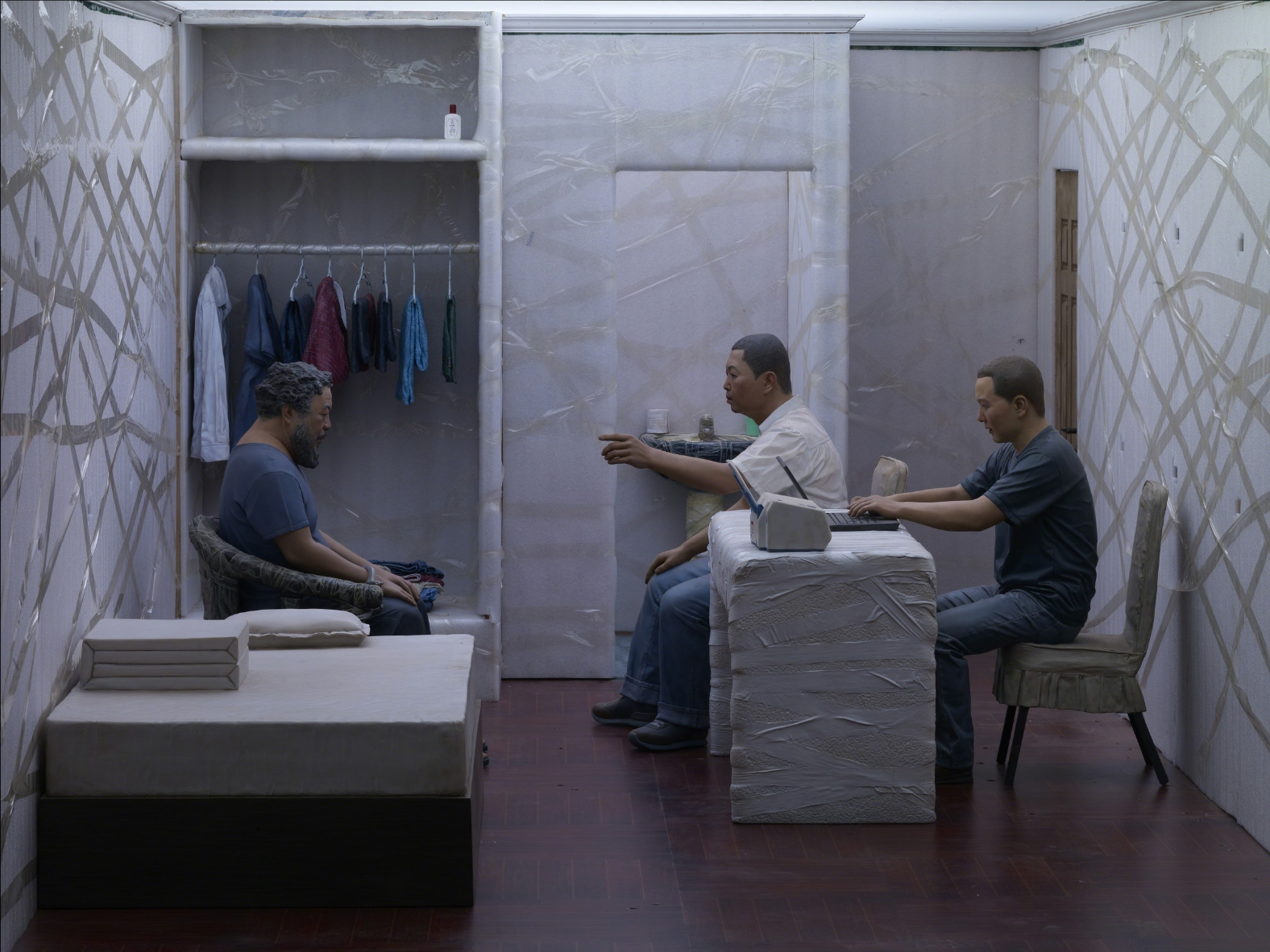
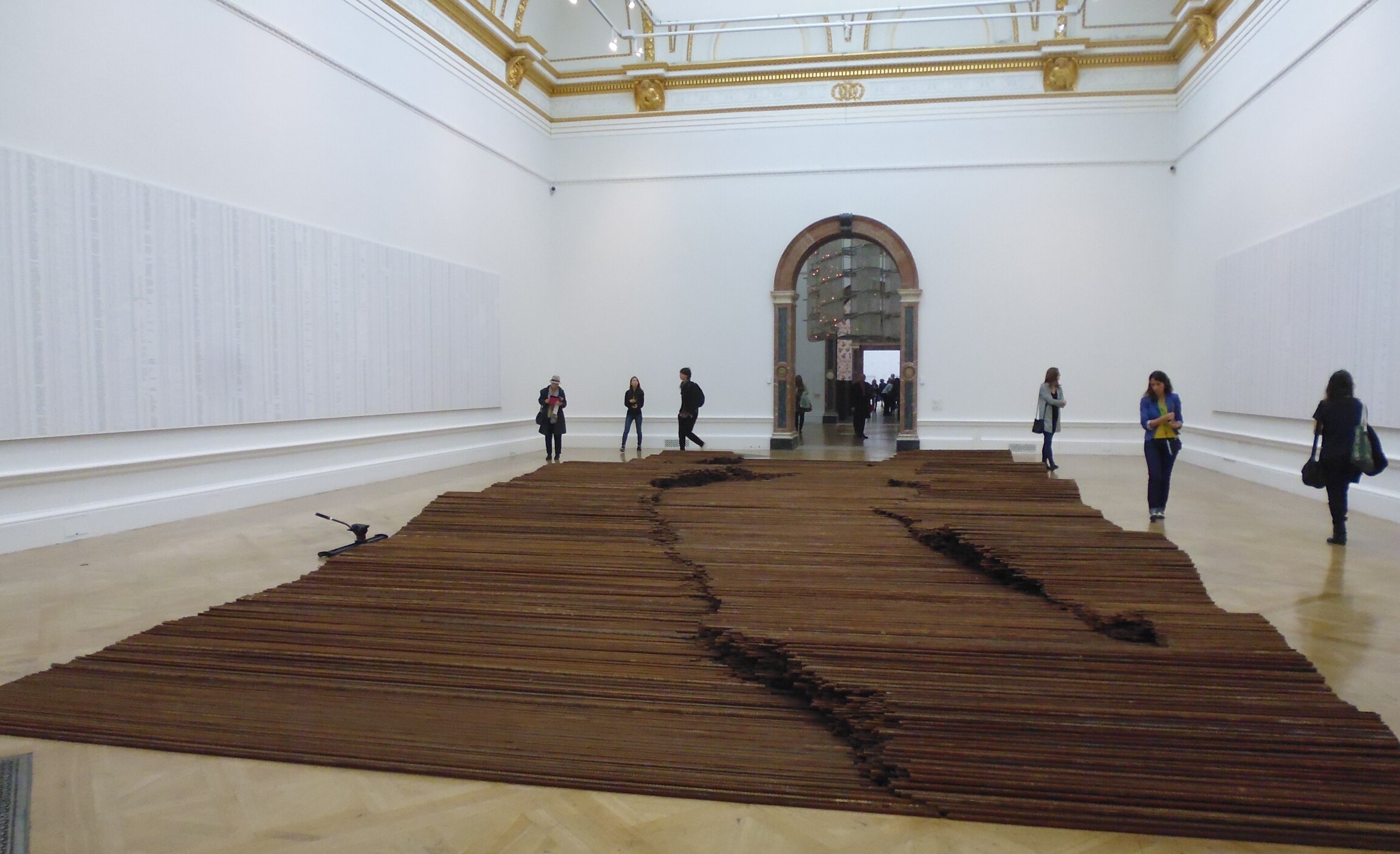
Visual artists and all who support them have inherited several ways of resisting the swallowing of their freedoms. Symbolic Contestation is the most common and most internally varied. Artists often conceive of visual figures that condense information that repressive authorities wish to distort or hide. In his work Snake Ceiling (2009), Ai Weiwei configured hundreds of children’s backpacks into the free-form shape of a snake to commemorate the living memory of the more than five thousand killed in the 2008 Szechuan earthquake. A more concrete evocation is his Straight (2008–13), an installation of steel rebar recovered from the collapsed schools. Corrupt local officials had permitted substandard buildings. This news was covered up by governments at all levels. Subsequently harassed by policemen, Ai Weiwei and his followers regularly turned their cameras on their tormentors, constantly posting images and commentary. Following his eighty-one-day detention on fake tax evasion charges in 2011, Ai Weiwei created six iron boxes, scaled-down versions of the spaces in which he was detained. Each contained fibreglass figures of himself and his two ever-present soldier guards, furniture, and other details, vignettes from their unvarying daily routine. Entitled S.A.C.R.E.D, it was shown at the Chiesa di Sant’Antonin, Venice, in 2013 as a collateral exhibition to the then-current Venice Biennale.
Terry Smith is Emeritus Professor of Art History, University of Sydney, and Andrew W Mellon Emeritus Professor of Contemporary Art History and Theory, University of Pittsburgh