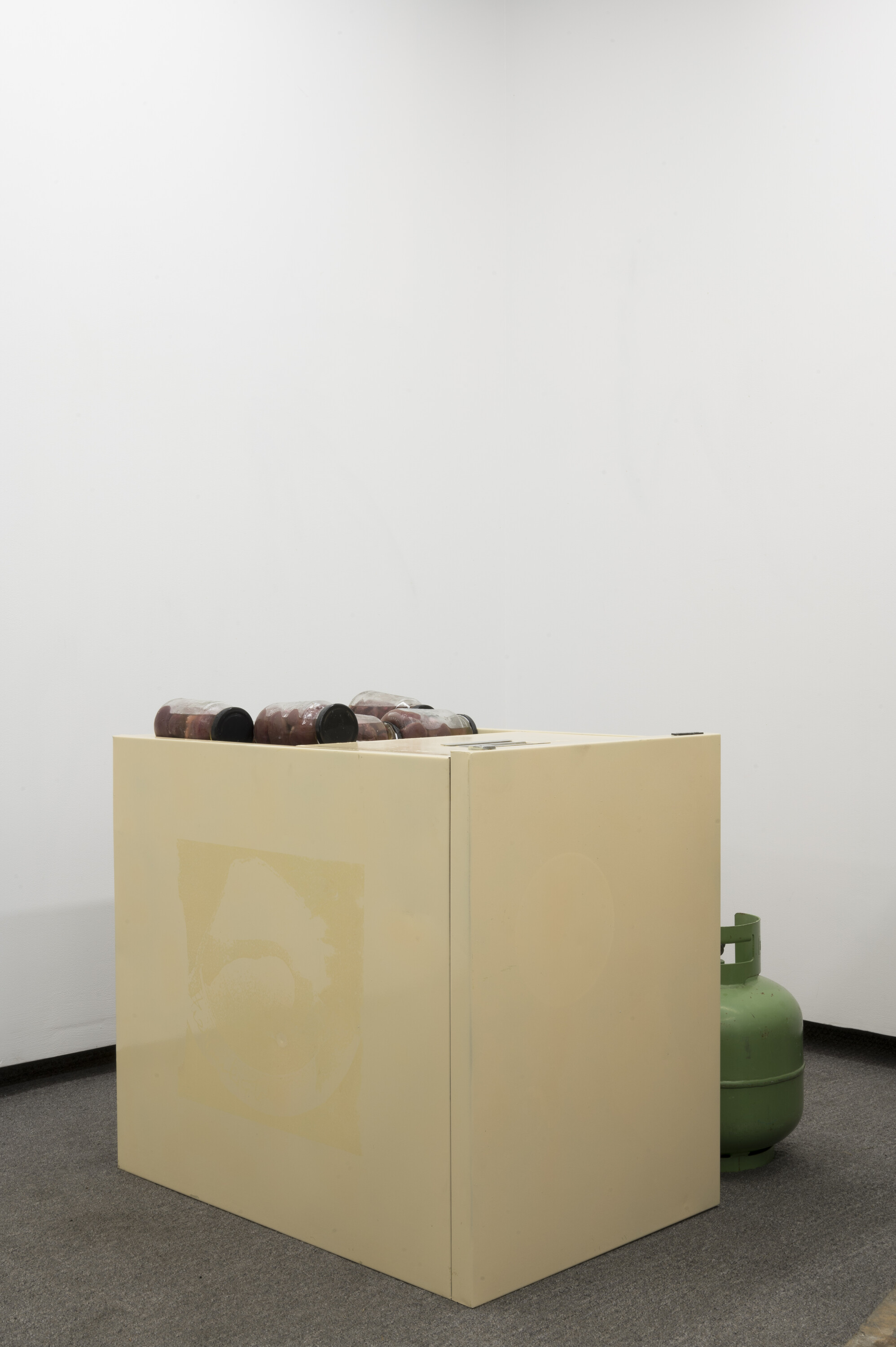
Khaled Sabsabi, YOU (2007)
Sabsabi’s YOU enacts the media's capacity to create structural and political dissonance.
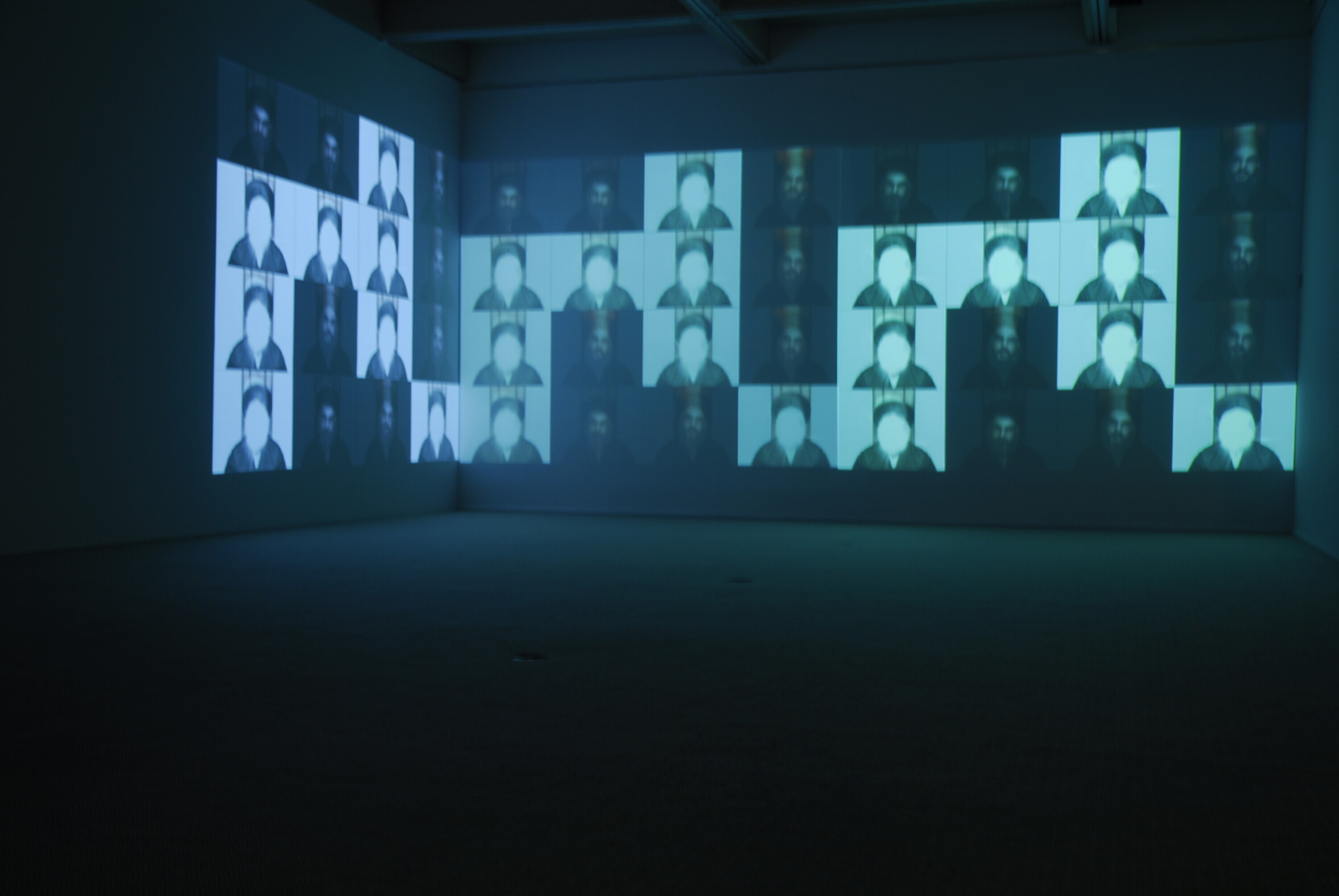
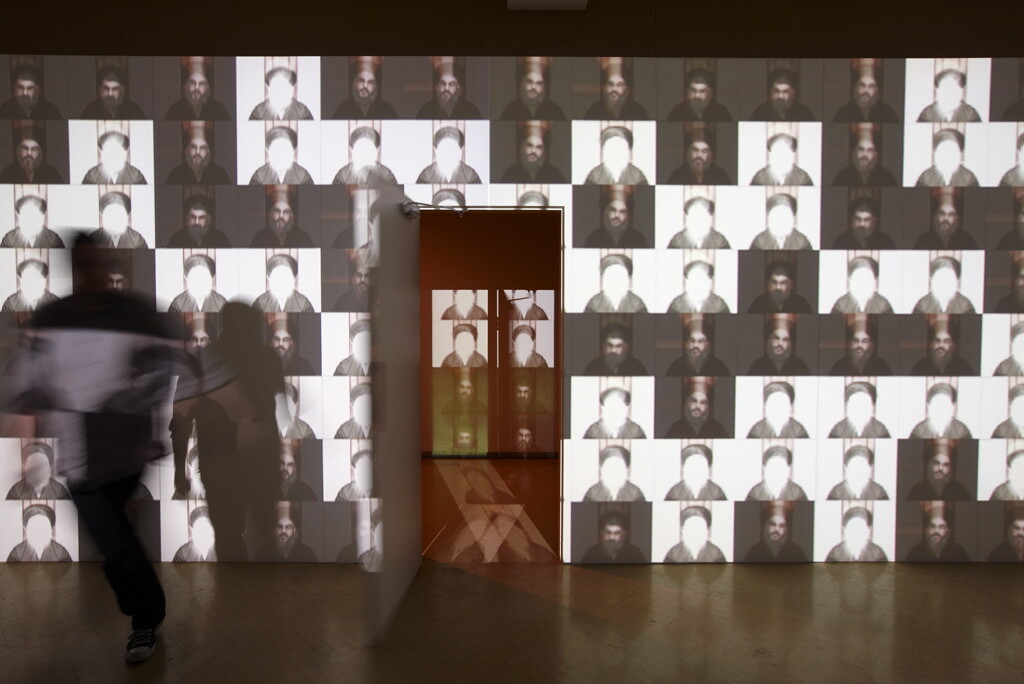
Khaled Sabsabi’s YOU (2007) transmits the face and voice of Hassan Nasrallah (1960–2024). When the work was made in 2007, Nasrallah was the Secretary General of Hezbollah, the Shia Islamist political organisation and militia he helped co-found in Lebanon in 1982. In YOU, Nasrallah speaks directly to the camera, claiming Lebanon’s victory against Israel following the thirty-four-day war between the two countries, despite suffering heavy losses. The speech was zealous propaganda, yet the artwork is different: YOU is challenging to see.
The context for the work is the 2006 war between Lebanon and Israel, during which the Israel Defense Forces developed and adopted what has since been called the Dahiya Doctrine. As Micaela Sahhar has recently explained, the name refers to a neighbourhood in Beirut that was mercilessly assaulted during Israel’s military campaign in 2006. This doctrine mandated a deliberate disregard and contempt for civilian life to force Hezbollah into submission. It didn’t work.
Sabsabi is very familiar with the complex history and politics that undergird the imagery in YOU. He has lived in Australia since 1977, when the Lebanese civil war displaced him and his family to Western Sydney. As part of the Levantine diaspora, marked by exile, conflict, and terror, Sabsabi has often depicted and examined scenes of violence he witnesses in the media from afar: bombed-out buildings, football hooliganism, and state-sanctioned terror. Like other artists in the Levantine diaspora, such as Fassih Keiso or Walid Raad, Sabsabi documents remnants of conflict—such as bullet holes in war-torn buildings—from highly subjective, fragmented or partial positions. He shares with Keiso and Raad an auto-ethnographic and experimental mode of photojournalism—asking us to look at the visual culture of conflict subjectively. In YOU, for example, the images of Nasrallah are mirrored and multiplied, his talking head reappearing hundreds of times, separated from the audio and out of sync with it, crowding the environment until the media also feels like an assault. Like much of Sabsabi’s work, YOU enacts media imagery's capacity to create structural and political dissonance. Here Sabsabi offers a diasporic perspective on the media of conflict in the Middle East, one that challenges the dominant Anglosphere media narratives that portray the Lebanese as beholden to terrorist propaganda.
The post-produced duplication of Nasrallah’s image in YOU is one Sabsabi has used before. In L.A. (2003), for example, a fifty-second video is distended and delayed using the digitisation effects produced by applying mathematical formulas to the source, in this case resulting in a warping of the speaker’s voice. Repetition through kaleidoscopic mirroring is another recurrent trope adopted by the Levantine diaspora, a derivative of the Damascus tile. This approach is evoked by Keiso’s earlier installation, Curtain For My Window (1999) and Raad’s recent video, Sweet Talk: Solidere (2019), which employ similar image-mirroring techniques. In some senses, this communicates the algorithmic origins of contemporary media imagery. The optical and geometrical ordering of space is traceable to the so-called “golden age” of Islam in the ninth century, figured in the work of polymath al-Khwarizmi (محمد بن موسى خوارزمی; c. 780–c. 850) at the House of Wisdom in Baghdad.
The first minute of YOU features a recording of Nasrallah welcoming the crowd celebrating the end of the 2006 war with an introductory prayer (الْنَّحْل Surah An-Nahl, The Bee, 98–103). The soundbite translates to: “I seek refuge with God from Satan, the accursed,” followed by, “In the name of God, the most honourable, purest, generous of people, may the peace, mercy, and blessing of God be upon you.” As the work progresses, the phrase “I seek refuge with God from Satan, the accursed” is eventually chopped and screwed into oblivion. In other words, Sabsabi uses repetition to gradually empty the prayer and its words of religious content.
On September 27, 2024, Nasrallah was assassinated in Dahieh, Lebanon, by the IDF. It was supported by its allies, including Australia, which continues to provide Israel with military components. Hezbollah has been listed as a proscribed terrorist organisation by the Australian government since December 2021. (Before this, and since 2003, Hezbollah’s External Security Organisation had been listed on Australia’s terror list.) Nasrallah’s memorial rally was held in Beirut on February 24, 2025, and, according to news reports, was attended by between 450 thousand and 1.4 million people.
This event occurred the same week that Creative Australia decided to reverse its decision to appoint Sabsabi as Australia’s represent at the 2026 Venice Biennale. This decision followed questions raised in the Federal Senate by Senator Claire Chandler, a Liberal Party Senator for Tasmania. They referred both to YOU and another work, Thank You Very Much (2006), an eighteen-second video that featured footage of the 2001 attack on New York’s Twin Towers. Senator Chandler repeated a line published the previous day in The Australian, suggesting Sabsabi had “seemingly lauded a terrorist leader in his past work.” It is unlikely that she has seen YOU. On the 26th of March, a planned exhibition of a different series of work by Sabsabi, to be shown alongside Stolon Press (Simryn Gill and Tom Melick) and anthropologist Elisa Taber, Stolon Press: Flat Earth, and scheduled to open at the Monash University Museum of Art in May 2025, was indefinitely postponed by the University. It is also unlikely that the University’s managers responsible for this decision had seen YOU (or, indeed, much if any of Sabsabi’s work).
YOU was first exhibited at the Campbelltown Arts Gallery in 2007 as part of Sabsabi’s solo exhibition, ON’n’ON. At this show, a second video by Sabsabi titled TOO (2007) played on an L-shaped gallery wall alongside sixty prints with added acrylic, oil stick, and enamel also shown as a part of the combined work. TOO depicts distorted and illegible Arabic text repeated across the video’s four channels. Like the distortions of Nasrallah’s image in YOU, the entire work foregrounds the effects applied to the video source. The imagery and the audio are separate, and by the time the work reaches its apotheosis the initial channels have been multiplied 256 times. The audio tracks are multiplied too, and over the course of ten minutes they rise to a cacophony, before falling in diminuendo, returning the spectator to silence before the video recommences. The images are “deep fried,” as we might have said in 2019. As in YOU, the use of post-production effects propose that viewers and listeners might reflect not on the source content as such, but on the state of its mediation.
Carmen-Sibha Keiso is an artist, writer, curator, and director of expanded literary practice space Read the Room. Giles Fielke is an editor of Memo Review.