65,000 Years: A Short History of Australian Art
Potter Museum of Art, 30 May to 23 Nov 2025. Curated by associate provost and distinguished professor Marcia Langton AO, senior curator Judith Ryan AM, and associate curator Shanysa McConville.
By Rex Butler
Issue 4, Summer 2025
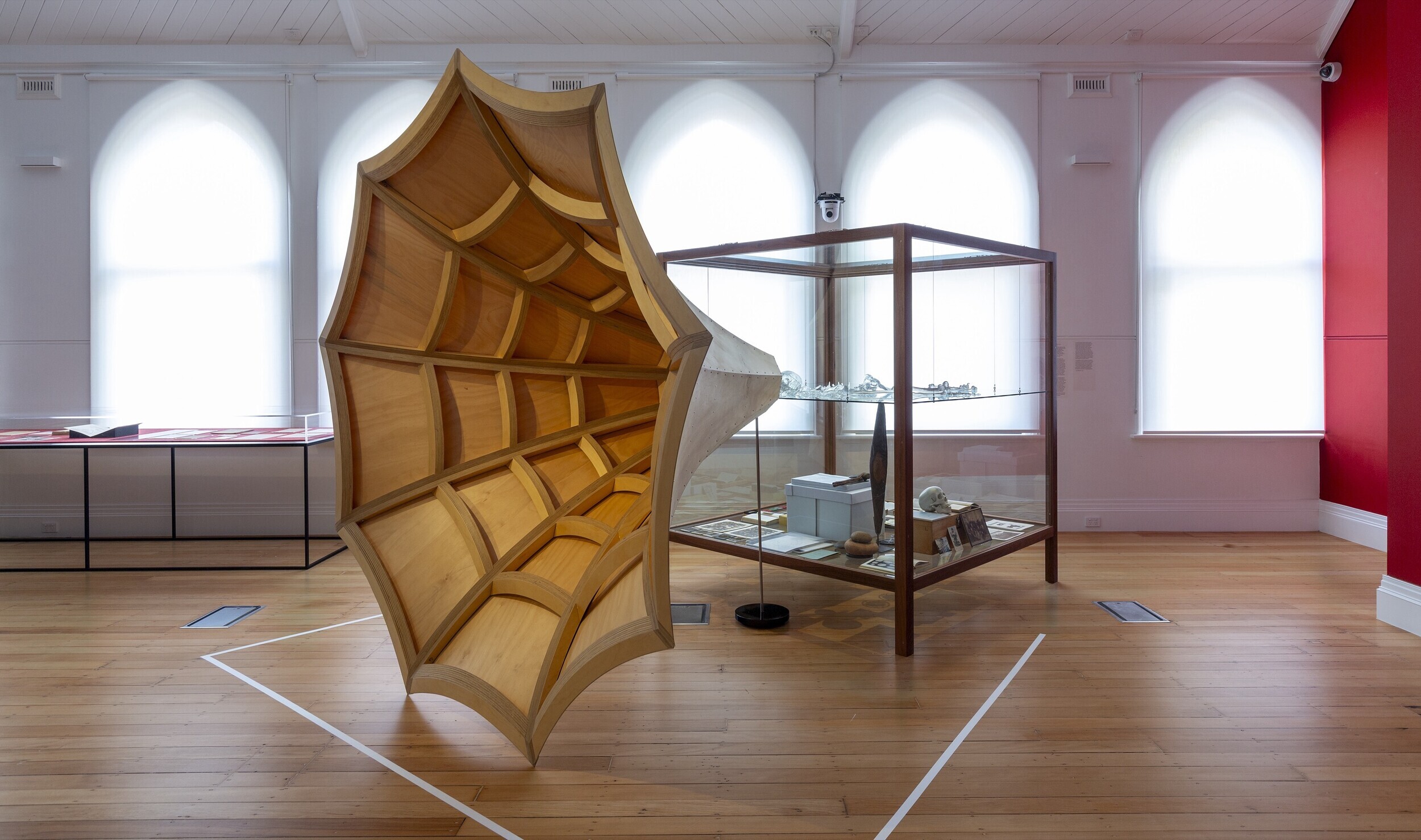
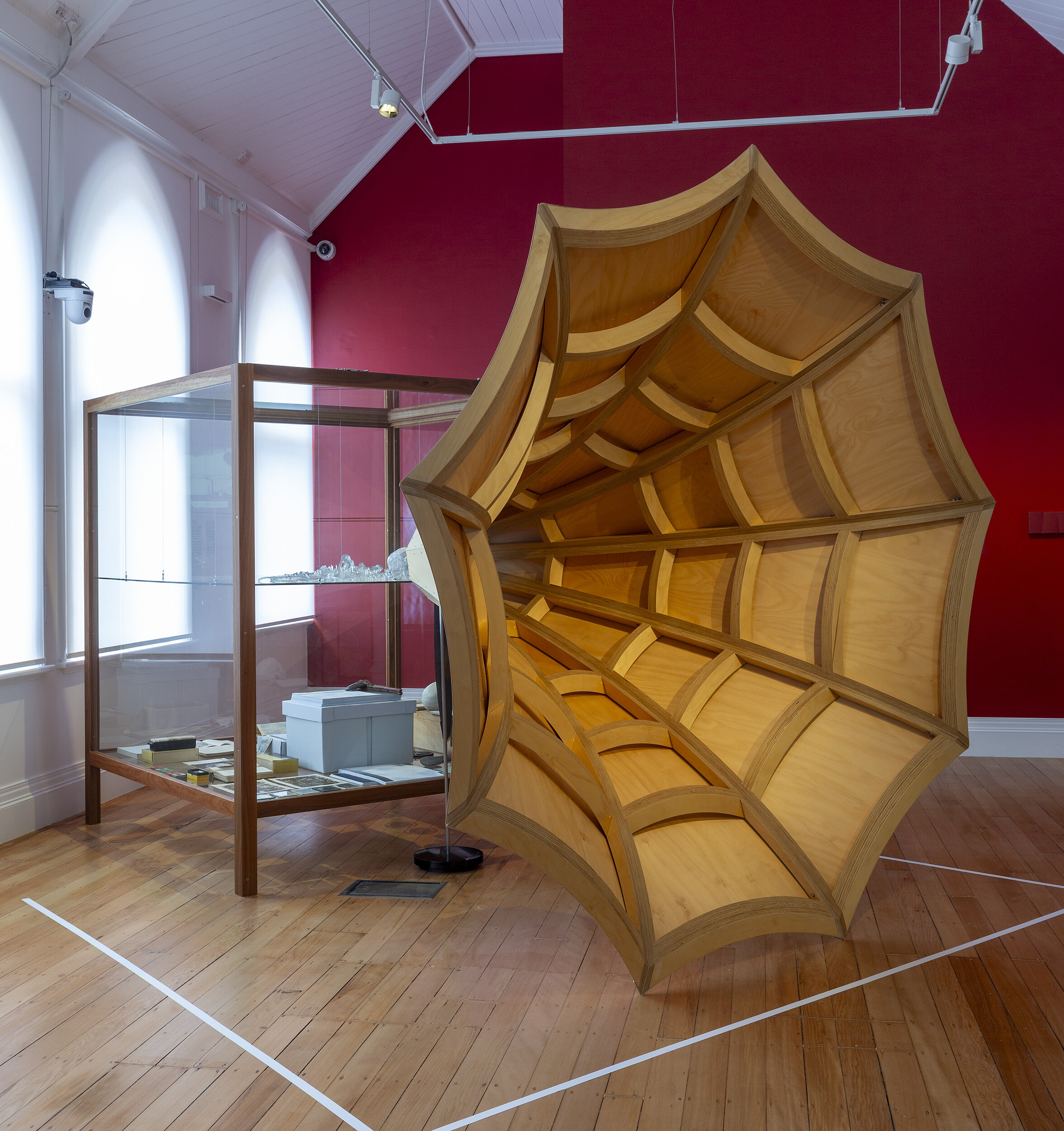
Installation view of 65,000 Years: A Short History of Australian Art, Potter Museum of Art, the University of Melbourne, 2025. Featuring Brook Andrew, Vox: Beyond Tasmania 2013. National Gallery of Victoria, Melbourne. Photography by Christian Capurro.
It’s a magnificent provocation: 65,000 Years: A Short History of Australian Art. It clearly says something, but what exactly is it saying? That Aboriginal artists have always made “Australian” art? That Australia is “Aboriginal”? But I thought that “Australia” and “art” and maybe even “Aboriginal” were European ideas. And hasn’t colonisation irreversibly—especially since the failure of the Voice referendum—taken place? And why the hell would Aboriginal artists want to make “Australian” art anyway?
It’s the best—because the most floating, unpindownable—title for an art show here for ages (I’m tempted to say for 65,000 years), and it’s got people coming in droves. On the four occasions I visited the show, the Potter was full—full of elderly, well-to-do, obviously ex-Uni of Melb graduates, bending down stiffly to read the didactics, and groups of international Uni of Melb students having “Australia” explained to them by guides.
Actually, I’m tempted to suggest that the obvious success of the show is as much as anything testament to the extraordinary cultural reach and power the prestigious Uni of Melb exerts over Melbourne, even and especially when it appears to be criticising itself (more on that later).
But first the show. It’s encyclopaedic, wide-ranging, all-encompassing, certainly one of the biggest and most inclusive exhibitions of Aboriginal art I have ever seen. And this in itself is worth noting: it’s exactly the kind of show a state, let alone a national, gallery should have done ages ago, although, to be fair, the National Gallery of Victoria’s 2018 Colony exhibition comes close (more on that later too).
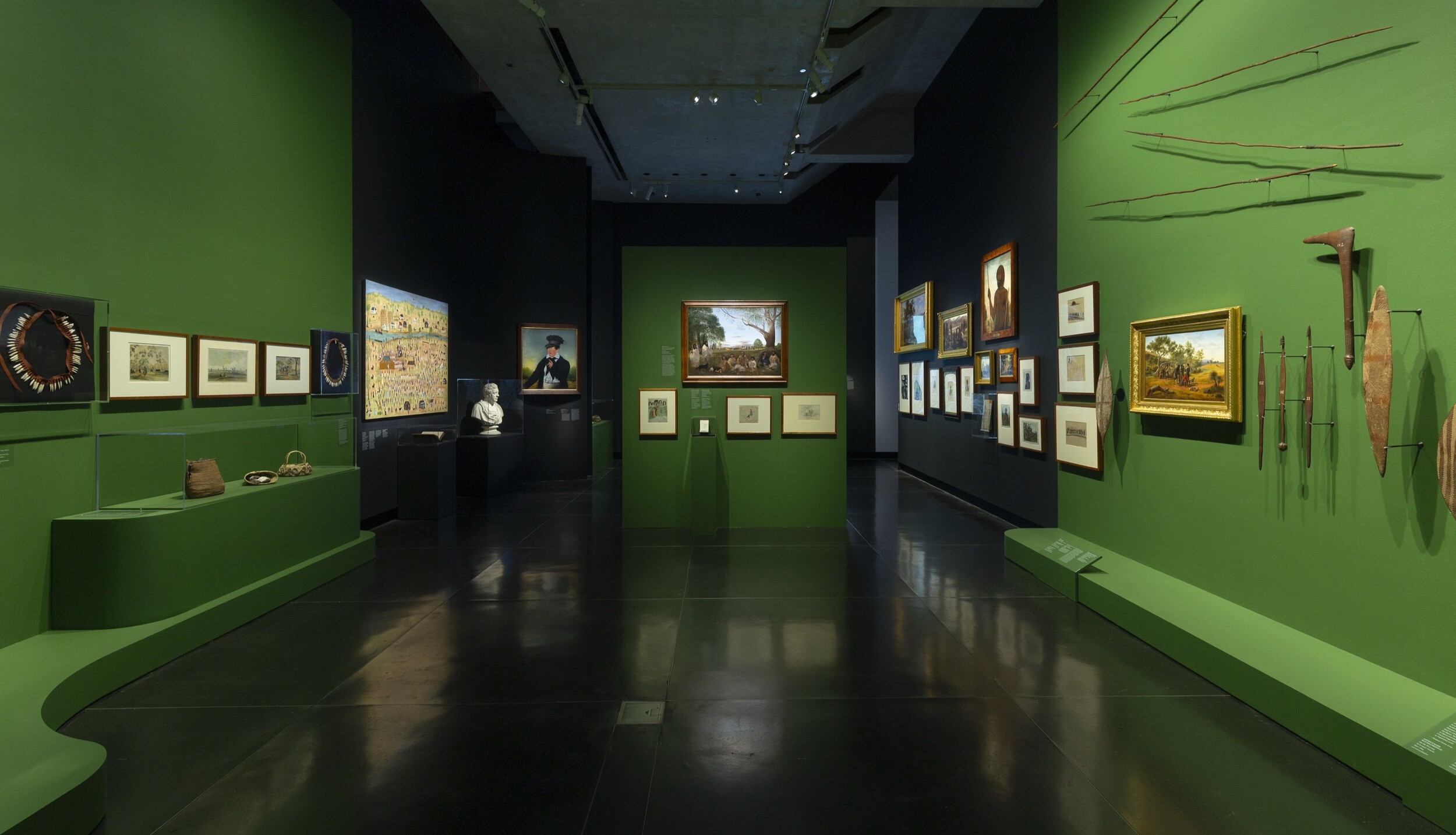
On the ground floor, there is “First Encounters and Responses,” which includes Nicolas-Martin Petit’s Aboriginal Warrior with Spear (1802), Augustus Earle’s Portrait of Bungaree (1826), Mickey of Ulladulla’s River with Boat (1891), and, of course, E. Phillips Fox’s Landing of Captain Cook (1902). And there is “Art of Victoria and Lutruwita,” which includes John Glover’s Mills Plains (1836), William Barak’s Corroboree (1897), Tommy McRae’s William Buckley and Dancers (1890), and Arthur Loureiro’s King Barak (1900). Of course, depending on which room the spectator enters first, there is either a kind of détente and mutual curiosity that is lost with invasion or an invasion that is followed by a certain détente.
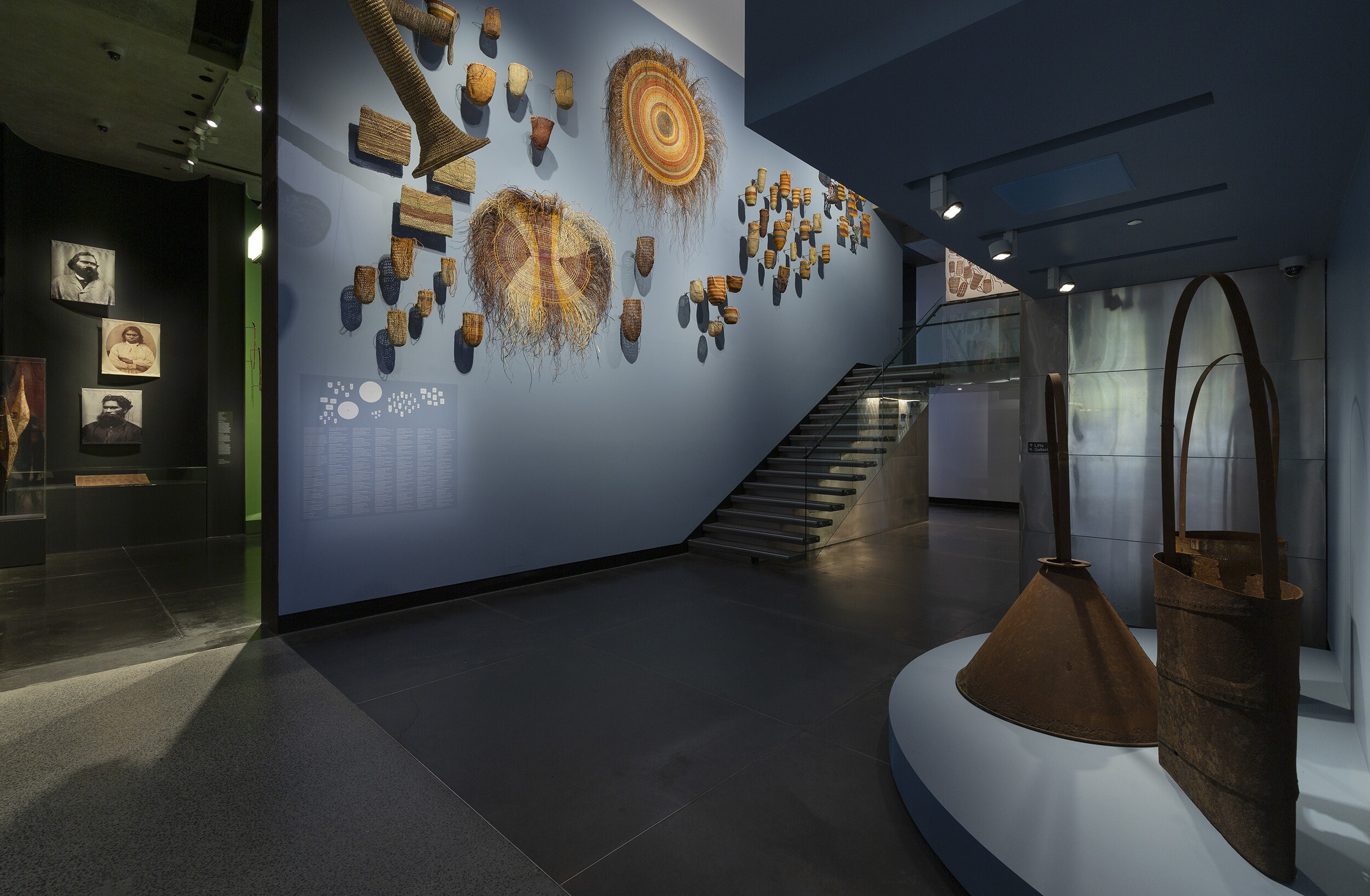
Then in the central stairwell, we have a number of contemporary women basket weavers, such as Indra Prudence, Gumirrmirr Garrawurra, and Lorraine Connelly-Northey, who actually makes her bags out of metal. (In fact, throughout those first two rooms, in response to the absence of Aboriginal voices from the time, there are works by contemporary Aboriginal artists addressing invasion and colonisation, and even the European depiction of Aboriginal people: Gordon Bennett’s Death of the Ahistorical Subject (1993), r e a’s Poles Apart (2009), Christopher Pease’s 4 Bedrooms, 2 Bathrooms (2011), and Brook Andrew’s Sexy and Dangerous (1996).)
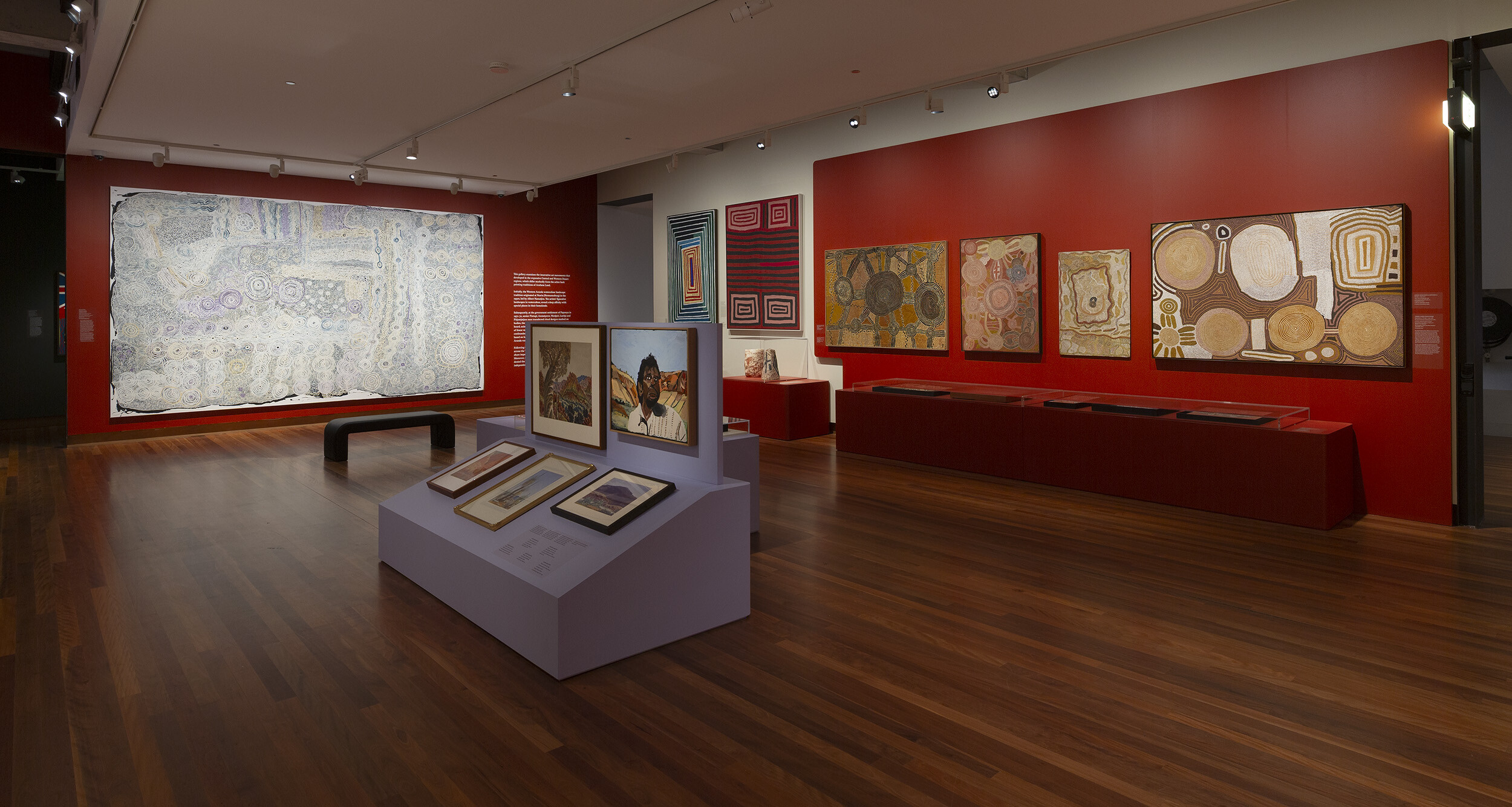
On the first level, we have a representation of that “founding” moment of contemporary Aboriginal art and perhaps of Aboriginal people finding their own voice or being given a voice in contemporary Australia. We have works from the Men’s Painting Shed at Papunya, such as John Tjakamarra’s Man’s Dreaming (1971) and Mick Tjapaltjarri’s Water Dreaming (1971). We have, from even earlier, Albert Namatjira’s Ormiston Gorge (1939), paired with his great-grandson Vincent’s Albert Namatjira on Country (2021). We have, from even earlier still, although this will open up one of the most profound questions of the exhibition, biologist and ethnographer Baldwin Spencer’s collection of barks from Oenpelli in West Arnhem Land from 1912 and anthropologist Donald Thomson’s collection of Yolngu barks from North-East Arnhem Land from 1935.
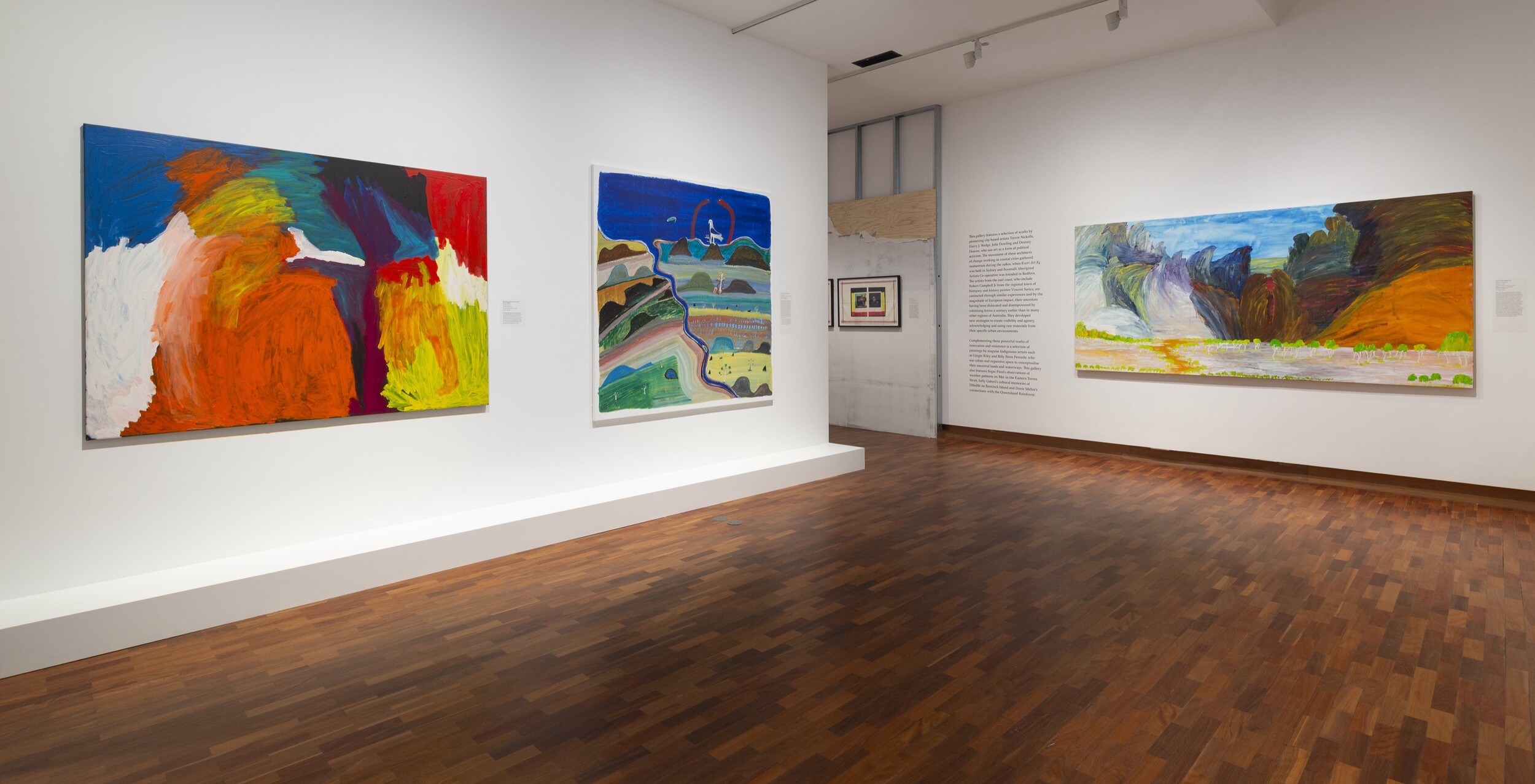
Finally, on the second level, in something of a literal and metaphorical ascension, we have “Cultural Astronomy,” which addresses the “intricate layers of astronomical and environmental knowledge, mapped out in the stars and passed down from generation to generation,” and includes Nym Bandak’s All the World (1958–59) and Larry Jungarrayi Spencer’s Milky Way Dreaming (1986). We have “Art of the Kimberley,” featuring Rover Thomas, Paddy Bedford, and Rusty Peters, and “Resistance and Innovation in City and Bush Studios,” which puts together a number of so-called “singular” Indigenous artists, such as Sally Gabori and Ginger Riley, with such pioneering “urban” Indigenous artists as Harry J. Wedge and Trevor Nickolls (although, as Tristen Harwood reminds us in his catalogue essay, such “urban”-based art is to be found on every level of the show).
A number of reviews of the show have been somewhat critical—no reviewer would dare be entirely critical—seeing in such a wide-ranging survey, in which so many different moments and regions are represented, a certain thinness or even tokenism. It is not so much that there is only one Mick Tjapaltjarri, one Uta Uta Tjangala, and two Emily Kngwarreyes, but why the same show had to include them all. But this is perhaps to miss the real aim and purpose of 65,000 Years. A more positive response is provided by Tim Stone, the reviewer for The Art Newspaper, who notes that the exhibition does attempt to be geographically far-reaching, to include as much as possible of Australia: “The more than 250 distinct nations across the country means that both traditional and contemporary Indigenous practice is incredibly diverse.” But even he misses the real thrust of the show, for what we would like to suggest is that it is precisely democratic, all-inclusive, wishing to leave nobody out. It is something like a poll or survey in which everybody is heard and everybody counts the same.
And then it hits us: this show, with its title making an Aboriginal claim on Australia and with its hundreds of artists all equally mounted on the wall, is not only a case for voting for an Aboriginal Voice to Parliament, but would itself seek to be something of a Voice.
We can bet that the show was originally planned years ago, before the long and protracted and I’m betting delayed rebuilding of the Potter Museum (actually, the only real change I see is the addition of a lovely coffee shop at the main entrance before you enter the exhibition space), as the opening show, and we can only imagine, as the opening was more and more delayed and the date of the referendum approached, how nervous everyone would have been getting.
And then the worst thing happened: the Voice referendum, for which Marcia Langton co-chaired the design group and was one of those on stage when Anthony Albanese first presented it to the Australian public, failed on 14 October 2023 by the fairly resounding margin of forty to sixty per cent.
For the formidable and imposing associate provost and distinguished professor Langton (more on her later) is one of the co-curators of 65,000 Years, along with the redoubtable, long-serving and now former curator of Indigenous art at the National Gallery of Victoria, Judith Ryan, and University of Melbourne associate curator Shanysa McConville.
I personally always thought that when the stately, regal Langton appeared alongside the inarticulate, uncharismatic Albanese, who seemed not to have a clue what the referendum was about, and certainly couldn’t explain it convincingly to anyone, the vote really should have been whether to make Langton our new queen when Elizabeth II passed away. That would have got up in a canter.
Instead, there are plausible rumours—and given its pathetic capitulation over Khaled Sabsabi, who would doubt them?—that the Labor Party secretly wanted the referendum to fail, that the last thing they wanted was a “voice” representing Aboriginal people over matters that concerned them, a kind of conscience whispering in their ear—for, of course, the Voice was to have no actual legal power—when they passed legislation allowing continued mining in Western Australia, the Northern Territory, and New South Wales that will lead to the destruction of sacred sites (which, of course, they proposed after the failure of the Voice).
But this failure now hangs unspoken behind or beneath the apparent triumphalism of the show, and indeed all histories of Aboriginal and Australian art that would understand it in terms of some eventual “reconciliation” or coming together between black and white. There won’t be another referendum in our lifetimes, just like there won’t be another referendum on the republic (so I’m sorry to say Langton will never be our queen).
In fact, my melancholy prediction—prompted both by the putting of Wesley Enoch in as deputy chair of Creative Australia to staunch criticism and Sam Neill’s use of the insignia of the Southern Cross alongside the Aboriginal flag in the sci-fi thriller Event Horizon (1997)—is that one day in the far-distant future, when Australia has completely decimated its environment and exhausted all of its natural resources, settler Australia will hand back sovereignty to Aboriginal peoples, at once hoping that they might somehow rescue us and having them face the consequences and take the blame for our actions. (And we shouldn’t forget that in Event Horizon Sam Neill plays an ultimately devil-like character for all of his PC insignia.)
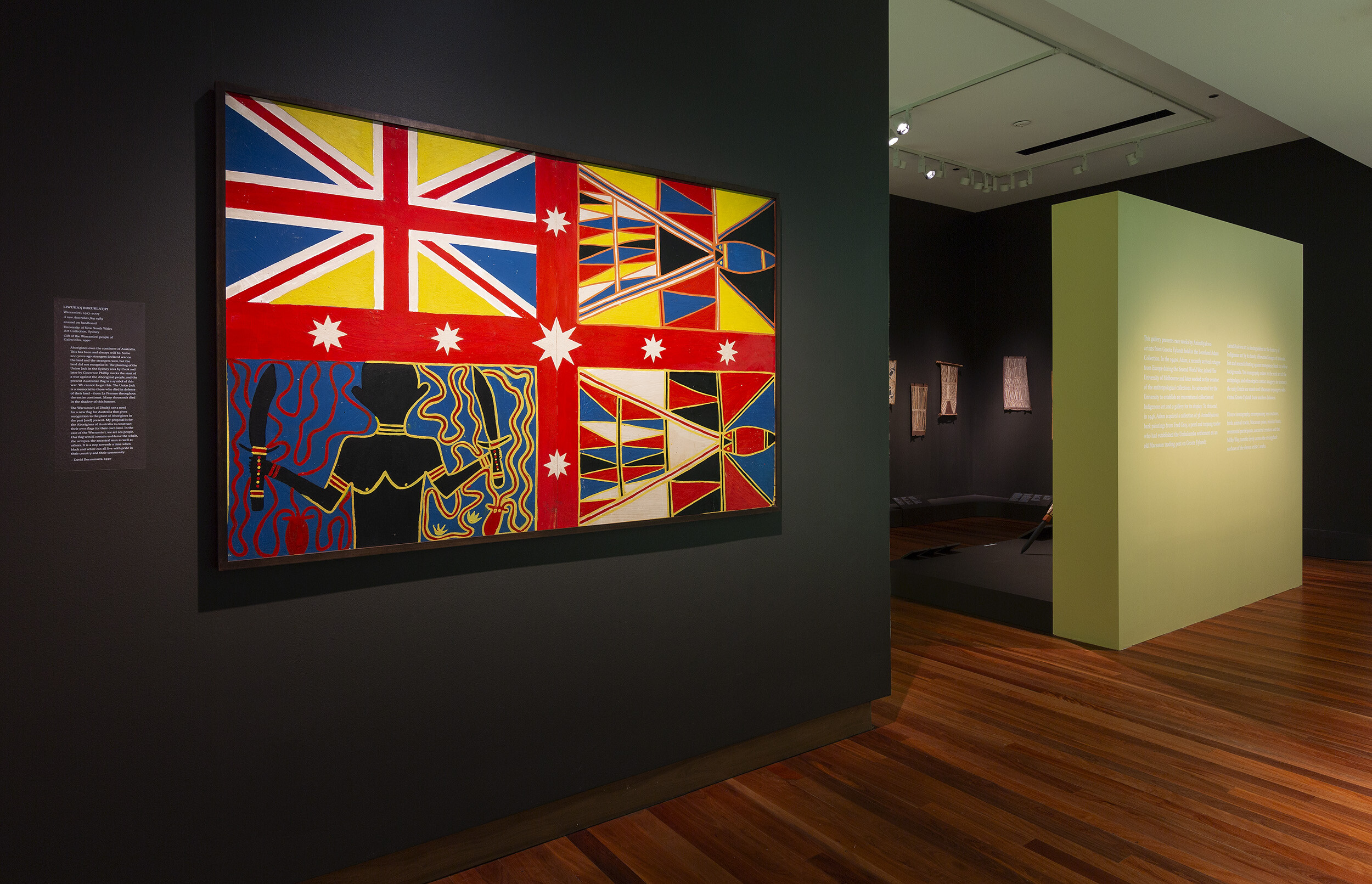
And if all this seems wilful on my part, consider two small decisions the curators made. The first is the inclusion of Warramirri artist Liwukaŋ Bukurlatjpi’s A New Australian Flag (1989), in which he puts together the Union Jack and the sea creatures of Elcho Island in North-East Arnhem Land in what can only appear as some sad compromise, like when we hang the Aboriginal flag alongside the state one and beneath the Australian one in all public spaces. How about an entirely new “UnAustralian” Aboriginal flag like the magnificent one Harold Thomas once dreamt up? And, conversely, there are the artists left out of the show, who could easily have been included. One is Ngarinyin writer and painter David Mowaljarlai, whose Yorro Yorro: Original Creation and the Renewal of the Earth (1993) explicitly challenges the idea of any Australia-wide boundary to Aboriginal culture. And, equally, I wondered why Richard Bell’s Australian Art It’s An Aboriginal Thing (2006) wasn’t included in the show when it was itself trying to make the point that the very idea of “Australia” and “Australian” culture was first posited by—we are tempted to say made possible by—Aboriginal people some 65,000 years ago. Maybe it was because during the debate preceding the referendum Bell opposed the Voice and wanted to go straight to a treaty. (I always personally believed that Bell was being magnanimously over-optimistic about settler Australians’ sense of justice here. As I say—and none of us will be around to prove me right or wrong—it will take an impending apocalypse for us to be willing to hand back the country to its original inhabitants. Maybe it will be the plot of number 456 in the Avatar series of films, which have been exploring what happens when someone invades another’s planet.)

But maybe in the end no one is going to save us, although already in Australia all kinds of groups use Aboriginal people as a form of reflection to make themselves look better. Most recently—and this is not simply a criticism, for it is obviously also an act of empathy—in the exhibition Five Acts of Love at the Australian Centre for Contemporary Art, the curator invited Megan Cope and D Harding along with a number of Australian-Arab artists to propose some supposed shared sensibility. Equally, before and during the Second World War, a number of émigré artists such as Yosl Bergner and Danila Vassilieff depicted Aboriginal people living in slums around Melbourne, identifying with their forced “displacement.” Indeed, to use a bit of psychoanalysis, we might even suggest that Aboriginality functions something like a “floating signifier” in Australian cultural life: able to be attached to any cause, to be taken up in any way by others, exactly insofar as Aboriginal people are seen to have no self-determination, including I’m going to say (and this is, of course, me using Aboriginality as a floating signifier myself) their being seen as making “Australian” art for some 65,000 years in this exhibition. Altogether today “Aborigines” are used to complete or complement the idea of “Australia,” to save it, renew it, redeem it, invariably by white critics, when this must be understood not as the “truth” but as, as everything is, ideological. And, for another ideology, see Djon Mundine’s recent work on the reception of Aboriginal art overseas from the time of first European contact, precisely challenging the ideas both of “Aboriginality” and “Australia.” And we wonder whether, in the light of the failure of the Voice, these two ideas have ever been reconcilable.
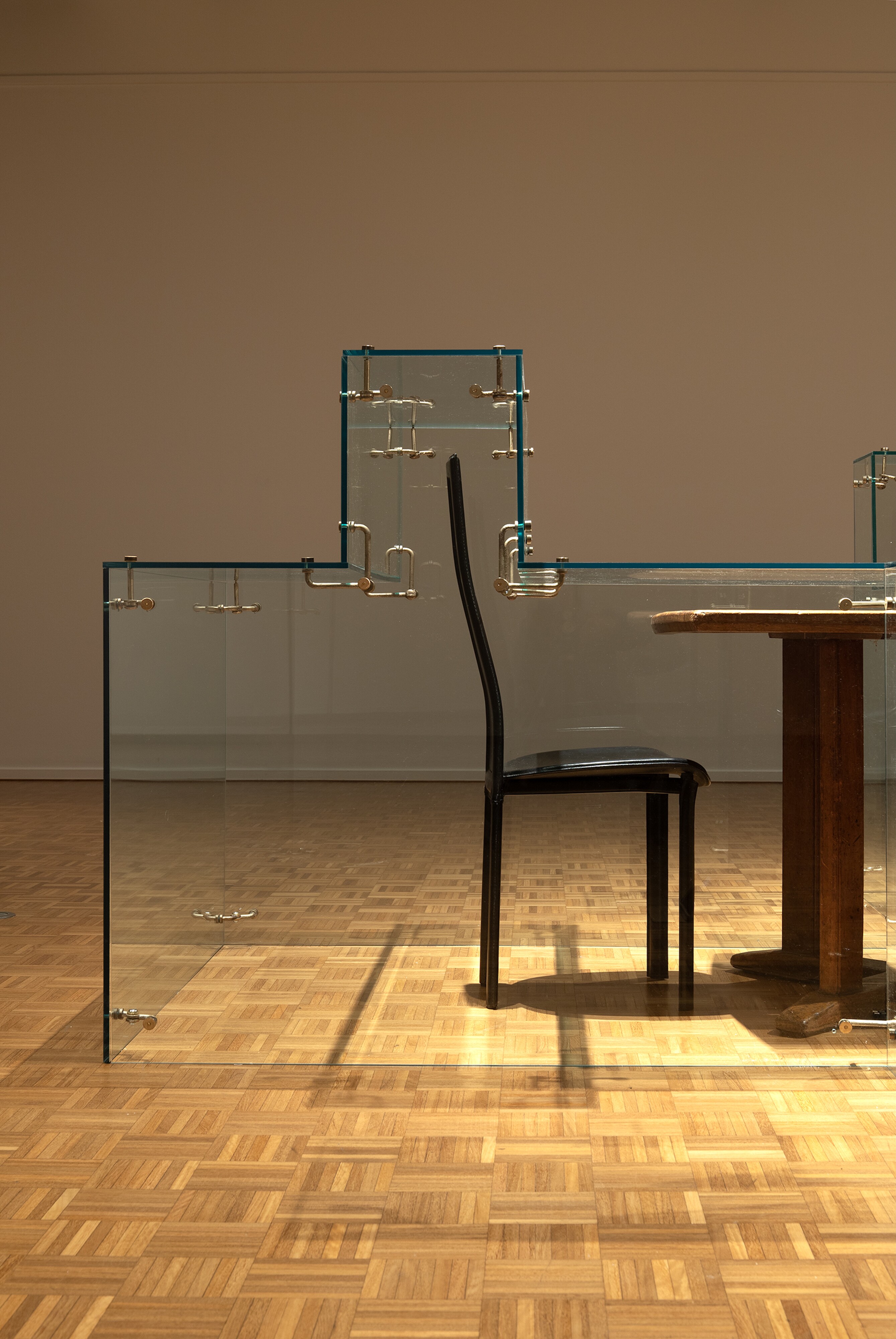
Finally, there was one other extraordinarily interesting and provocative detail of this extraordinarily interesting and provocative show. On the first level of the Potter, next to the rooms with the collections of Baldwin Spencer, Donald Thomson, and Leonhard Adam belonging to the Melbourne Museum and the University of Melbourne, in a room behind closed doors with a warning to viewers, along with works by Yhonnie Scarce, Julie Dowling, and Judy Watson, is a video of Langton denouncing the old University of Melbourne practice of collecting the bones of Aboriginal people as part of the now obviously discredited discipline of eugenics as practised in the anatomy department by such professors as Harry Brookes Allen from the 1880s and Richard Berry from the 1900s. Here is an excerpt of what Langton says as she sits on a throne-like grand wooden chair, which in usual circumstances only the chancellor of the university would be allowed to occupy:
From the inception of the Melbourne Medical School in 1862 until the middle of the twentieth century, the University of Melbourne illegally collected, examined, measured, and stored the bones and skulls of Aboriginal people as specimens without the consent of their communities. The publication of Charles Darwin’s Origin of the Species in 1859 brought on an era of scientific racism. Anatomists and their fellow eugenicists formulated a theoretical hierarchy with white men at the top and all the other races below, just above the animals. Later, this racialist theory was called eugenics. The anatomists working on these theories demanded specimens they could study. Due to their isolated and distant history, the skulls of Aboriginal people, their bones and bodies, became highly sought after by white eugenicists. An international market for Aboriginal bodies developed, and Australian eugenicists found themselves in an advantageous position as suppliers to the market. Providing Aboriginal remains to overseas institutions often resulted in great personal and professional wealth.
The video bears some connection to an earlier work by Brook Andrew, Marcia Langton (2009), in which he made a screenprint portrait of Langton holding a number of skulls in her hands while throwing a brightly coloured sun up into the air. And the video is part of an extensive and well-publicised campaign by the University of Melbourne since the mid-1980s to return the bones they held to the ancestors of those from whom they were taken and to congratulate themselves for doing so (although from what Langton says in the video, it is possible that the bones remain in the Melbourne Museum awaiting final repatriation, and although the university has renamed the Richard Berry Building the Peter Hall Building, the Harry Brookes Allen Museum of Anatomy and Pathology is still named the Harry Brookes Allen Museum of Anatomy and Pathology).

There is a work by Julie Gough on the bottom floor in the room devoted to the early colonial art of Victoria and Lutruwita, The Missing (2024), which films Benjamin Law’s busts of Wurati and Truganini while held in the basements of the National Portrait Gallery, the National Gallery of Australia, the Musée de l’Homme in Paris, and the Pitt Rivers Museum in Oxford, that makes a similar point (the busts of those Aboriginal figures, of course, stand in for the bones of Indigenous peoples that until recently were also stored there). But in a provocative and, I am sure, deliberate—and perhaps even deliberately unresolved—way, Langton, in speaking of the keeping of bones by the University of Melbourne, raises the question of what exactly is the status of those barks collected by Baldwin Spencer, Donald Thomson, and Leonhard Adam on the same floor. For all of their obvious celebration and all of their standing in for Arnhem Land and Groote Eylandt in the geography of the show, can we draw an absolute distinction between the two activities: the taking of bones and the collecting of barks? (At one point the didactic mentions that Spencer and his buffalo-shooter enabler Paddy Cahill exchanged the paintings for sticks of tobacco.) How has Aboriginal art, in the light of the failure of the referendum, in any way empowered Aboriginal communities? How has it, in the light of recent government decisions to give miners the green light, given them a Voice? Has Aboriginal art led to a different conception of Australia or done anything actually to change Australia?
But undoubtedly the most obvious yet provocative hang in the show is to have Andrew’s Vox: Beyond Tasmania (2013) facing Langton speaking in the same room. It’s obvious, in a good sense, because, as we say, that video of Langton echoes an earlier work by Andrew, which shows her holding skulls. It’s obvious because Andrew now works at the Potter as its Reimagining Museums and Collections Director, which undoubtedly raises similar questions to the repatriation of bones. It’s obvious because Vox: Beyond Tasmania features a series of anthropological records and artefacts (axes, mortars and grinding stones, photographs, boxes of slides) of Aboriginal people placed in a glass vitrine, along with a presumably Aboriginal plastic skeleton, whose skull faces out of an enormous wooden megaphone to make its voice concerning the appropriation of Aboriginal culture by generations of ethnographers, anthropologists, and maybe even art curators, heard. (In a fascinating way, with the two works now facing each other, we cannot decide whether it is the skeleton of Vox: Beyond Tasmania that is speaking to Langton through its megaphone and Langton is passing on what it has told her or whether its megaphone is something of a hearing device and Andrew has effectively listened to what Langton has previously told him and is now making a work about it. Either way, the two works must be understood to be in a profound dialogue or conversation with each other.)
But here is the extraordinary and unexpected twist. When I first saw the work on the top floor of the Colony exhibition in 2018, the skeleton was a real one, but perhaps not an Aboriginal one. As Andrew said in an interview, quoting one of his critics, “It is a real skeleton but its identity has disappeared. It could have been an Aborigine, a convict or a university professor (although its sex is marked in its bones).” Rumour even has it that the NGV, although quite rightly admiring the work, was hesitant about acquiring it in 2014 and then exhibiting it, given that it featured a real skeleton. (It’s actually this version of the work that is reproduced in the big catalogue that accompanies 65,000 Years.)
This certainly would not have been appropriate in a room about the racist and colonial acquisition of Indigenous Australian bones for whatever apparently “good” purpose they were understood to fulfil at the time. (And, again, can we really make such a definitive distinction here between the obviously racist ideas of eugenics and the often-wilful self-indulgence of art and artists? Maybe one day in the future, when the world is going down, people will be rightly critical of artists and the rest of us in the art world for doing absolutely nothing useful while pretending we were.) So the bones had to go, and what we have instead is a transparent plastic skeleton lying quietly on its stomach in the vitrine, a literal skeleton in the cupboard.
So maybe Vox: Beyond Tasmania here, like the advocacy of the Voice, falls short of the standard it wanted to set, is subject to the same critique that it would apply to others. The Aboriginal voice can be accused of hypocrisy, self-contradiction, the failure to get its own procedures and justifications right.
But here’s the thing—and this was the brilliant aspect of the overall hang of the show, for which I am going to thank one of its curators, Judith Ryan. In Ryan’s co-curated Colony exhibition, there were two parts: the first on the bottom floor, Australia 1770–1861, which traced the colonisation of Australia and the colonisers’ depiction of Aboriginal people, ending the year the gallery opened, and with very few works by Aboriginal artists because very few of them have been preserved. But up on the top floor of the gallery, Frontier Wars, there were works by contemporary Aboriginal artists (Michael Cook, Christian Thompson, Marlene Gilson) precisely offering a contemporary retrospective critique of this, an angel’s perspective, as it were.
And we have much the same thing in 65,000 Years, for all of its much-noted, sometimes-criticised, survey-like structure. On the bottom floor, there is the story of the invasion and colonisation of Australia. On the first floor, in some ways the continuation of this with the Melbourne Museum and the University of Melbourne collecting both barks and bones from Aboriginal communities, whether willingly or not. But then on the top level, there are critical political works by urban Indigenous artists (Trevor Nickolls’s Gertrude St Fitzroy (1981), Robert Campbell Jr’s Ripped-Off at the Pictures (1986), and Destiny Deacon’s Teatowel—Dance Little Lady (1993)) but also a divine, higher viewpoint offered by such artists as Jim Pearson and his Titui Poynti (Constellation Dance Machine) (1973), Rusty Peters and his Three Nyawana in Yariny Country (Moon Dreaming) (2016), and Mabel Juli and her Garnkiny Ngarranggarni (Moon Dreaming) (2013).
As I look up at Juli’s Garnkiny Ngarranggarni, which is about the Gija myth concerning the return of the moon every twenty-eight days, not so different for me from Romeo saying of Juliet, “Two of the fairest stars in all the heaven / Having some business, do entreat her eyes / To twinkle in their spheres till they return,” I began to reflect upon for whom and in whose name I could begin to think the various failures of the “voice” in 65,000 Years. Every justice and every referendum and all art will always fall short, but where do I stand in saying this? And then I realise that it is those works on the upper level that allow me—at once something “higher” and something “here.” Yes, in contemporary Australia it is still an Aboriginal voice, the ultimate “floating signifier.” And then I hear them, maybe for the first time, all those actual voices, crossing spaces and the different levels of the show: the chanting of the woven grass Seven Sisters (2020) by the Tjanpi Desert Weavers on the top floor, the singing of the schoolchildren in Ishmael Marika’s Wana Watangumirri Dharuk (2013) near the staircase on the first level.
They’re the actual voices of Aboriginal people in the here and now, but also higher than any actual voice, and by which we are all—and I mean all—judged and all—and I mean all—fall short.
Related

Seriality animates Maria Kozic’s art in 1990s Melbourne. Her fleshly weapons and pin-up girls mutate across media, trace the tangled circuitry of sex, violence, and mass culture’s compulsive pulse.


Er ist wieder da. He is back again. During the harrowing June nail-biter standoff between Israel and Iran, an otherwise dissonant chorus of global diplomatic voices — for a moment — seemed to speak in unison. According to a bare-minimum international consensus, Hitler had to be defeated once more.