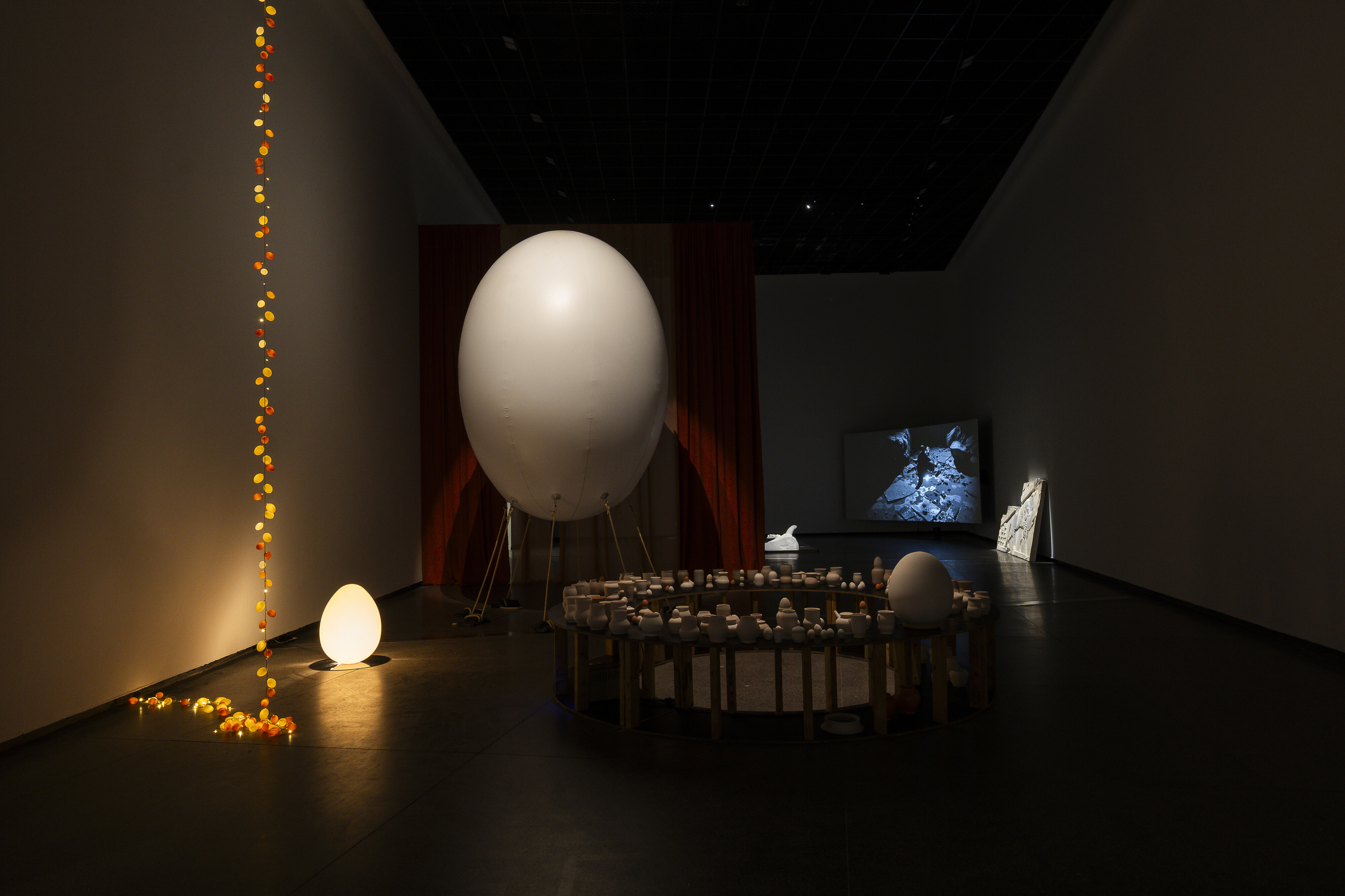
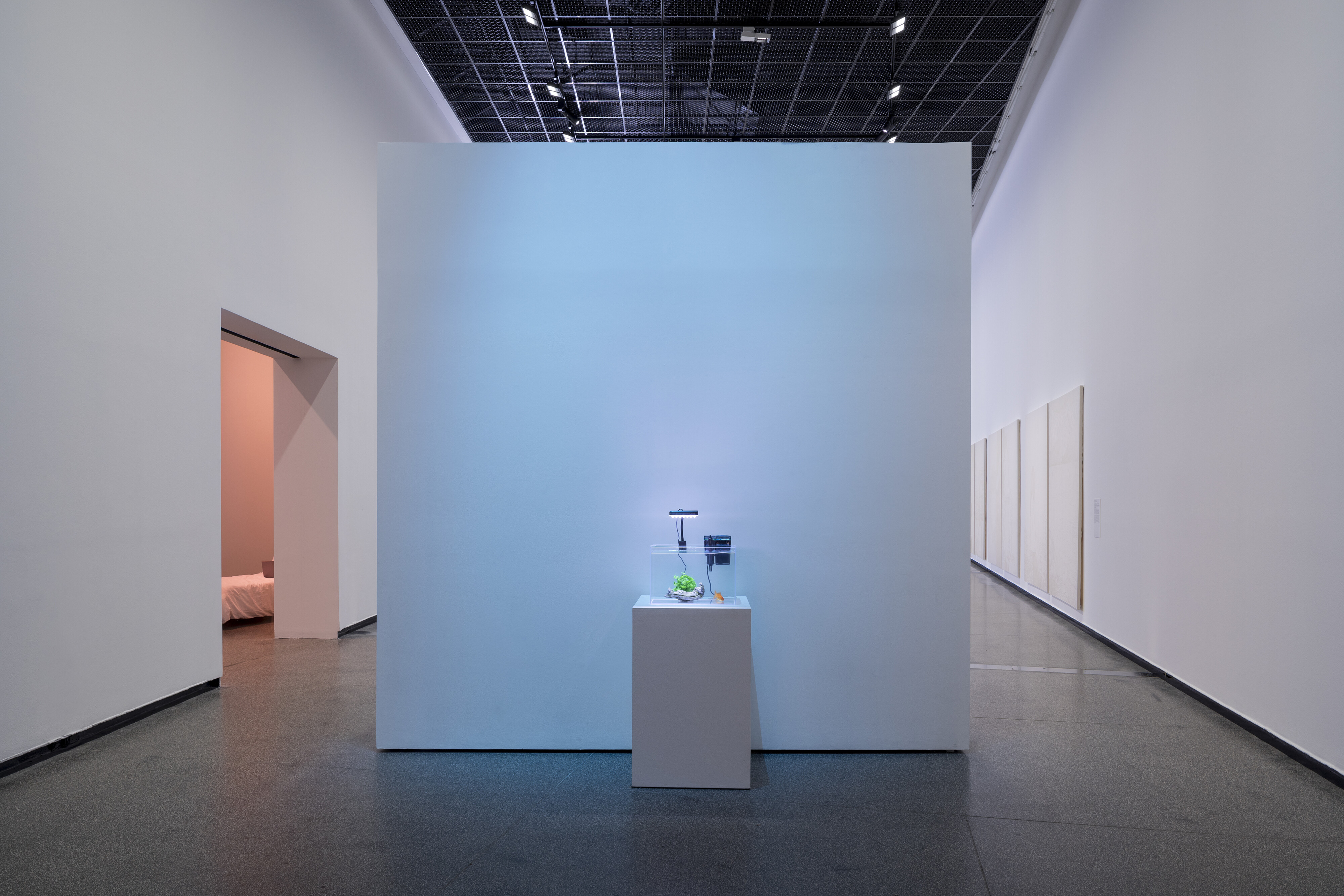
An artist, a farmer and a scientist walk into a bar, 2021, installation detail,The Art of Adaptation: Culture Changes Everywhere, Blue Mountains Cultural Centre, Katoomba, 2026. Photo: the author.
The Art of Adaptation: Culture Changes Everywhere
by Nina Stromqvist
The future is something we make together, in our daily practices.
- — Rosi Braidotti
Around 1970, feminist artist Vivienne Binns began shifting her attention away from the gallery as the primary site of art production towards creative encounters with communities of women. This was an embedded relational practice, returning to an understanding of art as a social and cultural activity that predates its entanglement with galleries and markets. Although relational and socially engaged art came to be recognised as distinct genres of contemporary art in the 1990s and 2000s, these terms can feel like an over-intellectualisation of an art that Binns and other feminist artists of the 1960s and 1970s intuitively knew was a practice that had always existed. This institutional refusal reflected a commitment to the idea that the value of the work lay in the relationships and exchanges it fostered, rather than in the terminology later developed to describe it. This approach invites connections that are contingent and emergent while proposing a radical renegotiation of leading ideas of modernity that support the myth of the artist as genius, and the neutrality of the white cube, for example. These notions have obscured relationships and systems, setting divisions that have distanced us from the Earth, and from one another.
When Binns began working with women who did not identify as artists during the 1970s, she created projects that celebrated lived experience and reconfigured the relationship between maker, collaborator, and audience. Some of these projects can now be encountered in museums and archives, yet I am heartened to find that traces of many of her regional projects remain difficult to locate online. Perhaps this is because their significance was never primarily in what was produced, but in what occurred. The work took place within communities and in the everyday contexts of the participants themselves. Binns was a conceptual pioneer, exploring questions that continue to resonate: what happens when art adapts itself to everyday life instead of requiring life to adapt itself to art?
So when I was invited to write about the Kandos School of Cultural Adaptation (KSCA)’s survey exhibition, The Art of Adaptation: Culture Changes Everywhere, at the Blue Mountains Cultural Centre, I found myself returning to Binns. How could the rich cultural projects that KSCA has generated over the past decade culminate in an exhibition? How might a practice grounded in relationships, conversation, and collective activity be presented as objects at all—and does it need to be?
The KSCA is a collective that explores how cultural change might emerge through sustained collaboration between artists and practitioners, including farmers, scientists, First Nations knowledge holders, educators, and rural community leaders. Grounded in regional NSW, but operating across diverse locations, KSCA develops projects that engage with regenerative agriculture, environmental stewardship, food systems, and climate adaptation, using artistic processes to facilitate exchanges between different ways of knowing and working. Its projects are distinguished by the active participation of non-art collaborators, whose practical, ecological, and cultural knowledge shapes both the questions being asked and the forms the work ultimately takes.
Conceptually, the School is a speculative proposition, an act of futuring that invites us to consider—or reconsider—the role of art. KSCA co-founder Ian Milliss writes:
For starters the future of culture will not be led by the official art world. It will be shaped by breakdown, mutual aid, ecological pressure, open-source improvisation, migration, anger and the practical intelligence of communities forced to invent new ways of living.
Milliss’s proposition avoids the individualist survivalism that so often accompanies discussions of social collapse, and like Binns (and so many feminist artists from the 1960s and 70s) positions art as a tool to adapt and innovate cultural tropes, which goes to the heart of KSCA itself.
But when relational projects do enter the gallery, they often arrive as the documentation of something that happened elsewhere and among other people. Too often, the exhibition asks audiences to learn about participation rather than to encounter its complexities, and by the time the work reaches the gallery, much of the energy generated through conversation, collaboration and shared experience has been translated into explanation. Documentation-heavy exhibitions can also leave viewers feeling informed but distant. However, here, at the Blue Mountains Cultural Centre, these once-complex entanglements of creativity share a uniquely joyful ratbagginess, which helps shift the didactic atmosphere that often accompanies work like this.
The Art of Adaptation, Culture Changes Everywhere is curated by Katherine Roberts and Ben Rak of Manly Art Gallery and Museum, where the exhibition was developed and presented in early 2026 before touring to its current location at the Blue Mountains Cultural Centre. Participating artists include Diego Bonetto, Laura Fisher, Lucas Ihlein, Ian Milliss, Georgina Pollard, Imogen Semmler, Peter Swain, Leanne Thompson, Erika Watson, Kim Williams, Alex Wisser, and Vickie Zhang. The exhibition also includes contributing members of KSCA over the past decade: Gilbert Grace, Eloise Lindeback, Sarah Breen Lovett, Christine MacMillan, Emmanuela Prigiona, and Kelly Reiffer. The artists have worked in close engagement with farming communities, hydrological systems, food production, and geological sciences, with the collective understanding that each system depends on infrastructural networks spread across urban and regional contexts. This commitment to ecological enquiry is frequently carried by an irreverent streak, where serious questions are approached through speculation, and makeshift invention.

Laura Fisher, Silk Water, 2024, installation detail, The Art of Adaptation: Culture Changes Everywhere, Blue Mountains Cultural Centre, Katoomba, 2026. Photo: the author.
Alex Wisser’s performance Earth Oracle (2019) is at once absurd and intimate in its attempt at understanding the soil and our relationship to the earth. The performance documentation is shown in the gallery via a video projection on the wall, and directly below on the floor is a large photo of Wisser standing staring upwards, from the bottom of a hole in the Earth. The video documents Wisser’s slow excavation of the three-metre-deep hole, dug by hand, only a few centimetres each day, through which he developed an intimate, embodied relationship with the earth as both material and metaphor. The work channels the pleasure of storytelling and collective imagination while remaining attentive to the ecological realities of a changing climate. A similar act of augury and invention is seen in Erika Watson’s Discomposure Composter (2024), inviting participants to compost our woes and grievances as we would pieces of food to make and feed compost. Participants write their woes on a slip of paper, which is then turned over inside a compost tumbler. The feeling is one of purging a worry into the world, trusting that with time and turning, it may transform into something else.
Presented in the gallery as a hot-pink portable composting toilet, Kim Williams and Lucas Ihlein’s The Turdis (2024) distils a much larger participatory project into an irreverent sculptural object. Its predecessor, V.I.Poo, a fully functioning composting toilet, premiered at the 2023 Yours and Owls music festival in Wollongong and was installed again at the Wollongong Botanic Gardens Super Saturday Plant Sale in 2024. The conspicuous outhouse is described by the artists as a:
faecal time-machine, a composting toilet where users bear down and imagine past, present and future. The past is recent, when human manure was widely valued as an agricultural resource, like any animal manure. The present is now, when humanure is used on some farms. The future is coming, where composting toilets replace flush toilets across the land.
For the exhibition, The Turdis shape-shifts as a Museum of Humanure for a one-at-a-time audience to sit within its walls and take in a salon hang of V.I.Poo moments, with photographs of various exchanges with farmers and artists documenting efforts to transform human waste from taboo to treasure.

Laura Fisher, Silk Water, 2024, Kandos School of Cultural Adaptation, Disturbed, at Cementa24. Photo: Gemma Swain
Across the gallery I recognise a series of watery blue banners, from a project I participated in at the 2024 Cementa Festival in Kandos, NSW. The banners were in a different form then, however, more like the flags or markers we use to map underground and invisible water systems beneath our feet. Laura Fisher’s Silk Water (2024) was part of the KSCA activation (Disturbed){.underline}, hosted at a vacant paddock in central Kandos for the duration of the four-day festival. The experience of participating in Disturbed was an insight into how KSCA, as a school, might operate in open dialogue with its communities and collaborators. I say might, as I see so much of what the KSCA does as a prototype for a future reality. The discrete projects dotted around the paddock were a curious combination of environmental sciences and anarchic contemporary art making. (In fact, it was here that I composted my first grievance in Erika Watson’s Discomposure Compost).

Erika Watson, Grazing Blanket, 2024, at Mulloon Creek, NSW as part of the Mulloon Institute’s Country-centred and Creative Residency
Another project emerging from the paddock and finding new form in The Art of Adaptation is Erika Watson’s Grazing Blankets (2024), a social sculpture made from a collection of repurposed vintage woollen blankets. In the gallery, the large circular sculpture is striking in its current form, as its colours and size dominate the large wall at the entrance —a circular stitching-together of familiar domestic blankets with a central hole, like an all-seeing eye casting its gaze over the space. The sculpture, in its original form, moved around the paddock during the 2024 Cementa Festival as a place for rest and collective grazing. Its central hole was used to frame the section of ground it was placed over—grasses, soil, insects all coalescing. Sitting in quiet and close proximity to anonymous others or lying chest down in the centre (heart to earth), a strange and sweet meeting occurred between the human and non-human worlds.

Kandos School of Cultural Adaptation, Disturbed map, Paul’s Paddock, Cementa24, Kandos, 2024.
Back in the gallery, I’m drawn to another of KSCA’s shape shifting projects, and perhaps the most creatively realised project from the coal face of field work. An artist, a farmer and a scientist walk into a bar (2021) is an assemblage of essays, stories, images, poems, and project documentation from eight cross-disciplinary collaborations printed as a newspaper. The print media work is installed as a pile on the floor, hot off the press, with an oversized cover page in a wire rack, leaning against the wall. The pages of the publication are displayed along the wall for closer reading, revealing a rich collection of projects showing how artists, farmers and scientists can work together to address ecological challenges. My eye is immediately drawn to an image near the beginning depicting a figure walking from behind, wearing a striking cape with the words ‘Mother Earth Country’ sewn across the back. The work is part of a project Wiradjuri artist Karla Dickens developed with First Nations historian and agriculturalist Bruce Pascoe, Blacklock Media, and Aboriginal children from Bingara Central School. On closer examination, I learn the photo is part of a project titled Mother’s Little Helpers (2019), which includes a short film featuring Pascoe and the children walking through Gamilaaraay Country wearing these exquisite hand-embroidered capes. There is something about this combination of collaborators that I find compelling; these projects thrive on a productive improbability, the sort that begins with an artist, a writer-farmer and a group of school children, and ends up expanding how we think about Country, culture, and care.
In its guise as a newspaper, the offset printing format is at once speculative and hopeful, carrying the authority of a dispatch from the field while imagining a future in which projects such as these have become part of the everyday public record. An artist, a farmer and a scientist walk into a bar (2021) is perhaps the most “art world” recognised project for KSCA. In 2021, it won the Northern Beaches Environmental Art and Design Prize in the Interdisciplinary Collaboration category, and was featured in Uncertain Territory, an exhibition curated by Halinka Orszulok at Artbank, in 2019. In the same year it was the focus of a public talk held as part of Kaldor Public Art Project 34, Asad Raza’s Absorption, at Carriageworks.

Karla Dickens and Bruce Pascoe with Blacklock Media, Mother’s Little Helpers, 2019
In the curators’ statement, Roberts and Rak invite us to recognise our own participation within systems of land, food, and water. However, I want to resist the familiar claim that exhibitions such as these reveal and make visible a network of cultures that already exist. The language of revelation keeps the attention fixed on what the gallery can recognise and interpret. I would argue that the KSCA artists and their collaborators aren’t particularly motivated by “raising awareness” or demystifying the conditions that produce a crisis. Rather, they are more invested in prefigurative experiments and assembling resources for creating microcosmic futures.
Like Binns’ sustained collaboration with women outside the art world, perhaps the works in The Art of Adaptation: Culture Changes Everywhere aren’t addressed to a viewer at all? Or at least a viewer in a formal artistic context as an endpoint. The communities, and indeed the artists, that gave rise to these projects, are rarely waiting for validation from institutions such as those within the artworld; they are already participating in the ongoing production of culture that precedes and exceeds its recognition.
The exhibition’s greatest achievement is that it resists reducing KSCA to a set of outcomes or retrospective evidence of something that happened elsewhere. Instead, it retains something of the joyful experimentation that has long characterised the collective’s activities. While the exhibition offers a partial glimpse into a practice that remains grounded in place and the work of cultural adaptation, it also trains our attention onto an underacknowledged lineage of artists, including Vivienne Binns and other feminist pioneers, whose work has long moved between community and institution, expanding our understanding of where art happens and who it is for.
Nina Stromqvist is a curator, writer and educator living in the Blue Mountains on Dharug and Gundungurra Country
From the Magazine

Open Now