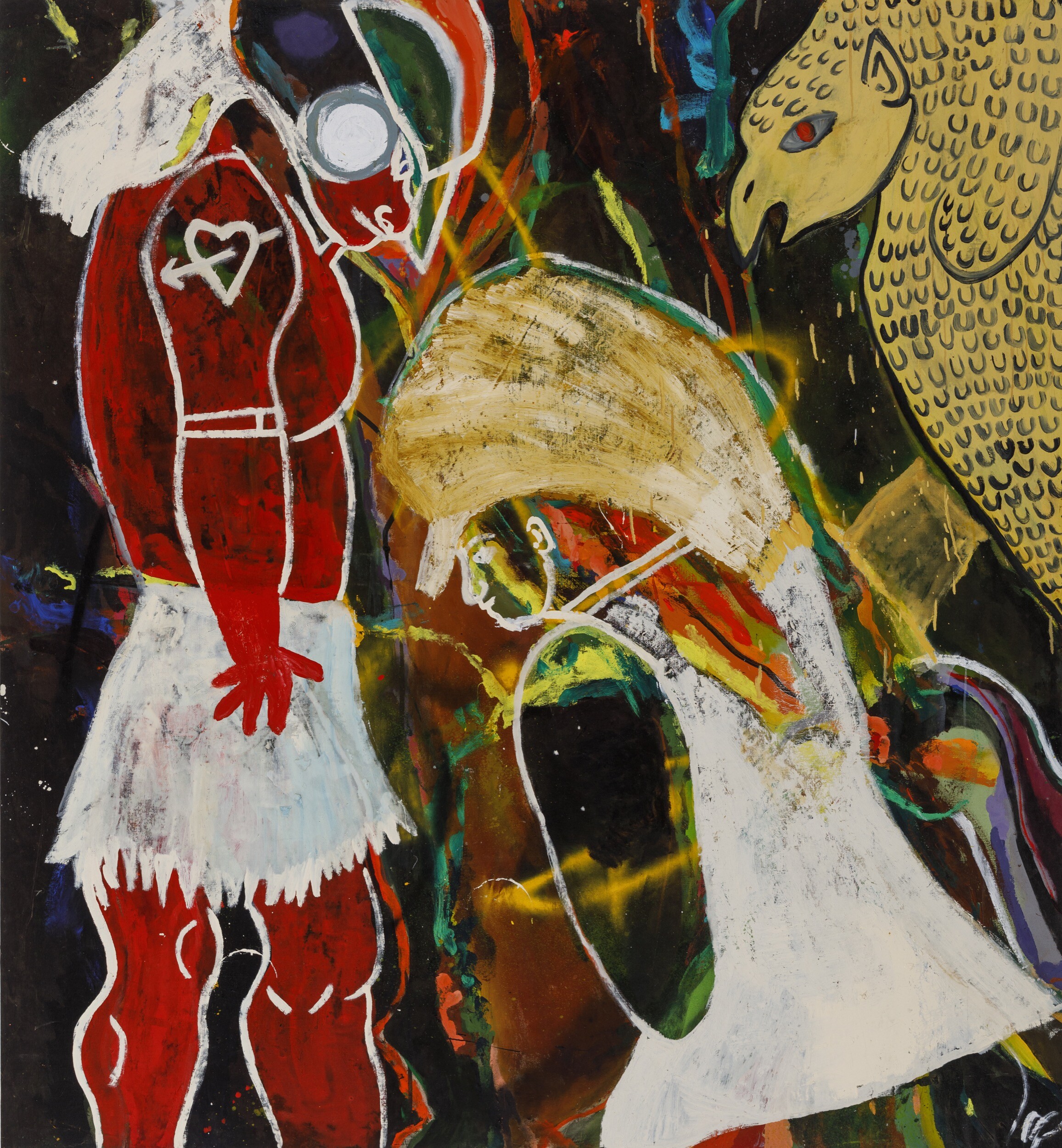
John Young, Fairweather Transformations The Chinese Room, 2022, oil on linen, 80.0 x 120.0 cm. Photo: Craate Creative for TarraWarra Museum of Art.
Inside The Mirage
by Hugh Magnus
Inside the Mirage is an exhibition about conversations. At its core is a decade-long project by Hong Kong-born Australian artist John Young to respond to works by an elusive titan of the last century, Ian Fairweather. Fairweather was a major sinophile, dedicating much of his life and practice to exploring Chinese culture, language, and imagery in a sympathetic and novel manner, a path which few anglo-celtic artists before—or for that matter after—have managed to follow with much success. Young’s slick, digitally-informed practice often feels at odds with Fairweather’s rustic intellectualism, yet the pairings of these paintings form a solid nucleus from which the exhibition can expand outwards to approach the places held by the art of the Chinese diaspora in Australia.
Pairing a great of twentieth-century Australian art with a contemporary practitioner has become a trademark of TarraWarra’s curatorial strategy, usually deployed with resounding effect (Anthony Fitzpatrick’s 2022 pairing of Sidney Nolan and Heather B. Swann was particularly memorable). While the dialogue between Young and Fairweather is the main event, curator James Lynch has accompanied these core works with an expanded field of artists navigating the territory between Australian and Chinese culture, and transcultural conversations more broadly. This is organised in Inside the Mirage as a series of expanding, concentric circles, like the rings and moons that orbit Saturn.
John Young, Fairweather Transformations The Chinese Room, 2022, oil on linen, 80.0 x 120.0 cm. Photo: Craate Creative for TarraWarra Museum of Art.
I was unfamiliar with John Young’s work before visiting this show; a handy monograph put out by Power Publications last year, The History Projects, gave me a good introduction to his motives and practice over the last two decades. Young’s ongoing metaphorical dialogue with Fairweather is only one of eleven of the artist’s discrete “history projects”: reading about these as a series, it struck me that Inside the Mirage is really an extension of them, sharing their cerebral quality and emphasising what Young describes as a sense of “ethical responsibility” towards history: complicating established canons, narratives and preconceptions in Australian art and broader histories of diasporas and intercultural identities.
Young initially baulked at the challenge of Fairweather, describing his paintings as “too existentially real.” Yet over the course of his career, an ongoing dialogue with the older artist has become central to Young’s practice: “I really consider Fairweather one of the origins of my work, because of his capacity to hold two world views together.” Young’s spectral response to Fairweather begins—like much of his work—with images downloaded from the internet and fed through an algorithm. These images are then replicated in oils on canvas by studio assistants (the works are signed verso by Young and the assistants) and framed in a style imitative of the original. Young’s historical gaze initially seems at odds with his essentially internet-art practice. As a painter friend with whom I visited Inside the Mirage astutely observed, the earliest of Young’s works in the show anticipate particular digital aesthetics like vaporwave and Pinterest-informed vibe-posting by at least a decade. Transculture, Colourful Beast (2003) is an excellent example of this, a work that was featured in TarraWarra’s first exhibition in December that year. The institution (largely due to the influence of the late visionary Maudie Palmer) has long been a key supporter of Young’s work, notably in the artist’s 2006 retrospective, Orient/Occident.

John Young, Transculture, Colourful Beast, 2003, digital print and oil on linen, 3 panels, 300 x 445.5 cm overall. Photo: Craate Creative for TarraWarra Museum of Art.
For Inside the Mirage, Young has created new responses to five of Fairweather’s works in the TarraWarra collection, presented alongside earlier works from the series. The pairing of Two Children (1934) and After Fairweather I (2022) is a powerful opener to the long corridor that begins the exhibition. While Eva and Marc Besen obviously loved Fairweather, and had a discerning eye (his work is not easy to collect), Lynch’s decision to borrow works from public galleries is decidedly prudent. The best of these initial pairings can be found in the dialogue between two works loaned from AGSA, Fairweather’s Mangrove (1961-62) and Young’s Fairweather Transformations: The Chinese Room (2022). Another notable work here is Composition I (1962), once belonging to Young himself but now held by QAGOMA.

Ian Fairweather, Composition I, 1962, synthetic polymer paint and gouache on cardboard on hardboard, 67.6 x 83.5cm. Photo: Craate Creative for TarraWarra Museum of Art.
Attempting to categorise the work in this exhibition pits the discerning viewer up against an octopus of unruliness. Young’s oeuvre is notoriously complex, and the many facets of Fairweather—army man, eccentric sinologist, bohemian, unstable adventurer, painter of fabulously tender landscapes and powerful, pulsating abstracts—equally make a straightforward conversation hard to frame. Not really approached in Inside the Mirage is a more elusive side to the artist: the role played by class in Fairweather’s life. Fairweather’s father was—like many bourgeois Scots of the period—an official in the British Raj, and after the artist’s birth in 1891, returned to India, leaving him in the care of a great-aunt for a decade. Genteel roots and education were what enabled his extensive study of Chinese calligraphy during several years as a German prisoner-of-war in the First World War, an interest that apparently never left him. When my grandfather was about my age, passing through Bribie in the early ‘60s, he paid a visit to Fairweather. The artist served tea in his legendary grass hut, and took him out to lunch at a local restaurant; he described Fairweather to me as nothing short of a perfect, patrician gentleman. Merely classifying Fairweather as an “Australian” artist also makes it difficult to examine the friendships he maintained in the metropole, particularly with Jim Ede, the founder of Kettle’s Yard. Examining the 1930s pictures in the light of this relationship could also draw links between Fairweather and fellow Slade alumni like Ben Nicholson and the Neo-Romantics. It is easy to forget this side to the artist when confronted with Homeric accounts of his raft voyage, or indeed tales of his wanderings across China and India—but this is material for another show.
The famous tale of Fairweather-as-explorer’s ill-fated voyage by raft from Darwin to Pulau Rote in Indonesia is charted in the second gallery by Michael Stevenson in the form of two charming classroom-style maps, alongside photographs of the replica raft made by the artist in 2004-6. It would have been more compelling in my books if said raft (in the QAGOMA collection) was included in the show, but I am reliably informed that it was too fragile to make the journey from Brisbane. This is a rare moment of weakness in Inside the Mirage—a show dominated by paintings—in that the works that the curators have chosen to break up the cavernous spaces of TarraWarra’s galleries do not seem to have much to do with the rest of the exhibition. True enough, Vietnamese-Australian artist My Le Thi’s 1993-ongoing project Our Shoes has something to do with diasporic memory and interculturality, even though I’m not particularly convinced. More flagrant is Mikala Dwyer’s Flat Square Circle Sculpture (2019), which—while a fabulous piece of sculpture—seems to have no place in this show apart from providing the de rigueur chance for a mirror-selfie.
Fairweather-as-scholar forms much of the focus of the third gallery, with the artist’s translation of The Drunken Buddha, a thirteenth-century Chinese tale, and its painted illustrations forming the core of this room. Flicking through the handily provided copy of the first edition, I land on a page that reads “Buddha’s strength at times not equal to the strength of fate. Regretting to have drunk too much and gazed too long upon the hills.” I can’t help but imagine Fairweather found this altogether rather relatable (as I do). TarraWarra owns three paintings from The Drunken Buddha series (and incidentally was partly responsible for UQ Press’ reprinting of the work in 2014, accompanying a show of the same theme). In my view, while not necessarily as brilliant as Mangroves or indeed the virtuosic (Farel) Cloth Market Peking (1936), these works alongside the translation of the novel situate Fairweather’s transcultural experimentation as exceptionally sympathetic, serious work, high above snide and puerile whispers of appropriation.

Johnny Bulunbulun, Laurie Maarbuduc and Zhou Xiaoping, Dragon, 2010-2011, Natural pigments on Eucalypt bark, 33 x 87 cm.
Transcultural collaboration sometimes works well. Other times, it fails extraordinarily. Alongside the Drunken Buddha paintings in the third gallery are a group of collaborative works, the product of a long friendship between the Chinese-Australian painter Zhao Xiaoping and the Ganalbingu (a Yolŋu clan) artist Johnny Bulunbulun, which perfectly illustrate this spectrum. The small ochre on bark Dragon (2010-11), credited to Xiaoping, Bulunbulun and Maarbuduc, is astounding, depicting a Chinese Loong (dragon) sitting alongside Guwaynang (the long-necked freshwater turtle) and Gumang (magpie goose). This humble painting must be up there with the best collaborative work produced by Indigenous and non-Indigenous artists, such as that of the partnership between Imants Tillers and Kumantje Nelson, or indeed the Tennant Creek Brio. The painting transgresses in the best way, pushing the strictures of bark and forcing viewers to reconsider the medium’s possibilities. The group of ceramic works is also worthy, blue-and-white china depicting Yolngu images of Macassans, a refined precursor to those (rustic yet more skillfully executed) pots produced by the late Ms. D Yunupiŋu in her final years. Work depicting the pre-colonial trade relationships between Yolngu and Macassans is currently in vogue, but has a history of drifting in and out of the public imagination: it is an uncooperative history, and, like Fairweather’s character or Young’s work, invariably has difficulty being leveraged by curatorial intentions.
In spite of these curiosities, the two collaborative canvases that dominate this side of the gallery are abysmally unsuccessful. From Art to Life (2008) shows fish, trepang and Macassans drifting out of Bulunbulun’s painting into Xiaoping’s murky sea; Discovery of Trading 2009 paints a similar story. Rather than a meaningful admixture of style or any formal or aesthetic synthesis (as in other works Bulunbulun influenced, such as Lin Onus’ rarrk paintings), the two artists’ contributions are placed side by side as if inherently incompatible. I thought this idea was what Inside the Mirage was trying to disprove? While these two paintings try to share a story of trade and cultural contact, the result struggles to get a cohesive narrative off the ground. In presenting what is effectively two paintings on the one canvas, both images become uprooted, somehow more diluted than the effect of hanging two works side by side. If anything, the inclusion of these works is a good reminder that the polished success of Young’s conversations with Fairweather are not to be taken for granted. Fairweather once described his work as portraying “the effect a scene had on me,” creating an image both whole and fragmented, and, while there are moments when the slick finish and digital conception of Young’s paintings appear unemotional or trite, their translation of the effect of Fairweather’s scenes is faithful and potent.

Installation view of William Yang, My Uncle’s Murder series, 2003. Photo: Craate Creative for TarraWarra Museum of Art.
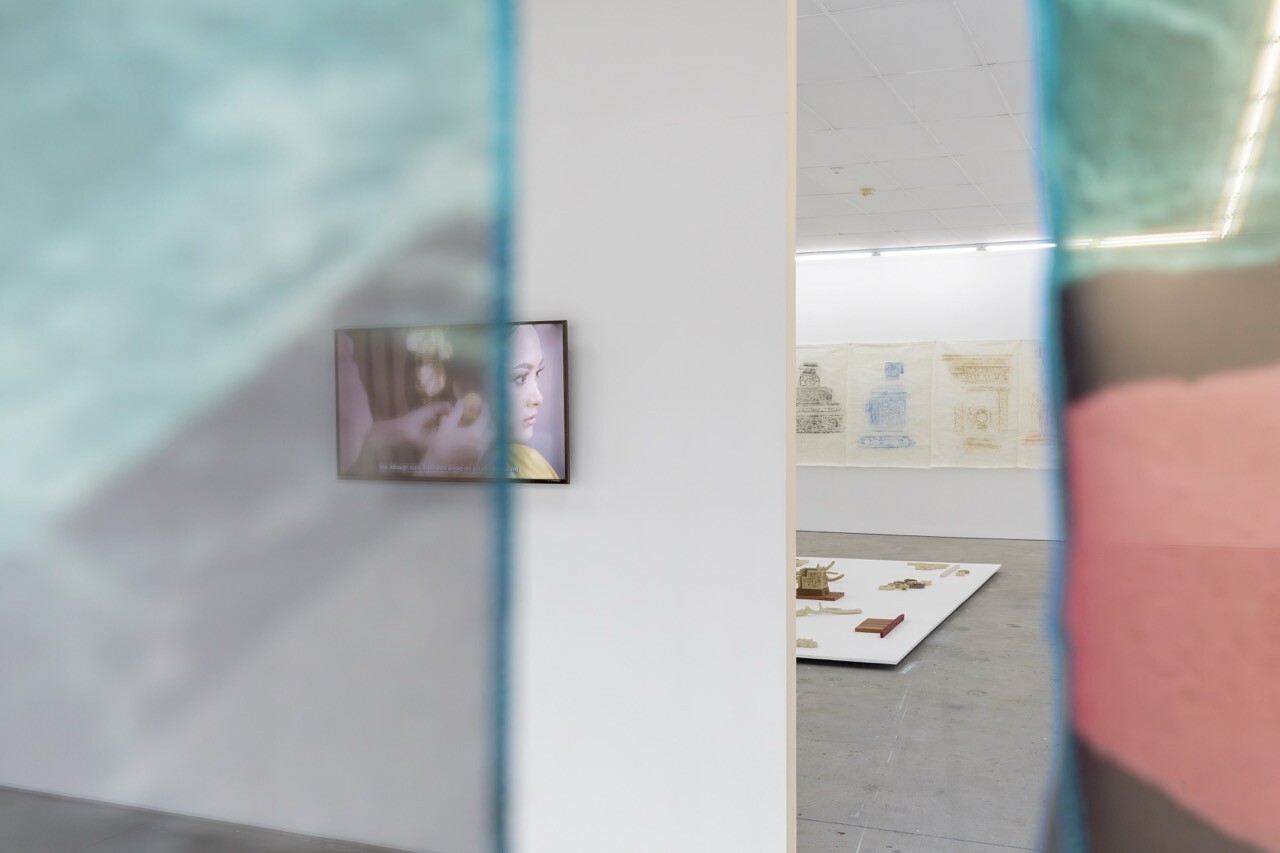
Reportedly, Young had some influence alongside Lynch in determining which artists made up this expanded field, selecting a variety of works from the collection and elsewhere that continue the transcultural conversations begun by Fairweather. Sometimes these are obvious, like William Yang’s poignant photographic series My Uncle’s Murder (2008), or indeed Meng-Yu Yang’s lovely three-channel video Double Witness, which pays homage to Taiwanese writer Qiu Miaojin’s final days in Paris. There are moments, however, when these concentric rings of historical dialogue reach an almost hyperbolic trajectory, threatening to break free from the lateral networks and connections that ground the rest of the show. Some, such as the pairing of a tender series of work by Narelle Jubelin and two of Young’s Mute Palace paintings, simply need a bit more explanation. I read it as the artists both looking back to historical homeland traditions from their place in a diaspora—Jubelin to Cossington Smith and Blackman from Spain, Young from Melbourne to the work of eighteenth-century Jesuit court painter Guiseppe Castiglione in Beijing. Others are more obviously still about conversations, perhaps just not relevant ones—Gordon Bennett’s tremendous Notes to Basquiat: Totem Lesson 2 (2001) is admittedly sourced from the TarraWarra collection, but I can’t help but feel a Home Decor painting (responding to Margaret Preston) would have suited the brief more.

Installation view of Inside the Mirage. Photo: Craate Creative for TarraWarra Museum of Art.
It is clear that Inside the Mirage sets out to challenge the linear narrative of a limited canon, asking how the history of Australian art can be told in a different way. And, for the most part, it convincingly succeeds. Taking the lateral approach permitted by the show’s expanded conversations ensures that the answer to this question unfolds non-linearly—rather like protagonist Chi-tien’s path in The Drunken Buddha—full of twists and turns. While these dialogues are less convincing at times, or best left on the outside, Lynch and Young’s mission is exciting, and the show does not have the condescending or didactic element that I have come to expect from exhibitions that share the revisionist intent of Inside the Mirage. If anything, for the uninitiated viewer it might be too obscure, too cerebral, to come away with a sense of the show’s significance. But, even in spite of this, the works (and the core dialogues) are always interesting enough for the show to get away with it.
Hugh Magnus is an art historian in Narrm/Melbourne