wani toaishara from the exhibition Everyday Raptures and Repairs. Courtesy the artist.
wani toaishara, Everyday Raptures and Repairs
by Rex Butler
A few weeks ago—it’s getting towards the end of semester—I did the lecture on the Antipodeans for my Australian art history unit, and, of course, in the lecture we looked at John Brack’s The Bar (1954) and Collins St., 5 pm (1955).
We looked at them again in the tutorial when students gave their accompanying, hopefully not too AI-enhanced, presentations. But when they finished in each class, I said, “Wait a moment. Let’s leave the slides up a little longer. What do we actually see?”

John Brack, The bar, 1954 © Helen Brack. Image courtesy National Gallery of Victoria, Melbourne
Of course, the presenters had already explained to the class—maybe looking it up online—where in Collins St the people were walking and what the famous or better infamous six o’clock swill was. (After all, who from their generation or even mine, with their pubs and bars open all night, would have any idea that since World War I they used to close at 6 pm to encourage “austerity” and “public sobriety”?)
But as we stared at the two PowerPoints up on the blackboard, I insisted there was still more to be seen. “Be a bit cruel,” I explained. “Think how things used to be. Brack’s actually a bit of a satirist, looking at things with an unsparing eye, just like the subject of his 1969 Archibald Prize entry, which crazily didn’t win,” quickly casting onto the wall his portrait of Barry Humphries as Dame Edna Everage using Google Image search.
“Things weren’t always like they are now, and the good thing about looking at works of art closely is that they tell us about other times, other places, other peoples. You just have to know how to look closely and be prepared to be challenged by the work.”
I then pointed to the way—because none of them were yet able, still looking through the lens of the present—that all the guys drinking in the pub looked old, both because of the effects of the alcohol but also because the younger male workers, newly married and with young kids, weren’t allowed to stay out after work. The six o’clock swill—this is part of both its comedy and tragedy—is for older men whose children had grown up (everybody had them young then) and now can’t bear or at least don’t have to go home to their wife, to whom they haven’t really properly spoken for twenty years.

John Brack, Collins St, 5 p.m., 1955 © Helen Brack. Image courtesy National Gallery of Victoria, Melbourne
And in Collins St. it needs to be pointed out that all of the people in it are pale Anglo-Australians. The pre- and post-War migrants from places like Italy and Greece hadn’t yet “risen” to middle-class office jobs in the city. And the women depicted there—undoubtedly all secretaries or personal assistants—are all younger-looking because when they got married they largely left the workforce to have kids (or were even “let go” from their jobs when they fell pregnant). And, of course, finally, none of the men we see there are anything more than anonymous middle management (clerks, salesmen, accountants) because their bosses wouldn’t walk down Collins St to catch a train but drive home from their company-funded city parking stations.
It can shake the students seeing the past through such unvarnished eyes and hearing someone willing to point out to the best of their ability—for, of course, I wasn’t there either—how things used to be. It can seem cruel or insensitive speaking of such things now, and with Brack’s flat, non-declarative style it’s hard to read his attitude towards what he’s depicting (which is why he is such a great satirist). But it is also the power of art, perhaps beyond that of documentary, to make us reflect upon what part we play in seeing what we see. Are we bringing our own prejudices and preconceptions to bear? Is this Brack showing us this, or am I seeing too much of myself reflected in it?
And just to prove that this does not just apply to old white men, the next week when we spoke of the art of the 1960s and ’70s we looked in the lecture and tutorials at two images by Carol Jerrems, Vale St. (1975) and Mirror with a Memory: Hotel Room (1977)—of course—and asked similar questions about the new place of women and women’s sexuality in Australian culture.
All of this was still in my mind when I went to visit Everyday Raptures and Repairs, the exhibition by Congolese-Australian photographer, poet, and performance artist wani toaishara, curated by David Sequeira, at the Fiona and Sidney Myer Gallery at the Victorian College of the Arts.
It’s a relatively small show in the always dimly lit two rooms of the gallery, consisting of some eighteen photographs of different sizes, some in colour and others in black and white, a large blown-up reproduction of a historical image mounted on the wall, and a four-piece video screen playing what looks like three short videos on a ten-minute loop.
toaishara, who came to Australia from the Democratic Republic of the Congo via New Zealand in 2012, is one of a small number of originally African-born photographers currently living and working in Australia. Perhaps the best known is the South Sudanese Atong Atem, celebrated for her portraits of women wearing a dazzling range of make-ups. But there is also the Nigeria-born Ayooluwatomiwa Oloruntoba, who last year had an important exhibition at Melbourne’s Immigration Museum, and the Ghana-born digital artist Stephanie Martei, who held a residency in Sydney’s Powerhouse Museum in 2023. And this is not even to consider such photographers as the English-born Jon Frank, who in 2013 made a convention-upsetting series of images of African Australians swimming and surfing on Victorian coastal beaches.
toaishara already has something of an extensive exhibition history. He perhaps first came to widespread attention in 2022 with his show Nexus at Black Dot Gallery in Brunswick, which drew extensively on family archival material. That same year, he won the prestigious Ulrick and Win Schubert Photographic Award for his work do black boys go to heaven? (2022). In 2024 he held an exhibition at the National Portrait Gallery, for which he wrote the essay “Why Portraiture?,” and just last year the Northcote Town Hall Art Centre hosted his acclaimed spoken performance piece garçon (2025).
All of the works from Everyday Raptures and Repairs date from 2026 but in fact appear to belong to different previous series. On the wall to the left as we enter the gallery, we have a close-up of an African man getting a haircut—and the haircut, African hair, and indeed the barber are something of a long-running theme in the show. On the wall next to that we have black-and-white photos of a mother and child and a girl with a cat and our first shot of the barber. Then on the opposite wall in colour we have a much more complete shot of the barber on his chair, wearing a T-shirt that says “FJM Barbershop,” along with the usual photo of all the different haircuts he can do and high up on the wall flags from all around the world (I can see, for example, ones from Burundi, Sudan, and the Ivory Coast). Next to that there is a photograph of an African couple holding hands, with the man dressed in a suit and tie and the woman in a flattering white dress and shoes, a photograph of a woman standing in a kitchen with a T-shirt that reads “Jesus Saved my Life,” and finally a photograph of a young couple standing in a photographic studio, either before or after being photographed.

wani toaishara from the exhibition Everyday Raptures and Repairs. Courtesy the artist.
In the next room, we have smaller photos of a woman’s beautiful face, three photos of the artist with his metal earring flashing in the light, a close-up of hands brought together, and at the back an enormous blown-up photo of the artist’s grandparents getting married in Bukavu, a city in the eastern Democratic Republic of the Congo in the 1950s, and inserted inside that two coloured photographs of his now grown-up cousin in a patterned blue dress and beneath that two Polaroids of her and her sister as young children.
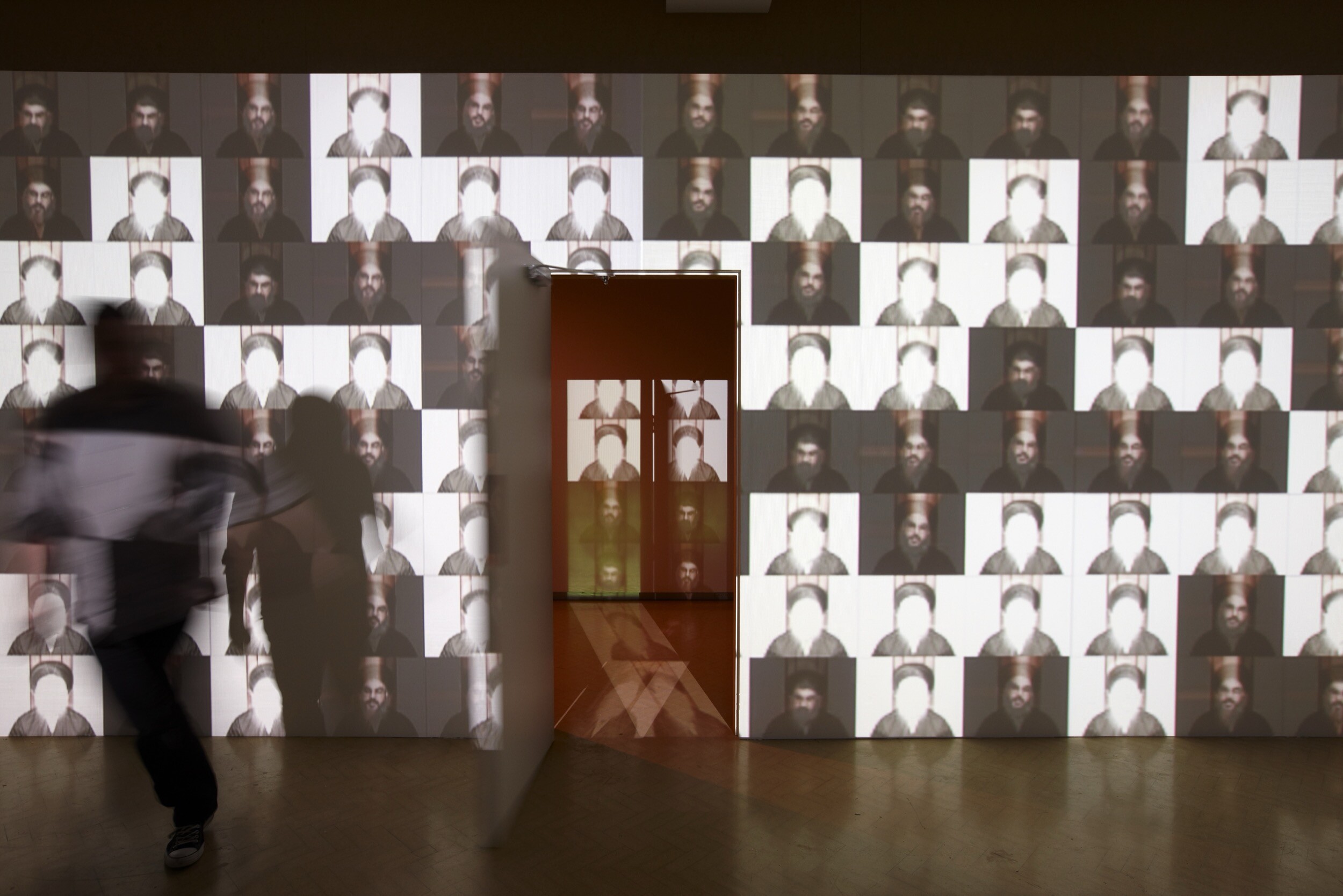
In the first gallery space, there’s the video A Most Beautiful Experiment (2026), which shows first of all the artist’s partner and then the artist trying out various poses in front of the camera. Then we have a dancer, in black and white and then in colour, trying on and putting down a mask and then breakdancing to some music. I must admit breakdancing has been spoiled for me a bit by the experience of Rachael “Raygun” Gunn at the Paris Olympics in 2024, although while I was smiling at the wobbling horizontally held arms and athletically crisscrossing half-bent knees, the mood was broken with the sombre and enigmatic words delivered over the top that give the show its title or at least justification: “The paradox is that the ordinary is constituted by stuff that is so terrible and impossible to bear, yet in that context people make things happen and continue to act and produce.” Then later we see footage from the first parliamentary moment of the newly independent Congo in 1960 with someone saying in French: “We have known ironies, insults. We have had to submit to beatings, morning, noon, and night because we were negroes. A black was always addressed in a familiar form, certainly not as a friend, but because the respectful form of address was reserved for whites,” reminding us, of course, of that distinction between “tu” and “vous” that everybody here learns in their about third lesson of French.

Still from wani toaishara, A Most Beautiful Experiment, 2026.

Still from wani toaishara, A Most Beautiful Experiment, 2026.
But the works that really made me stop and think were those of the barber sitting in his chair, the woman in her kitchen with the Jesus T-shirt, the couple in the photographic studio, and the couple holding hands.
Why? Because I wondered how much I should read into them, or put otherwise how much toaishara was telling me. I wanted to read an ease and assuredness in the barber, an almost sacred kindness in the woman in the kitchen, a domestic familiarity in the couple in the studio, and a kind of awkwardness and romantic mismatch—and maybe even a kind of comedy—in the couple holding hands in what appears like the backstreet of a far-flung generic Melbourne suburb.

wani toaishara from the exhibition Everyday Raptures and Repairs, 2026. Courtesy the artist.
I wanted these works—or would want these works one day—to be the equivalent of those Bracks at the NGV: images of Australia and of what Australia was back then. And in the same way I would want them to be revealing, both obviously and less obviously, of its peoples and its times. We’d have to “read” these images, and the people in them would not just be individuals but also types, representatives of certain social forces and tendencies. That’s why they are works of art and not just documentary recordings: because they don’t merely belong to a particular time and place, but are generalisable, indeed, in a way universal. We are all these people, or least we are when we try to figure them out. Of course, we can go too far and put too much of ourselves in them, in my case an old middle-class white guy, but I think that’s a lesser danger than refusing to engage and empathise with them at all.
toaishara, for his part, says something very interesting along these lines in an interview he does with Sequeira for the show, which is given away as one of the exhibition’s roomsheets: “Photography appeals to me because it sits between evidence and imagination. It is often treated as proof, a record that something happened, that someone stood there at a particular time, but in practice it is full of omissions, desires and projections.”
In fact, if I were a curator of Australian art at the NGV—and what a great job, much more important than being a mere lecturer on the subject—I’d rehang the collection to put the Bracks and a couple of works by toaishara or at least African-Australian photographers in dialogue with one another. (Let’s face it, the Australian collection hasn’t been rehung in ages and is too much like Bernard Smith’s model from Australian Painting of having the Heidelberg School as a “genesis,” then a couple of rooms of expatriates as “exodus,” before having them return in a regretful “Leviticus” and ending with the Antipodeans and a triumphant “rebirth.”)
What would hanging them together do? It wouldn’t be to speak of their difference or the all-too-simple idea of some token representation of African-Australian artists. Rather, it would be to indicate their sameness, that they are both works of art and therefore in a sense “satires,” in that they express a certain attitude towards their subject matter, implying a certain distance between the artist and what they depict and the spectator and what they look at. Put simply, there is an “attitude” expressed towards what we see, and it is our task as spectators to discern or deduce it. The artist is not just recording something but expressing something about it. (This is probably altogether the problem with something like the Archibald Prize, where the prevailing criterion is still accuracy, truthfulness, and artistic technique: what we see is never allowed to be an expressive type that says something more broadly but has to be an individual.)
So, yes, I want to read something about who I am as an Australian today into these four images by toaishara, just as I do with Brack. They speak to me; they speak of me and my times. I could call them a new, wider “UnAustralian” art in some kind of opposition to the “Australian” one of Brack and his backer Bernard Smith, but really this would only be to reveal that Brack was already in his way “UnAustralian”: already questioning who and what was Australian, who and what was left out, who wasn’t walking down Collins St after work or drinking in the bar. Brack was already looking at Australia from an “UnAustralian” perspective, as was his friend Barry Humphries. Just as we might say toaishara is looking at his subjects from an “Australian” perspective, forcing his spectators to think how they are like them here and now.
Rex Butler teaches Art History in the Faculty of Art Design and Architecture at Monash University.