Michaela Gleave, Event Horizon, 2026. Installation view, Artspace, Sydney, 2026. Photo: © Hamish McIntosh
Michaela Gleave: Event Horizon
by Anastasia Murney
Last Saturday, I tuned in to a live-stream of Michaela Gleave’s endurance performance 7 Stunden Ballonarbeit / Balloon Work (Purple). She sits on a wooden stool against the blank white wall of her Sydney studio, blowing up purple balloons one at a time. She averages about ten seconds per balloon, which she knots and then volleys into the room or lets drift off her lap. We hear nothing but the pressure of her breath filling the balloons. I check on Gleave a few hours later; the balloons are creeping up the walls, small signs of fatigue are starting to show on her face. But she continues with the same calm, efficient rhythm. I check back again; she is now waist deep. A few hours later, she has disappeared beneath a sea of balloons. Then, the popping begins—hours of work undone in a matter of seconds.
Gleave is restaging a performance from 2010. In fact, she has plans to do six more—one colour per performance, covering all seven colours of the rainbow. The impetus for the 2010 version was an invitation to contribute to an FBI fundraiser at Sydney’s Oxford Art Factory, which Gleave couldn’t do in person, having just moved to Berlin. So she decided to throw a “party for one” from her new home, and streamed the performance live via Skype. A condensed ten-minute version of the performance sat on YouTube for a while. At some point it went viral, and it now has over 225 million views. Watching the original, which shows Gleave sitting barefoot amongst a rising tide of bright, multi-coloured balloons, I’m reminded of a kind of bubblegum aesthetic that permeated the Sydney art world of the early 2010s—fun, colourful performance art, lightweight festivals, and a loose, rambunctious ARI scene that was more porous with the city’s nightlife. After a few years, these energies started to wane with increased pressures on rent along with a process of consolidating grassroots infrastructures and absorbing them into larger institutions. To be fair, this connection could be a symptom of my own bubblegum-tinted lens. At the time, I was mashing together press releases and undergraduate verbiage for an online lifestyle magazine and then drinking vodka and Red Bull at Oxford Art Factory at least once a week (somehow, I missed Gleave’s live-stream performance).
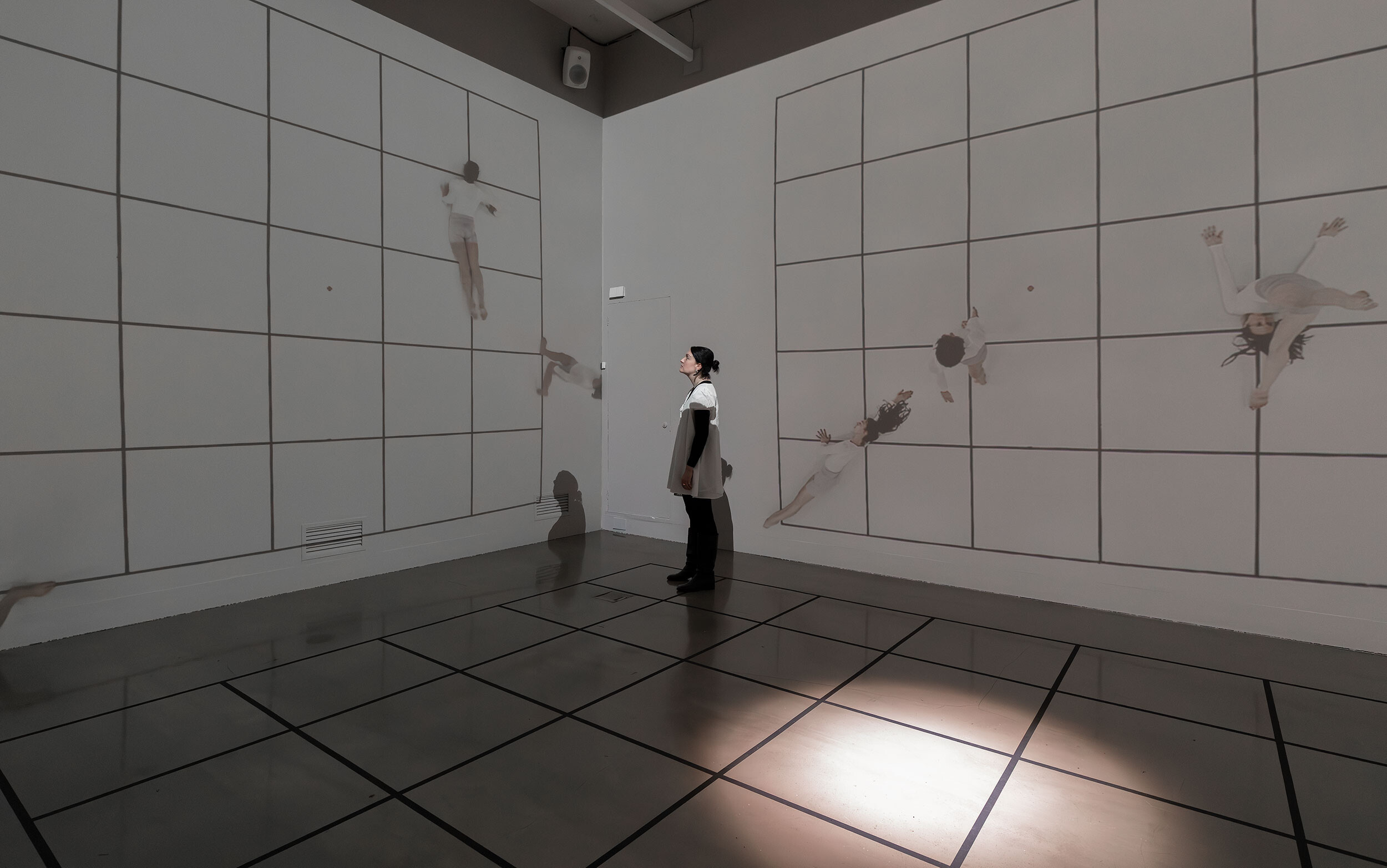
However, as so often happens with viral phenomena, the original balloon performance, which Gleave somewhat hastily conceived on the plane to Berlin as a riff on the German pop banger 99 Luftballons, gives a skewed perspective of her broader artistic practice. Her major solo exhibition at Artspace, Event Horizon, curated by Katie Dyer, is deeper and darker in tone. It is, in her words, a “deconstructed survey show”, which refers to the impossibility of gathering together past artworks that no longer exist, or were too ephemeral, site-specific, or labour intensive to be reproduced. Event Horizon comprises four discrete rooms called “movements”; Gleave also describes them as “atmospheres”. The first is the Reading Room, a low stimulation resting space with a scattering of photocopied chapters from books that have influenced Gleave. The second is the Quantum Zone, an alien landscape lined with glittering, luminous objects, bathed in pink light. The third is the Organic Realm, a dark space with two subwoofers buried in six tonnes of soil and a bronze gong hanging overhead. The fourth is the Entanglement Field, a narrow passage that circles back to the Reading Room. Two electromagnetic transmitters are fixed on both ends. There’s also a performance component called Universal Maintenance, which involves Gleave coming in at various unannounced intervals and tweaking things: resetting sound loops, tending the soil, curating documents, and so on.

Michaela Gleave, Event Horizon, 2026. Installation view, Artspace, Sydney, 2026. Photo: © Hamish McIntosh.
The title, Event Horizon, is a reference to the edge of a black hole, the threshold at which its gravitational pull becomes irresistible. Inside the event horizon, space and time undergo distortions and switch causal roles, so that moving through space becomes moving through time. To fall deeper into a black hole is to travel closer to your future. But does matter just disappear once it enters a black hole? Scientists don’t seem to know. An external observer will never see something cross into a black hole, so what happens to perception? NASA’s much-feted “image” of a black hole, announced in 2019, begs rather than resolves this question. The cosmic is Gleave’s preferred scale and these are the kinds of questions she is interested in. Their foregrounding in the present non-retrospective provokes a re-reading of the earlier balloon performance that punctures its cuteness. The balloons are, from this cosmic perspective, a means of spatialising time. Gleave’s breath is not allowed to dissipate but is rather trapped, sculpted into a visual form. The breath in a balloon from the first ten seconds of the performance jostles against another balloon that holds her breath from the last ten seconds. In other words, each second of the performance is still present in the studio. And when Gleave starts popping the balloons, she is obliterating time as well as space.
You enter Gleave’s exhibition through another exhibition, Singaporean media archaeologist Ming Wong’s Fata Morgana (1) in the Void Space, an angular architectural configuration of bamboo culms set with LED lights and shining LaserDiscs. On the discs, there are projections of 1990s science fiction films and Cantonese opera (Wong’s longer-term goal is to make a Cantonese space opera film). In the smaller Ideas Platform is Pitjantjatjara and Yankunytjatjara artist Desmond Woodforde’s Kinara Tjuta (Many Moons), featuring an assortment of textured silver sculptures (stars, suns, crescent moons) suspended from the ceiling, their shadows cast upon the wall. Unlike the gentle shimmering effect in both Wong and Gleave’s exhibitions, there is an industrial heft to Woodforde’s sculptures, which are cast from aluminium salvaged from abandoned cars in the desert. There is also an audio recording of Woodforde narrating the creation of the cosmos in both English and Pitjantjatjara. So all three exhibitions are looking into outer space from different vantage points—physics (Gleave), science fiction (Wong), and astronomy (Woodforde). Under the new directorship of Victor Wang, these curatorial choices indicate a more conspicuous and strategic anchoring of Australia in the Asia Pacific region. At the same time, there is a familiar cool, clean formalism that is characteristic of how Artspace presents itself as a serious mid-scale institution.

Ming Wong, Fata Morgana (1), 2026. Installation view, Artspace, Sydney, 2026. Photo: © Hamish McIntosh
Coming back to Event Horizon, when I do the first loop, passing through each space and then back to the Reading Room, I can’t help but feel I’ve missed something. So, I sit down and pick up one of Gleave’s readings. I walk through again. And repeat. This is the rhythm of the exhibition, and I don’t mind it. Gleave’s idiosyncratic curriculum of space includes excerpts from Tyson Yunkaporta’s Sand Talk: How Indigenous Thinking Can Change the World (2019), Samantha Harvey’s Orbital (2023), Italo Calvino’s Cosmicomics (1965), Gaston Bachelard’s Water and Dreams (1942), Clarice Lispector’s Agua Viva (1973), Carlo Rovelli’s The Order of Time (2018), and more. There is no real scaffolding or guide, so it’s up to the viewer to pick up and read whatever photocopied text intrigues them or sits within easy reach. This tangling of epistemological structures is quite enjoyable, producing strange and compelling tensions—the weirder the better. There are poetic and lyrical fragments, explorations of aesthetic form, philosophical provocations and then radical crossings between the cosmos and music, science and the spirit world.

Michaela Gleave, Event Horizon, 2026. Installation view, Artspace, Sydney, 2026. Photo: © Hamish McIntosh.
The richness of the texts is counterposed to the sparseness of the spaces to come. I do think Event Horizon rewards solitude. Perhaps this is because each space feels so complete and precise as its own environment—the interruption of another person disrupts the balance. Although I’m told the Quantum Zone is an unstable place. This is Gleave’s interpretation of quantum physics, which studies the behaviour of nature at the level of atoms, electrons, photons, and other subatomic particles. Mirrored silver balls (balloons, again) are placed on a bed of small stones, glitter, and foam. Here I learned about “quantum foam” as the bubbling, pulsing, and rippling of spacetime on a microscopic scale—a constant but undetectable fizz happening in the background at all times. To stand in the middle of the Quantum Zone is to see multiple versions of yourself reflected back. This “hall of mirrors” effect might be Gleave giving shape to the concept of superposition, that is, the idea that it is possible to exist in multiple states at once.
However, step through the threshold into the Organic Realm, and the body shrinks back down to size. I felt the scent of earth enter my nostrils before my eyes adjusted. This room is in complete darkness except for a beam of light shining on a volcanic mound of soil and organic matter. The light makes visible clouds of mist rising up like steam from a geyser. This is the black hole of the exhibition. Gleave makes a reference to selaginella lepidophylla, better known as a “resurrection plant”, which is capable of surviving extreme dehydration for months, curling up into a tight ball. When its dead limbs are exposed to moisture again, the plant softens and unfurls within hours. At this point, I recall an interview I once saw with a theoretical physicist who argued that if there is a place in the universe where new universes are being produced, it will be inside a black hole, where there is an unmatched, gargantuan amount of energy. So, death and rebirth here on Earth or in the stars? Or are both happening at the same time?

Michaela Gleave, Event Horizon, 2026. Installation view, Artspace, Sydney, 2026. Photo: © Hamish McIntosh.
I’d be remiss not to mention the importance of sound to Event Horizon and Gleave’s practice as a whole. The four spaces are labelled “movements”, referring to self-contained sections of a larger composition. Musical performance is indeed often a hidden structuring force in Gleave’s work. She also, for example, has the lungs of a classically trained flautist—not everyone should attempt to blow up a thousand balloons in one sitting! The sound builds throughout the exhibition. In the Reading Room, there is a faint hum of pink noise, a layering of midtones in the Quantum Zone, and then deep, penetrating bass notes in the Organic Realm (frankly, I found it difficult to linger there). To exit this room into the blank corridor of the Entanglement Field is somewhat anti-climactic. The two transmitters are mimicking the Schumann resonances, the natural electromagnetic standing waves forming between the Earth’s surface and the ionosphere at the extremely low fundamental frequency of 7.83 hertz. While often metaphorised as “Earth’s heartbeat”, the Schumann resonances are not sound as such. But they are a kind of rhythmic baseline, an ever-present atmospheric condition within which sound is made to operate. The exhibition’s slightly disquieting evocation of absence—the invisible, the unhearable, the inconceivable—is confirmed for me as I complete my final circuit of the work, and head to the exit. Because it turns out I have missed something in Event Horizon. On the wall, there is a maintenance log. This is a record of Gleave’s Universal Maintenance performances; I see about four entries signed and dated. I look at the last one; it seems I’ve just missed her. Just as in her earlier balloon work, Gleave renders the imperceptibilities of space-time briefly perceptible through the mundanity of a missed encounter with maintenance.

Michaela Gleave, Event Horizon, 2026. Installation view, Artspace, Sydney, 2026. Photo: © Hamish McIntosh.
The questions Gleave explores in her practice are bewilderingly big: what is the nature of reality? How much disorder can the universe accommodate? What it at the end of everything? Indeed, it’s possible to slip off the (sometimes) dazzling surface of her work and become stuck in orbit around a series of big speculative ideas. “Tuning” and “sculpting” are verbs that crop up again and again with Gleave. Unlike the spectacular exertions of her balloon performances (which, to be clear, are not formally part of Event Horizon), her small, iterative acts of maintenance are invisible—like quantum foam or an object passing into a black hole. Nonetheless, it feels like Gleave’s intermittent, unpredictable presence anchors the exhibition, which has a strange emptiness, almost like a theatrical set waiting for actors to appear. The performance, then, and its relationship to the viewer becomes its own atmosphere, one of anticipation or belatedness or both.
Anastasia Murney is a writer, researcher, and educator living on unceded Gadigal land.