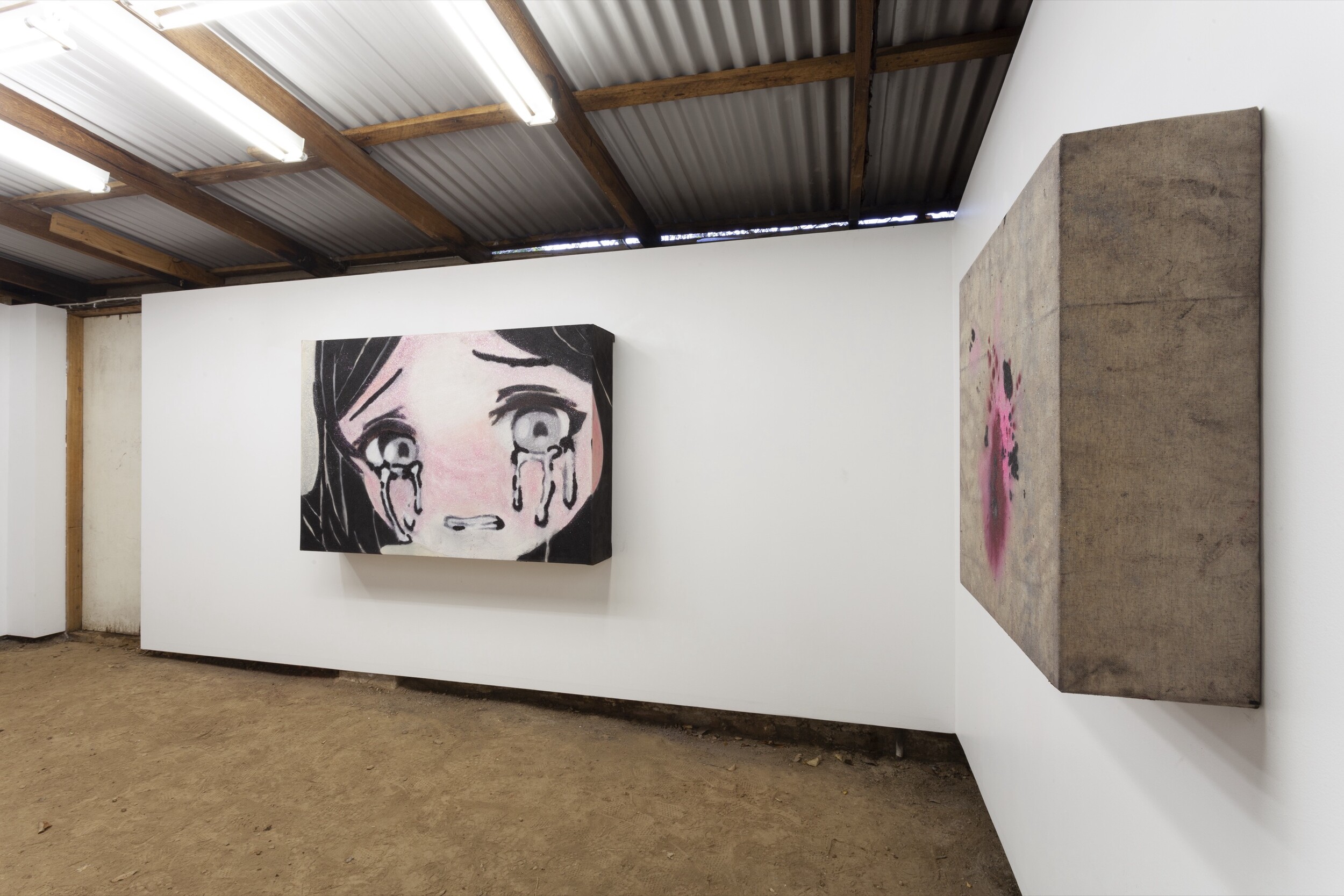
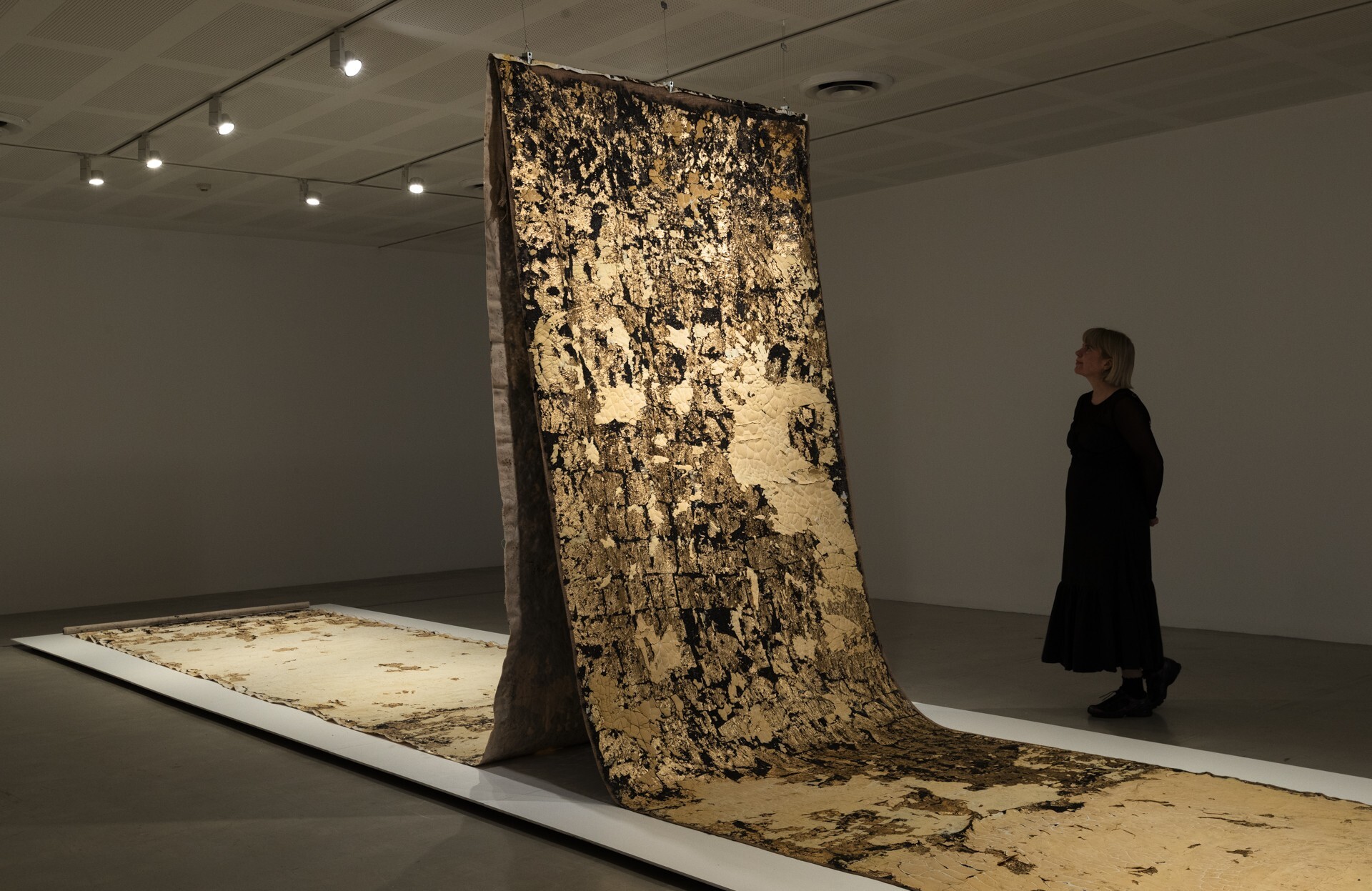
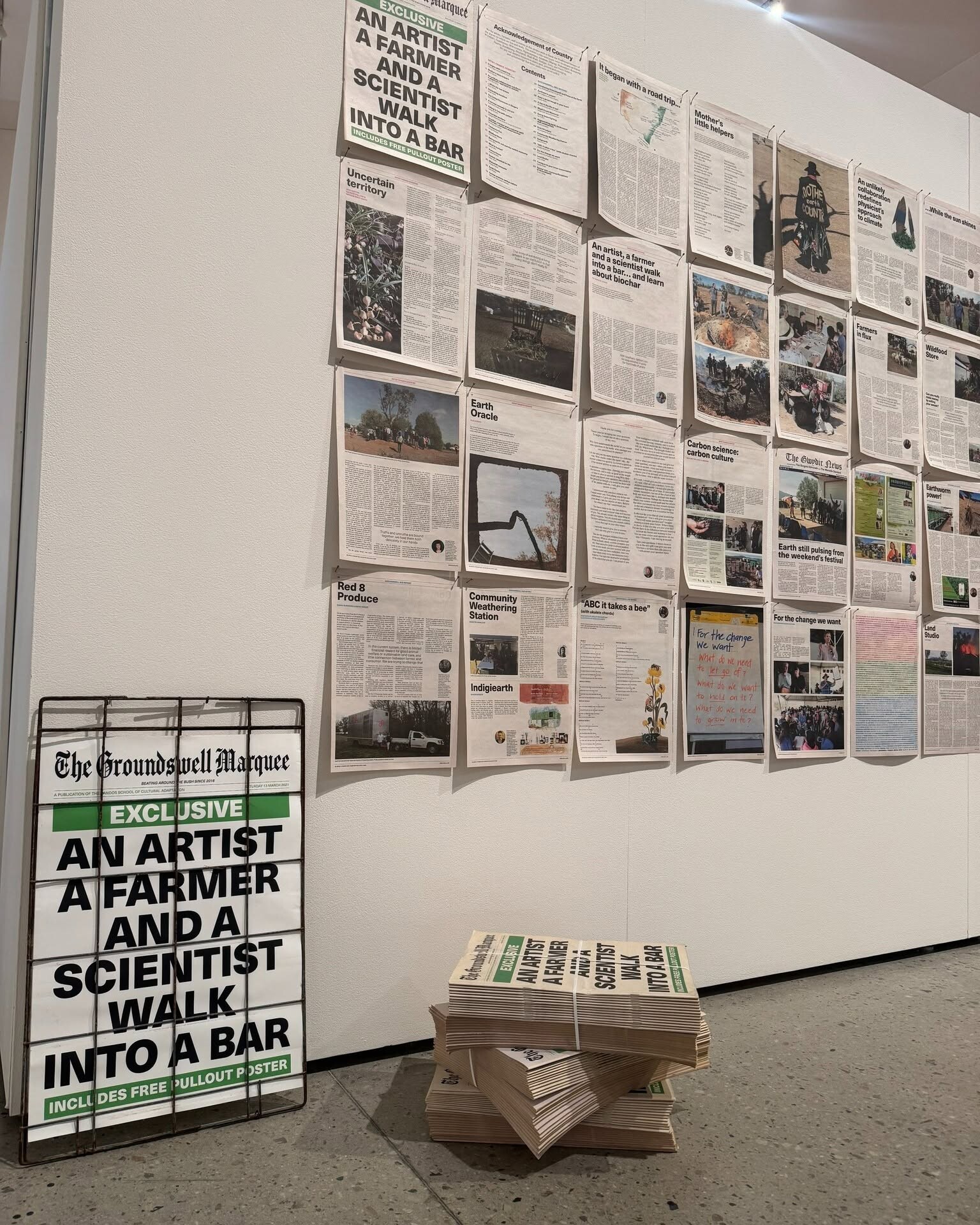
Installation view of The Maze, Walker Street Gallery and Arts Centre, 7 March – 16 May 2026. Image courtesy of the artists and Greater Dandenong City Council. Photograph: Nick Addison.
The Maze; Jon Tjhia and Fayen d’Evie, The Maze: Reimagined, back ↑ notes
by Victoria Perin
I’m thrilled. The curator Miriam La Rosa is describing the panel before me as problematic, but I won’t be convinced. We’re looking at The Maze, a large historical installation comprising thirty panels, and the offending one in front of us is perhaps attempting to represent South America with smiling totem poles and cacti made of crumbling papier-mâché. Culturally confused, perhaps. But you know what else is famously problematic? Teenagers—a cohort of which created The Maze in 1991. This is children’s art. I’m aware of the problems of art-world insiders dipping into the cool waters of community/child/folk/outsider/outlier art to get refreshed and reinvigorated. I know this whole dynamic is a busted trope. But I’m looking at this franken-work of semi-amateur sculpture and painting, and I’m feeling zippy and falling head over heels.

Installation view of The Maze, Walker Street Gallery and Arts Centre, 7 March – 16 May 2026. Image courtesy of the artists and Greater Dandenong City Council. Photograph: Nick Addison.
The Maze is kind of a celebrity within the small cloister of the Greater Dandenong council art collection. It’s big. For over thirty years it has sat in art storage like a whole circus packed into a closet. A massive, profoundly dated monument, council curators can either embrace or spurn The Maze, but they can’t ignore it. Exhibited only once since its debut, La Rosa has opened her arms to this awkward icon, to test whether it can be reinterpreted for 2026. This is lucky for us, because The Maze has a powerful presence that is only getting better with age. As we get further and further away from a time when teenagers can be absorbed into large-scale manual craft, we can look back at the pedagogical ambition of The Maze and marvel at its peculiar success.
Rolling through the maze is like taking a series of short, sharp punches to the cheek. I’m reeling past a panel called ‘Nightmares of hell and horror’, before thwack, it’s time for ‘Animals in the world as it is and as we wish it to be’. Boom, now it’s a forest of ‘Tree-people struggling to free themselves of pain’. All the genres of popular painting unfold across the work: flower painting, cool D&D style dragon art, horny fairy portraits, jungle tigers and woodland creatures from the walls of a child’s bedroom, murals of Chinese motifs that you might find behind the till at your favourite restaurant. And this is before we even mention the ingenuity in the huge array of character sculptures, like cavorting medieval gargoyles, swamping each scene. The most batshit panel features an arctic futurism, with a distant ice-city and mechanical polar bears, a cyber monkey, and frozen trees crawling with computer-chips. I’m hopelessly trying to capture details on my phone: yes, thank you, another please, great.

Details of of The Maze, 1991, Walker Street Gallery and Arts Centre, 7 March – 16 May 2026. Image courtesy of the artists and Greater Dandenong City Council. Photograph: the author.
The origin story is deceptively simple, helpfully illustrated with dozens of archival photographs. In 1991, artist Suesy Circosta facilitated the project, inviting over a hundred young people aged between fifteen and nineteen to help make The Maze. The teenagers were drawn from regional, migrant, and refugee communities in Tallangatta, Warragul, and Warrnambool. Circosta’s goal for the project was, broadly, “conflict resolution”—a theme that came to her after she saw some migrant friends being hassled by police. But looking at the work, the idea of conflict resolution is swallowed by all of Circosta’s other noble ideas, which are imparted through inspirational quotes, lengthy introduction texts, and the array of concepts about life and love that spiral from one panel to the next. I think I saw a quote about journeys by Ursula Le Guin reproduced four separate times during my visit, and Circosta was certainly on one.
Given the variety of painting formulas (set-like backdrops, vignettes, wall-paper pattens, and foreshortened landscapes), and taking into account how many different teenagers worked on The Maze, it’s impressive how stylistically unified the installation is. I’m puzzled at how consistent the papier-mâché creatures are, before I see an image of technician Leon Manuel knocking out a bunch of moulds—the reproduction process surely helped to harmonise the piece. Suesy Circosta had a vision. I think of Vivienne Binns’s community art project Mother’s Memories, Others Memories, from a decade before The Maze. In a similar structure, Binns set up workshops in Blacktown, Sydney, where participants could turn family photographs into glossy, candy-coloured metal “postcards” via the novel technique of enamel firing. In both projects, the limits of a particular medium yoked the participants, and the character of a single artist was set in motion among a hundred others.

The Maze, 1991, archival documentation. Image courtesy of Greater Dandenong City Council.
Binns was a keen observer of her own ego in these spaces: “I felt myself linked, sometimes uncomfortably, (to) the work of the lay or semi professional people I collaborated with,” she recalled in the early 1990s. “Despite my desire to play down the role of the artist with unique and superior skills and perceptions … I was discomforted if taken for granted or not recognised as an artist” (my emphasis). More than a novel experience, or a bit of community activism, Binns allowed the experience to change her practice, after being “flung … face to face with a mass of contradictions and tensions which greatly tested the rationales of what I was doing.”
The theory and history of community art in Australia is well attended to in this exhibition, which after all is not just a restaging of the maze panels, but a clever reactivation by two contemporary artists Fayen d’Evie and Jon Tjhia. The Maze: Reimagined, back ↑ notes expands on The Maze with an audio-visual display that sweetly holds the installation. D’Evie and Tjhia are experienced artists and broadcasters who focus on disability-led projects, and their contextualisation quickly shapes how we access The Maze, helping to break down the sly prejudice that might arise on first contact. Their most successful intervention is the presentation of oral history collected from the former teenagers who made the work, alongside a new set of remarks solicited from today’s gen-Z highschoolers, who were asked to give their opinions on The Maze. Answers from both groups appear as a “song” that permeates the space, as well as text on LED panels. Spend more than ten minutes with The Maze and you will hear and see a loop of the collected annotations scroll past. Children, meet contemporary research art strategies.

Jon Tjhia and Fayen d’Evie: The Maze Reimagined, back ↑ notes, Walker Street Gallery and Arts Centre, 7 March – 16 May 2026. Image courtesy of the artists and Greater Dandenong City Council. Photograph: Nick Addison.
The memories of the original artists are fun, enlivening some documentary photographs. (“He was a really cool guy. Yeah, I loved him,” says one artist about Leon Manuel, who does indeed look like a really cool guy.) But the contemporary children deliver a charming kind of banal crit that only teens are capable of (“these are colours that I wouldn’t normally see on fish”). I’m reminded about how you’re not supposed to get too invested in an artist’s juvenilia. For any professional artist, juvenilia is supposed to be interesting but importantly insignificant. We need the brain to develop before the oeuvre begins proper. But d’Evie and Tjhia suggest that these observations stand as their own style of thought, a valid mode of proto-criticism. As the same statements loop around The Maze, I settle a little in my prejudices: it’s true—these are colours that I wouldn’t normally see on fish.
The best thing about d’Evie and Tjhia’s addition to the installation is that they know they are being out aura-ed by The Maze itself, and they clearly do not mind. Their interventions are respectfully, even tenderly, obsessed with the original artists and their memories. I’m charmed by a guard of boomboxes stationed around The Maze, like funky sentinels. And I note a sentimental story about another technician, Tae Amiatu, gifting some of the teens a ghetto blaster and watching them ride away on their bikes with tears in their eyes. The anecdotes, remarks and annotations that d’Evie and Tjhia pull out feel intentionally low-key, as do the other collages and video art they use as supportive work. This can be contrasted with Circosta’s own vivaciousness; one of the introduction panels enthusing: “WE MARVELLED AT THE BEAUTY THAT BLOSSOMED UNDER OUR BRUSHSTROKES AND EXPERIENCED SHEER JOY ON ITS COMPLETION. THE REALISATION OF SEEING SOMETHING SO BEAUTIFUL EMERGE FROM RECYCLED NEWSPAPER WAS OUR MOST POTENT LEARNING EXPERIENCE.” It’s a great mix: the now-standard aesthetic dourness of the contemporary, cut with the impulsive exuberance of this past.

Detail of The Maze, 1991, Walker Street Gallery and Arts Centre, 7 March – 16 May 2026. Image courtesy of the artists and Greater Dandenong City Council. Photograph: the author.
The artwork that The Maze most recalls is that other local icon, The Fairy Tree in Fitzroy Gardens, carved in 1934 by sculptor Olga Cohn for the local children. I see that carved tree and think, why don’t all parks have one? Yes, thank you, another please, great. It’s something you get to like before your critical faculties kick in. Art for the brain in your guts. But the problem with fetishising this type of work is almost an exact echo of why it’s so pleasing. The Maze doesn’t invite my criticism, my art- historical knowhow, my curatorial comment—it’s inviting me to feel “SHEER JOY.” And, for that, Suesy Circosta and her teens may have a genuinely distinct claim on the knowledge of art. As Binns, the art insider, wrote of her activity with community art, “I feel I have gathered a mass of information about cultural production through art forms which I’m only partially able to process at a theoretical level.”
After La Rosa gave me a rousing introduction to The Maze (and then an astonishingly successful, boosterism tour of Dandenong itself), I thought a lot of thoughts about the work. Stuff like “wait, how do you actually mould papier-mâché?”, “I wonder if my friends, the artist (redacted 1) or the critic (redacted 2), would like or hate this,” “why is sincerity (“SHEER JOY”) a taboo emotion in contemporary art?”, “is ‘batshit’ a dismissive description? Or is it just right?”, and “I wonder if my son (14), will ever make art again?” Just a little proto-criticism before the main event. I resolved to write this review to make it up to the hundred regional and migrant teenagers of The Maze, for my sins of being an art historian who is trying to theorise something she is only partially able to process at a theoretical level. Already feeling absolved, I left the Walker Street Gallery and Arts Centre and bought a selection of sweets from the Sajad Bakery, a Pakistan/Afghanistan/Indian/Iranian spot nearby, and ate them instead of lunch. What a great day.
Victoria Perin is an art historian and critic living in Naarm / Melbourne.