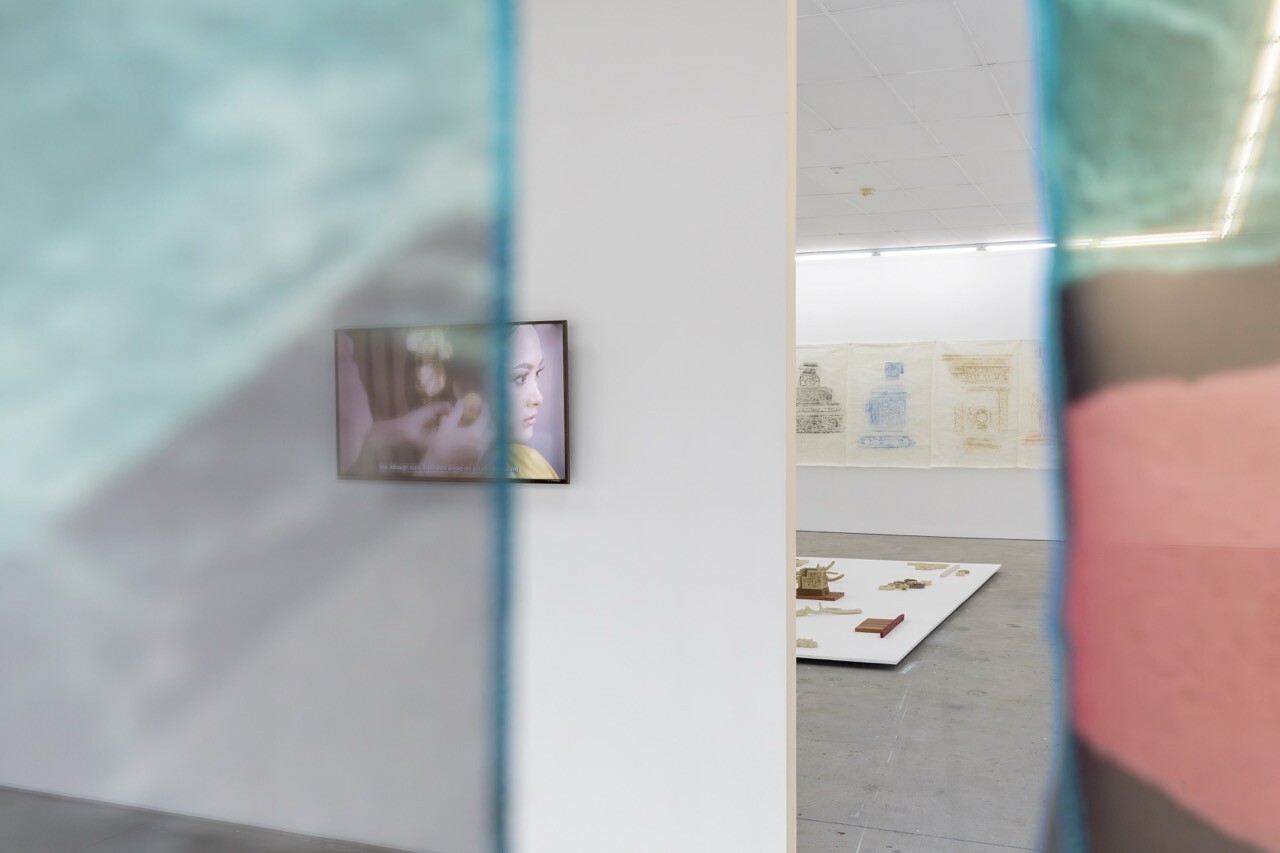
Installation view of Ngarn Wa’ngal: Art of the gum tree, Potter Museum of Art, the University of Melbourne, 2026. Photography by Christian Capurro.
Ngarn Wa’ngal: Art of the gum tree
by Jarrod Zlatic
When thinking about gum trees in Australian art, neither John Brack nor his iconic painting The Car (1955) would usually come to mind. Brack is instead best known as the painter of a profoundly treeless suburbia. Yet The Car is included in the sprawling exhibition Ngarn Wa’ngal: Art of the gum tree, currently at the Potter Museum and curated by Alisa Bunbury and Sophie Gerhard. Peering past the sightseeing family, out through the car windows, one can see gum trees. They are simple green monochrome silhouettes against a wispy sky. The blank trees and sickly pink sky amplify the queasiness typical of Brack’s work as seen in the awkward, almost painful, geometry he inflicts on his subjects in pursuit of ironical comment. The gum trees themselves were a later addition, the original sketch for The Car having an urban setting, with the outlines of roofs and a single tree. It is impossible to tell what type of tree it is, but its bare limbs suggest a deciduous species. Brack opted for a blank, nondescript rural scene to emphasise the car’s inhabitants and riff on the suburban endeavour of the regional day trip. The gums in The Car are a stand-in for the totality of the countryside, a shorthand for the nature itself that has predominated within the pictorial conventions of Australian art.
Brack’s painting is accompanied by Alyawarr artist Marylin Brown Petyarr’s cartoon-like painting on a car door, Car, art and the landscape (1990), and directly across from there is Marrakulu artist Wukun Waṉambi’s Three rocks (2015). These are coffin-esque larrakitji made from stringybark, some ornately decorated with overlapping white circles, others stark and unadorned. The combination prompted ominous thoughts of car crashes, conjuring an image of The Car wrapped around a roadside gum.
Although larrakitj are funerary monuments, it is hard not to think of them as having a double function here as also memorials to the impacts of colonisation. Among the myriad metaphors one might conjure for the “fatal impact” of colonisation, the scene of a rural car crash is apt. Even Brack’s chosen vehicle in The Car is, somewhat appropriately, a Triumph Mayflower, named after the first ship of Pilgrims (colonisers) to arrive in America. These three works stage a collision between the industrial velocity of the car and the gum tree’s seeming immobility, both temporal and physical. Fragments of this crash are scattered throughout Ngarn Wa’ngal, quite literally. There are re-purposed and re-painted road signs, including Western Aranda artist Mervyn Rubuntja’s No more give away (2024), and Luritja artist Selma Nunay Coulthard Luritja Pmara Nurnaka’s Our Home (2024). In the opening room of the show is Marrakulu artist Gaypalani Waṉambi’s Ḏawurr (2022), a highly ornate engraving of the gaḏayka (stringybark), surrounded around by leaves. The work’s support is the reverse of a found road sign, polished so that it reads no longer as stainless steel but a dazzling silver.

John Brack, The Car, 1955. oil on canvas, 41.0 × 102.2 cm, National Gallery of Victoria, Melbourne.
The kind of free association I experienced while looking at The Car is encouraged in Ngarn Wa’ngal, as the range of material and themes covered under the rubric of gum is broad. There are many riffs on Indigenous belonging, ecology, nature conservation, leisure, and colonial violence among others. The comprehensiveness extends to its treatment of the gum itself, focusing not only on the most recognisable aspect of the tree—trunks and leaves—but also on the gum blossom. The fine, decorative, folk, and scientific arts are equally represented. This breadth is one of the exhibition’s strengths, especially in its selection of nineteenth-century paintings. The exhibition comprehensively demonstrates that the gum was as captivating to jewellers, potters, photographers, and cabinetmakers as it was to painters.
Yet it remains painters—specifically landscape painters—who elevated the gum into a national icon. If landscapes typically include trees, it is unsurprising that in a painting such as Brack’s they are gums by default. The ubiquity of the gum across the continent means that the “tree” is virtually synonymous with “gum” in Australia’s visual vernacular. This ubiquity is one of the central premises underpinning Ngarn Wa’ngal. The gum is an unavoidable source for both Indigenous and settler-colonial art. You might even say that all Australian art is the gum tree, whether by directly embracing the gum or in consciously avoiding it.
But the exhibition prompted a question: does a gum tree make a gum tree painting? For example, does Arthur Boyd’s stale Irrigation lake, Wimmera 1950 really belong here? Gum trees are incidental within the overall scene of Wimmera wheatfields. What purpose do they serve? It does mark one endpoint, aesthetically and chronologically, at which the gum tree-focussed landscape tradition began to fall out of fashion (although Boyd would later find his greatest success as a painter of gums). The curators seem to have intended it to illustrate the gum tree’s ubiquity across different types of Australian terrain—it hangs beside Vincent Namatjira’s striking King Dingo (salute) (2024), an even more arid scene further in the interior—taking us from the green hinterlands through to the edges of the red desert. Yet here the Boyd feels like dead wood.
The same question could be asked of Fred Williams’s Red cliff landscape (1981), a somewhat formulaic late work. The trees are incidental within the composition, mere accessories. Williams is certainly a significant figure in relation to gums in postwar Australian art, but chiefly through their demotion. His development of a semi-abstracted style began with a series of paintings and etchings of eucalypt saplings, his Sherbrooke Forest series from the early 1960s. From these studies of massed tree trunks, the gum became increasingly abbreviated within Williams’s art, appearing only as blotchy, scumbled streaks and blobs that provided texture within compositions dominated by horizontality and geological mass.

Jessie Traill, Beautiful victims, 1914, etching on Oriental paper on cardboard, 70.1 x 53cm, Queensland Art Gallery | Gallery of Modern Art.
Perhaps it is impossible to paint a landscape anywhere in Australia without painting a gum tree. But is it? There had been rumblings against the gum soon after Federation, but by the late 1940s there was outright discontent with the dominance of the gum—and not only among modernists. Gums had become “unfashionable.” Artists, as one newspaper critic joked in 1947, might “paint landscapes, Australian landscapes, if you must… but not landscapes with gum trees.” The critic noted this “noticeable tendency to shear off native trees when painting landscapes,” with artists restricting “their landscapes to city and suburban scenes, in which only trees of imported varieties are to be seen, and to strips of countryside from which all, or nearly all, native timber had been cleared.” This metaphorical clearance contrasts with a thread throughout the exhibition, in which the landscape tradition harboured an emergent ecological consciousness in opposition to literal land clearance. But this equation between landscape and the veneration of the gum was actively denied by subsequent generations of artists, either by seeking out new subjects or rejecting any notion of a national painting altogether.
It is tempting to see the exhibition as one sign that we are coming to the end to this cultural cringe around the gum tree. Yet a notable absence from such a comprehensive exhibition is any discussion in the wall texts or labels of what was derogatorily known as the “Gum Tree School,” otherwise known as “Australian School” painting (again, the gum is “Australian art”). While there are works by Arthur Streeton, Albert Namatjira, Rex Battarbee, Hans Heysen, and so on, the dominance of the gum tree tradition seems to be taken as a given. Yet the gum’s hold on the national imaginary was owed not only to the work of these well-known artists, but also to their legions of followers and imitators. Anyone who has spent any time looking through second-hand paintings in op-shops or local auctions can attest to this. Indeed, this genre of gum tree painting excels at bridging the fine and decorative arts that is undertaken throughout the selections in the show.
The roots of this Gum Tree School run deep, twisting through amateurs as well as artists beyond those we would normally identify with gum tree painting. Take the twisting Escher-like limbs of Yorta Yorta artist Lin Onus’s misty Floodwater ‘Woorong Nucko’ (1995), which hangs in the final section of the exhibition “Regeneration.” It seems pertinent that Onus was mentored by and exhibited with Indigenous gum tree painter Ronald Bull, who was mentored himself and supported by both Hans Heysen and Ernest Buckmaster, yet is unmentioned here.

Installation view of Ngarn Wa’ngal: Art of the gum tree, Potter Museum of Art, the University of Melbourne, 2026. Featuring Matthew Harris, With a Warm Embrace, 2023. Wangaratta Art Gallery Collection, Victoria. Donated through the Australian Government’s Cultural Gifts Program by the artist. Photography by Christian Capurro.
Focusing on these small examples in an all-encompassing exhibition might read as nitpicking, but it is at these edges that Ngarn Wa’ngal’s sense of ubiquity is pushed towards being almost meaningless. There is a literalness about the gum which restricts the show. Every work is of gums; and, as far as I can recall, Matthew Harris’s With A Warm Embrace (2022-2023), a group of soft-sculpture koalas, is the only one where the gum is implied rather than shown.
The limits of this literalness are most apparent in the contemporary works, which unfortunately tend towards the bland. Trawlwoolway artist Julie Gough’s Witness (2021) are elegant constructions: a cluster of portrait-oriented screens, each attached to a chrome pole running from floor to the ceiling. Each screen mixes HD nature footage of sites where Indigenous massacres occurred in Tasmania with newspaper reports and extracts from period diaries set in a Clarendon/Baskerville-like font. Their mood is understandably sombre. Yet watching (or glancing) at this ambient didacticism this felt like standing before video advertising screens: a glimpse into the future of airport art welcoming tourists to Tullamarine.
The transit-lounge ambience also greets you when entering with the pair of commissioned works from megan evans. The video work Remanence of fading gum leaves, which unfolds across the three-storey video screen that runs down the stairwell at the Potter Museum, looks more like corporate lobby art than the result of a Miegunyah Creative Fellowship commission. Evan’s adjacent wall work Gust fares better—hundreds (thousands?) of individual gum leaves pinned to the wall to form the image of a gust of wind. Yet this painstaking work with such delicate materials results in something that you might find on Shutterstock, albeit sans-watermark.

Henry Gritten, Merri Creek near Dights Falls, c. 1863, oil on canvas, The University of Melbourne Art Collection. Purchased through the Russell and Mab Grimwade Miegunyah Fund, 2023.
Although there are many strong individual artworks, an admirable number of hefty and impressive loans, and consistent cross-cultural juxtapositions, there is ultimately no robust art-historical argument beyond reaffirming the primacy of the gum. Instead, the show largely reflects the current institutional consensus on Australian history—which is to say, its works are instrumentalised in the service of history rather than art history. There is nothing really to object to in this as general history; it is all fairly textbook by now.
This approach has increasingly become the new curatorial norm, and can be highly generative, as with the NGV’s 2018 exhibition Colony Australia 1770–1861. Yet walking through the show, one yearns for some art-historical arguments between works. Take Hal Missingham’s photo Graffiti and scribble gum (1971), which sits in-between William Ford’s At the Hanging Rock (1875) and Henry Gritten’s The Merri Creek near Dights Falls (c. 1863). It is a pointed comment on the colonial violence hidden behind these gentle scenes, but has little more to say about the works themselves.
Argumentation and art-historical elaboration do occur, but away from the show: they are outsourced to the contributors to the accompanying catalogue—an omnibus of critical opinion. In the exhibition itself, however, the visitor receives gentle instructions and suggestions. By the time I reached the final room, with the wall text cloyingly suggesting that “the works here ask us to pause, to breathe, and to consider our role in ensuring their survival,” I felt as though I were being suffocated beneath a yoga mat. With such vaporous messaging, it is appropriate that the most impactful work here is not an artwork per se but a component of the overall exhibition design. Entering and exiting the gallery one is greeted by the wafting, forceful scent of eucalypts. I had presumed it was provided by one of the show’s sponsors, Bosisto’s, a manufacturer of eucalypt oils and cleaning products, a small wall label crediting Erin Adams of Smell Art. The almost bracing, yet deeply relaxing aroma of lemon-scented gum (Corymbia citriodora) fills my nostrils. I breathe, I pause, I think; the gum tree itself will always stump any of its depictions.
Jarrod Zlatic is a critic and musician from Melbourne.