Mahesh of Chamba, India active c1730–75, Varāha avatar, c1750–75, folio from a Dashāvatara series, opaque watercolour on paper, 16.3 × 24.1 cm, Museum Rietberg, Zurich, purchased with funds from Balthasar and Nanni Reinhart
Avatar: Forms of Vishnu
by Simryn Gill
A few weeks ago, a visitor from overseas who had an afternoon free asked for a tip on what he should see before he left the city. I suggested the exhibition at the Art Gallery of New South Wales called Avatar. Before I could elaborate, beyond the title of the show, he looked at me and pulled a face—a non-verbal why would I go to see anything like that? We all know Avatar as an outrageously successful film franchise about blue-skinned creatures who live between a moon and a dying earth. “No,” I said to my visitor’s facial expression, “it’s an exhibition on the Hindu god, Vishnu”. I could have said: “It’s not religious,” and clarified that “Avatar is an Indian word meaning previous versions, or returns, and Vishnu’s avatars Ram and Krishna are often painted with blue skin”. But I said neither of those things. I didn’t think he’d go to see the show, and there was no point muddying the waters with any more explaining.
After that exchange, I wanted to see for myself this exhibition that has obstinately held onto the Indian usage of a word that has been hijacked, kidnapped, or rustled (if you want to compare it to a bolting horse from a stable). Imagine the job of the publicity team at the Gallery, working to rise above the word’s embeddedness in a favourite franchise for school holiday special attractions and new gaming releases, a clogging visual saturation. Then again, you could say that the film’s lead (I’ve not seen it, I’m assuming there is some kind of hero) is another avatar of the god Vishnu, a new story line following the general vibe of Vishnu as the god who can do and be anything. This would mean that the film too is accommodatable into Vishnu’s logic of returns, and that maybe somewhere the move to absorb those wispy blue copy-cat alien creatures into the system of the pantheon is already well underway. The jump from film to godhood has happened before.
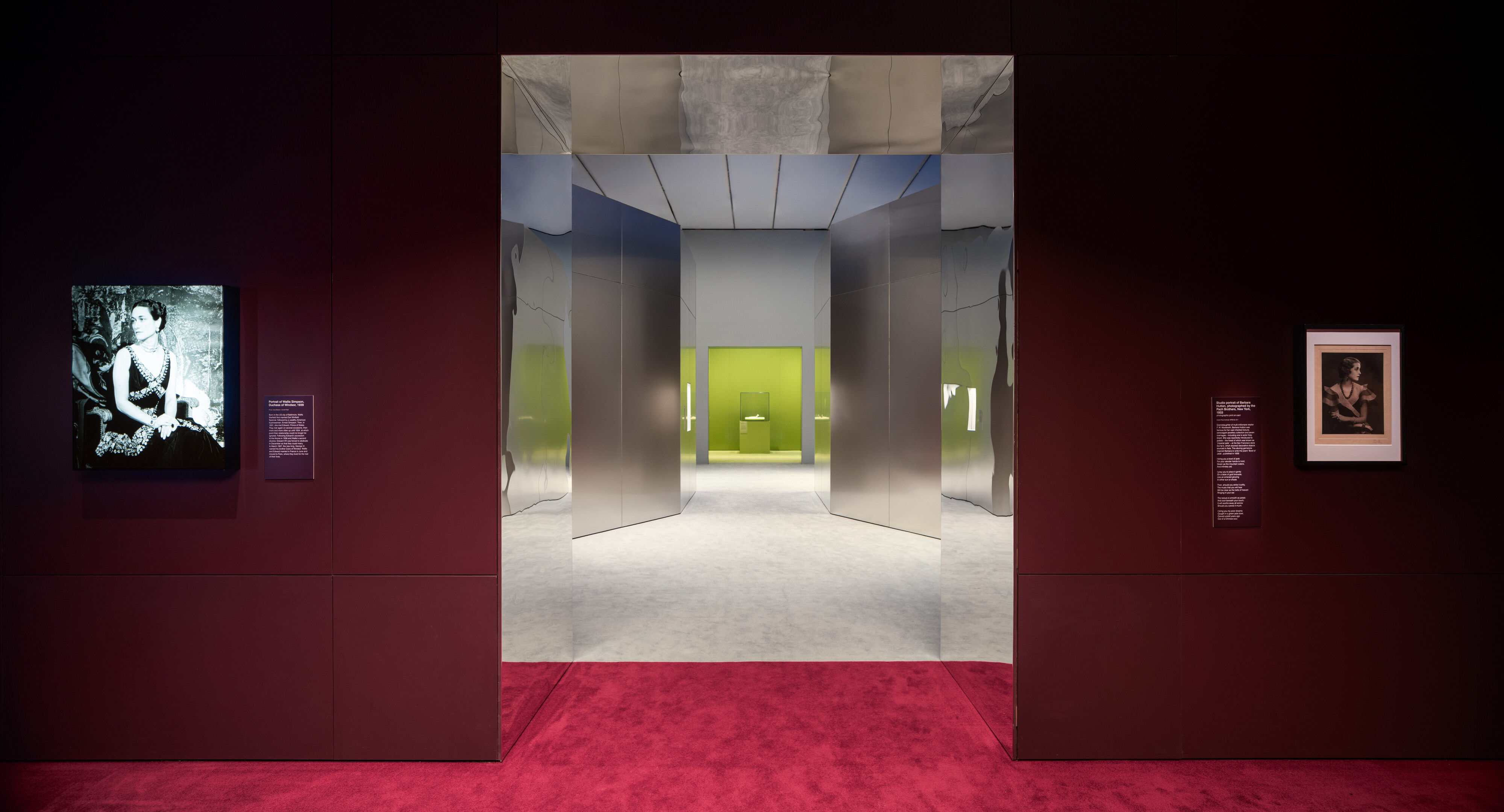
Avatar: forms of Vishnu is an exhibition of beautiful things. An exhibition of becoming fish, becoming boar, becoming conch, becoming tortoise, becoming virtuous king, becoming lion, becoming irresistible lover, becoming hero personhoods—avatars—of the god Vishnu. We see him in miniature paintings in the courtly style from the eighteenth century, alongside the mysterious doe-eyed Bengali Kalighat Style of the nineteenth century, and the European-influenced, machine-coloured, and mass-produced lithographic religious posters of the early twentieth century—large, self-conscious contemporary art interpretations from very recent times. There are old and new works on paper, on silk, cotton, canvas, cut from leather, printed by inkjet, painted on glass, embroidered with gold thread, drawn and annotated with Chinese ink on English paper. So riveting were the small eighteenth and nineteenth century paintings in gouache and pigments (of multiheaded snakes, fish reaching out of water holding gods in their open mouths, tusked boars holding slabs of the earth aloft, and tusked sea creatures tugging boats full of gods and pilgrims) that my friend who was with me, who I don’t peg as a miniature painter, or a painter of any sort, poked me to ask how they were done. “Is the background painted first and then the action painted on top of that, or are spaces left to be filled in later?” What else is that but enchantment to feel such an unlikely urge upon seeing paintings?
Alongside paintings and prints spread across the five to six rooms are the sculptural works. The standouts: sandstone sculptures from the National Museum of Cambodia, a serene full-sized ninth century Vishnu as himself, holding in his fours hands a conch, a discus, a staff, and in a Khmer variation to the subcontinental lotus, a lump of earth; the horse avatar Hagiya standing patient and reliable; a heart-stopping sixth century Krishna stretching upwards to hold a mountain aloft. The loans from Cambodia alone are worth visiting.

Cambodia, Takeo, Angkor Borei, Wat Koh, Pre-Angkor period (c100–800), Phnom Da style Krishna Govardhana late 500s, sandstone, 161 × 65.5 × 35.2 cm excl tenon, National Museum of Cambodia, Phnom Penh
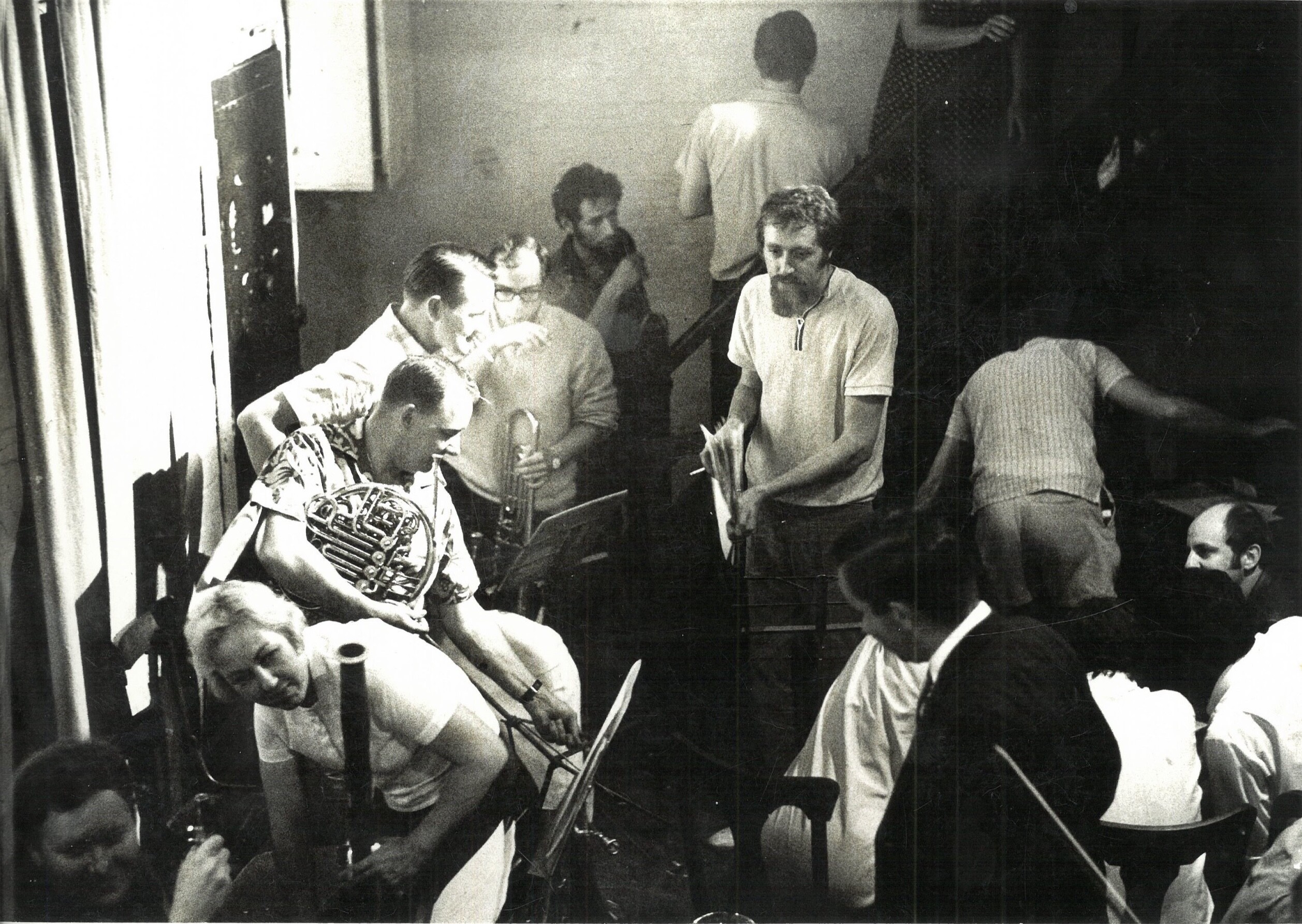
The sum of all the parts I’ve just described and many more make up the exhibition, and it’s the exhibition I want to think about. Wonderful as the objects and paintings may be in themselves, I cannot seem to find a centre to the whole. What holds this selection of works together in their variety across material, time, and geography? What I find in the spread of rooms is too much, and not enough. Too much range and heterogeneity, too many shifts and moves. It took me a while to figure out. The only way I can understand this too-muchness in the show is that the exhibition has been built around the works on Vishnu that are already in Australian museum collections. Those holdings would be one or two of this and a few of that: more range and variety than depth of collecting. Walking around the rooms, you start to see a pattern: the borrowed works from overseas would seem to be selected to support and surround the works from museums here. The display felt to me almost like an act of giving some brief companionship to these sometimes-lonely pieces here. The loans from around the world brought their company from Bengaluru, Delhi, London, Mumbai, New York, Oxford, Phnom Penh, Zurich (among others). If you understand the exhibition as being locally seeded, the spread of works across forms, imagery, processes, history, place, makes sense.
I wish that the story of what is in Australian collections—how they underpin the show, how these things came to be here—was openly told. That Australia is a settler colony, a long-suffering outlier from the parent-land, and presents as anxious and needy in matters of culture—all of this we know well. Australian museums never having been in that envied (still?) position of a dominant imperial plunderer, many things have arrived into their collections in secondary, sometimes random, piecemeal ways. If you look carefully, you will see some of that narrative submerged in the captions. Many of the historical works were given as gifts or left as bequests. Maybe from colonial officers retiring in the antipodes, or well healed tourist-collectors, or by scholars of the subcontinent. Of course, there are purchases made by institutions to add to what’s there or following the tastes of individual curators and directors. But these are still piecemeal. By bringing to the fore how the show was made, there could have been life breathed into the relationships within the display, and a relationship with a viewing public: How to look at the all the variety? As I was leaving, I spoke to two visitors to the exhibition, a couple from South India and now living in Sydney, who were also just exiting. I asked how they found the show. “So many things!” one of them said, looking a bit bemused. “Even Bali paintings” her companion added. They seemed perplexed.
We need to be able to talk about how we do things and why—I guess in this specific instance I’m talking about collecting. How things and systems arrive at where they are. Leaving a process unnamed or coyly enveloped in a bluster, almost like hiding shame, gives power to the wrong instincts. Here I saw it as a tendency to Orientalize, to gatekeep what can be said and how—border minding, you might call it. There are a lot of politics already embedded in these old forms, before you even start thinking about how they got here. They are even now not fixed entities. As I walk around the show I think of some of these layers. I remember the historian D.D. Kosambi’s aside on the Bhagavad Gita, Krishna’s long lecture to Arjuna on the duties of a good warrior. Kosambi believed that the book was constructed early in the seventh century, citing Hsiuen Chuang, a Chinese monk in India at the time who wrote of “a Brahmin having forged at his king’s order such a text (supposedly of antiquity), which was then ‘discovered’, in order to foment war”. In our times it’s hard not to think about the violent destruction in 1992 of a mosque in the city of Ayodhya, built by the Mogul emperor Babur, pulled down by mobs claiming it stood on the avatar Ram’s birthplace. I see a painting by an unnamed artist, of the Krishna avatar in a me-too moment, spying on young women, gopis, bathing in a river; in other paintings he lures them all to him in the night, pied-piper style. I spot Sita in beautiful bronze and am reminded that her husband Ram made her prove her virtue because she had slept in another man’s house when she was kidnapped by him. Perhaps most striking for me was the small eighteenth century painting by Manesh of Chamba, of the Buddha avatar. It struck me as a classic Brahmanical move to quell something new and radical (in its time) by absorbing it into the existing hierarchies (in our time capitalism understands this well). In an echoing gesture, in a vitrine built into a wall are a line of nine eighteenth century avatars of Vishnu and, dropped in this line, a bronze of the Buddha, which is not described as an avatar on the caption, simply as Buddha. I look at that line of figures and wonder why the Buddha is inserted in the row: Was it a decision of the curator, or of the lending museum who owns all these bronzes? Who made the executive decision to contextualise the Buddha in this row as an avatar?
As the world swirls and sinks around us, we see similar logics, if we can call it that, with the fixing (here and elsewhere) of organising categories for people on the move: expats and emigres and exiles, migrants and refugees, adventurers, travelers, explorers, settlers. Another kind of caption. I think again about the clod of earth in the hand of the Cambodian Vishnu (instead of the usual lotus flower)—a kind of defiant claiming gesture, I want to call it. Was the earth in his hand saying “this is mine” or “I’m from here”? We need to see, and hear, to know our material cultures, the things around us, as fully functioning entities in our time, not some inert artefacts to be controlled by scholars and bureaucrats, separated from the affairs of the world.
So maybe the film Avatar is closer to the spirit of Vishnu than we know. Or is it the other way around? The mutations of the film script have already jumped the fence and taken on some other logics as mascots to all manner of public attractions, and entities in games. Sure, all this shapeshifting is driven by capitalism and tearaway commercialisation, but what’s new?
Simryn Gill is a Sydney based artist. With Tom Melick she runs Stolon Press, a publisher of small run books and pamphlets.