Installation view of Studios Exhibition at Hayden’s Melbourne. Courtesy of Hayden’s, Melbourne
Black.2; Family Values; Studio Exhibition
by Amelia Winata
When the Titanic sank in 1912, a ship named the Carpathia came to the rescue of the many survivors stranded in lifeboats. Accounts of the mission always detail the treacherous journey taken by this hero vessel, which had to weave its way through countless icebergs with absolute caution lest they meet the same fate as the more cavalier Titanic. In late 2025, the average Melbourne gallery goer might feel a bit like the Carpathia, navigating haphazardly to dodge the icebergs that—bear with me here—are the glut of end of year group exhibitions bobbing around Melbourne’s commercial spaces. Perusing the list on Charles Lai’s famous openings calendar, I’m overwhelmed by the sheer quantity. Certainly, there is an element of pathos attached to the group show. But can we rewire our brains to see these exhibitions as more than “Christmas stocking filler shows,” as one jaded Melbourne artist described them to me? In a bid to break free of my own biases, this weekend past I visited the galleries Void_, FUTURES, and Hayden’s, where each space has a group show based around the work of stable artists or studio artists.
I begin on Saturday afternoon climbing the narrow stairwell to Void_, a small commercial gallery on Bourke Street housed in the 1929 Godfrey and Spowers-designed former Bank of New South Wales. The building is deco chic, complete with Egyptian style capitals and palm tree engravings as was the Poirot-style of the day. It’s hard to comprehend how this sparsely populated, opulent structure exists in one of the busiest commercial parts of the Melbourne CBD. How exactly the gallery remains financially afloat in this location is also anyone’s guess. But the motivation for the show’s theme and title—Black.2—is obvious when one is greeted by director Paul Handley, who is decked out in black and sports a head of black hair. As its title suggests, this is Handley’s second black-themed show, with the first one taking place in 2023.

Installation view of Black.2 at Void_Melbourne. Left to right: Paul Handley, David McBurney, Nick Devlin. Courtesy of the artists & Void_Melbourne. Photo: Andrew Curtis Photography
Void_ represents largely old-school Melbourne artists, who came up during the nineties and have long since swapped dole bludging (no shame) and heavily subsidised studios for ongoing teaching contracts or institutional roles. These include Nick Devlin, Elvis Richardson, and Sarah Goffman. En masse, one sees the works in Black.2 first and foremost through a formalist lens (and it is true that the show only considers black through an aesthetic lens rather than a socio-political one, i.e. blackness and race). Suzie Idiens’s Untitled #8 (2014) is a square wall-mounted object that has had a deep slit cut through it, completely coated in acrylic gel and pumice. It has the vibe of a post-war German minimalist sculpture, insofar as it combines geometric form with a rough materiality turned refined by its all-over use—I’m thinking of Günther Uecker and his nail-studded wall pieces. It also seems to absorb light, which makes me think of the dark abyss of Anish Kapoor’s Vantablack, the blackest of all blacks, which the haughty British sculptor Kapoor patented so that nobody else could use it. The artistic hyper-focus on a single hue—Kapoor is an extreme case—can sometimes tip over into the absurd. I’m reminded of the classic Spinal Tap bit when Nigel approvingly says of the band’s all-black record cover: “How much more black could this be? None. None more black.” The risk here is that the black theme teeters on a negation of complex interpretations. But I think, in this case, there is a consideration of the way in which the shade has myriad affective qualities. Next to Idiens’s sculpture is Tara Denny’s Rogue Allure (2025), a bronze sculpture with short branches that appears to be growing out of the gallery’s corner—like a possessed spore. In the case of Denny, black is otherworldy or a signifier of contamination, sitting in stark contrast to the cool and rational logic of Idiens’s work.

Installation view of Black.2 at Void_Melbourne. Left to right: Tara Denny, Suzie Idiens. Courtesy of the artists & Void_Melbourne. Photo: Andrew Curtis Photography
Do collectors buy from these group shows? By all accounts, art sales are at a record low, not only in Australia but also abroad. Don’t let the recent record-breaking result for Klimt’s Portrait of Elisabeth Lederer fool you. While some tycoon coughed up $US236m for the Klimt, everyone else is tightening their belts and gearing up for recession. Sales figures from Sydney Contemporary have been steadily decreasing for the past few years. Many local gallerists I have spoken with are stressing about the forthcoming Melbourne Art Fair. A kind of damned if you do, damned if you don’t event. Damned if you do because it is a prohibitively expensive exercise, and damned if you don’t because if you’re not at the fair you might as well not exist. Over at FUTURES in Collingwood, gallerist Zara Sigglekow warns me that the success of a show is rarely known until months after the fact, when collectors have had time to mull things over. Void_, FUTURES, and Hayden’s all have a combination of younger and more established artists in their cohorts. The sense I get is that many Australian buyers are less interested in a bargain than an artist’s consistent track record. Which honestly takes a lot of the fun out the game, which should be speculating on young artists early and gloating that you “discovered” them later on.
The premise for Family Values is simple. Each of the gallery’s eight stable artists has selected another artist to show alongside their work. For example, Matilda Davis has chosen Rumer Elisabetta Guario, Nathan Beard has chosen Tarik Ahlip, and Sam Martin has chosen Merryn Lloyd. It helps to know the relationship behind some of the pairings. Chunxiao Qu’s chosen exhibition companion, Stuart Ringholt, was her teacher at Monash, and Qu has repeatedly stated how important Ringholt’s support was to her as she came up. The installation combines Qu’s neon YOU FEED ME WITH YOUR LOVE AND I FEED YOU WITH MY JIZZ (2021) with one of Ringholt’s classic Nudes collages from 2013. It’s quite funny to consider this pairing of sexually charged works—with Qu’s words literally reflecting off Ringholt’s porn star hero—while also contemplating the warm and supportive mentor/mentee dynamic of Qu and Ringholt’s real-life relationship. Hootan Heydari has chosen Elyas Alavi as his buddy. Heydari has a wisened cool uncle vibe about him, and he is a friend to the younger generation of Iranian artists coming up in Melbourne (Alavi was born in Afghanistan, but fled to Iran in his youth and spent many years there). I once witnessed an amazing scene where Heydari arrived late to one of Alavi’s openings, only to be cheered by a crowd of adoring fans and friends. Alavi is a pretty chill dude and didn’t mind sharing.

Family Values, group show, FUTURES, 2025. Left to right: Tyrone Te Waa, Hannah Ireland, Elyas Alavi, Hootan Heydari, Nathan Beard, Tarik Ahlip. Photo courtesy of the artists and FUTURES, Melbourne.

Family Values, group show, FUTURES, 2025. Left: Stuart Ringholt, Nudes, 2013. Centre: Chunxiao Qu, YOU FEED ME WITH YOUR LOVE AND I FEED YOU WITH YOUR JIZZ, 2019; right: Merryn Lloyd, Soft Painting, 2025. Photo courtesy of the artists and FUTURES, Melbourne.
The new FUTURES, opened in the middle of 2025, sits in the same complex as its first space. Where the earlier iteration was a quirky (read, pokey) make-do site, this gallery is chicly fitted out and signals a stepped-up level of seriousness from the young gallery. Wall works reign supreme and look good in the new fit-out. This emphasis upon two-dimensional pieces is one I have seen not only in the commercial scene but generally amongst young artists, who don’t have the space to store big sculpture. Admittedly, collectors also tend to gravitate towards two-dimensional pieces. Yet it is Rumer Elisabetta Guario’s papier maché Apple (2024), which you might have seen in Jemi Gale’s Every Painting has a Friend at Mary Cherry in 2024, that is my pick of the litter.
This mini tour ends at Hayden’s in Brunswick East. While Hayden’s is technically a commercial gallery, the current exhibition represents artists who reside in the surrounding complex’s studios, which gallery owner Hayden Stuart built himself in 2017. Since then, Stuart has expanded his modest empire, taking over the studios in the complex across the road. This year, he also opened a new gallery in Richmond, where he recently staged an exhibition of represented artists. He acknowledges that end-of-year group exhibitions operate as a “mall” for some last-minute Christmas collector-shoppers. But to my mind the commercial logic of a gallery and its artistic integrity do not have to cancel one another out. These are, after all, commercial galleries. And trust Stuart to produce an exhibition of formal rigour from such a broad range of practices. Slick, symmetrical forms from the likes of Natasha Johns-Messenger, Rohan Schwartz, and Stephen Bram look hot (many of his stable artists were influenced by Australian post-modernist modernist John Nixon).
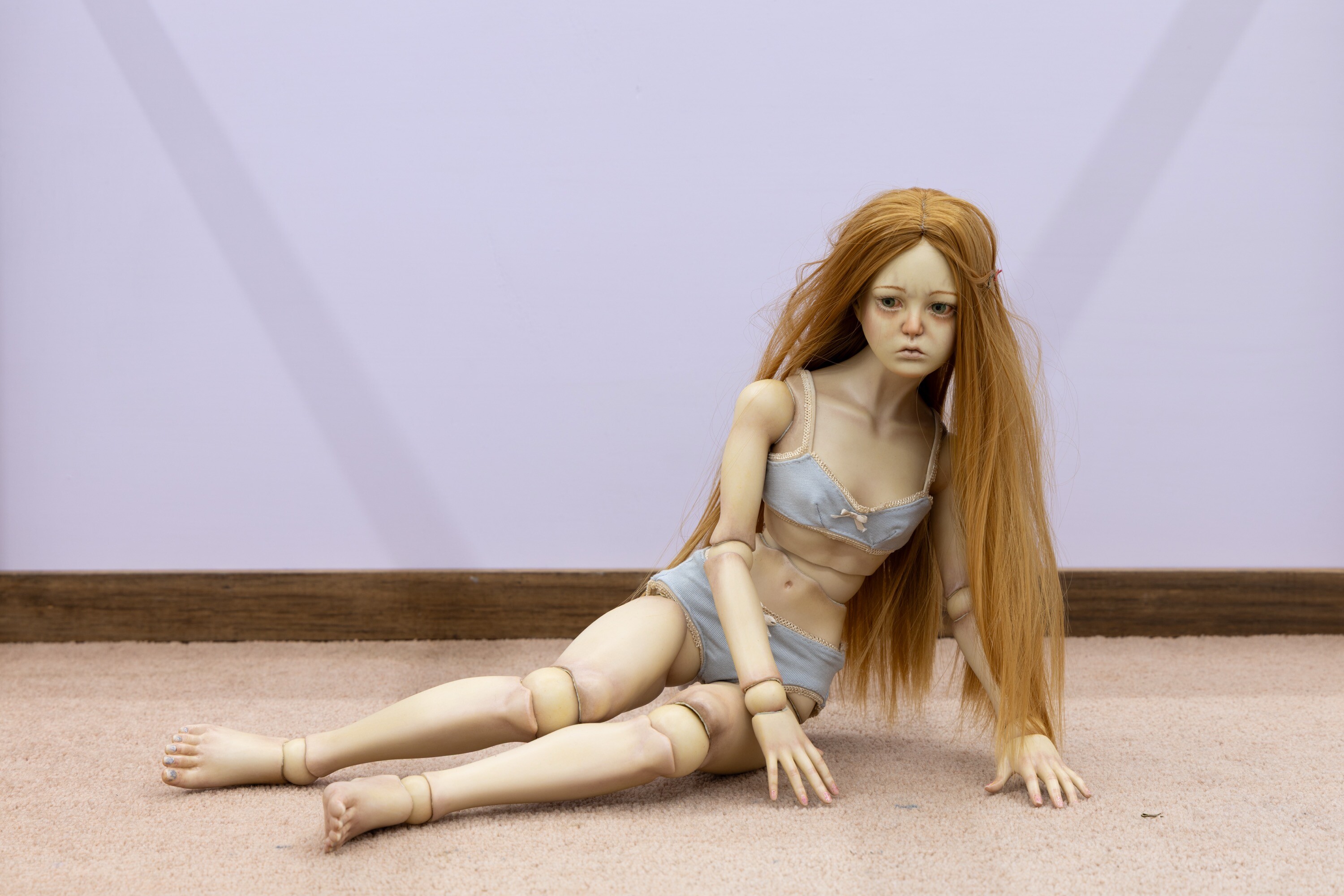
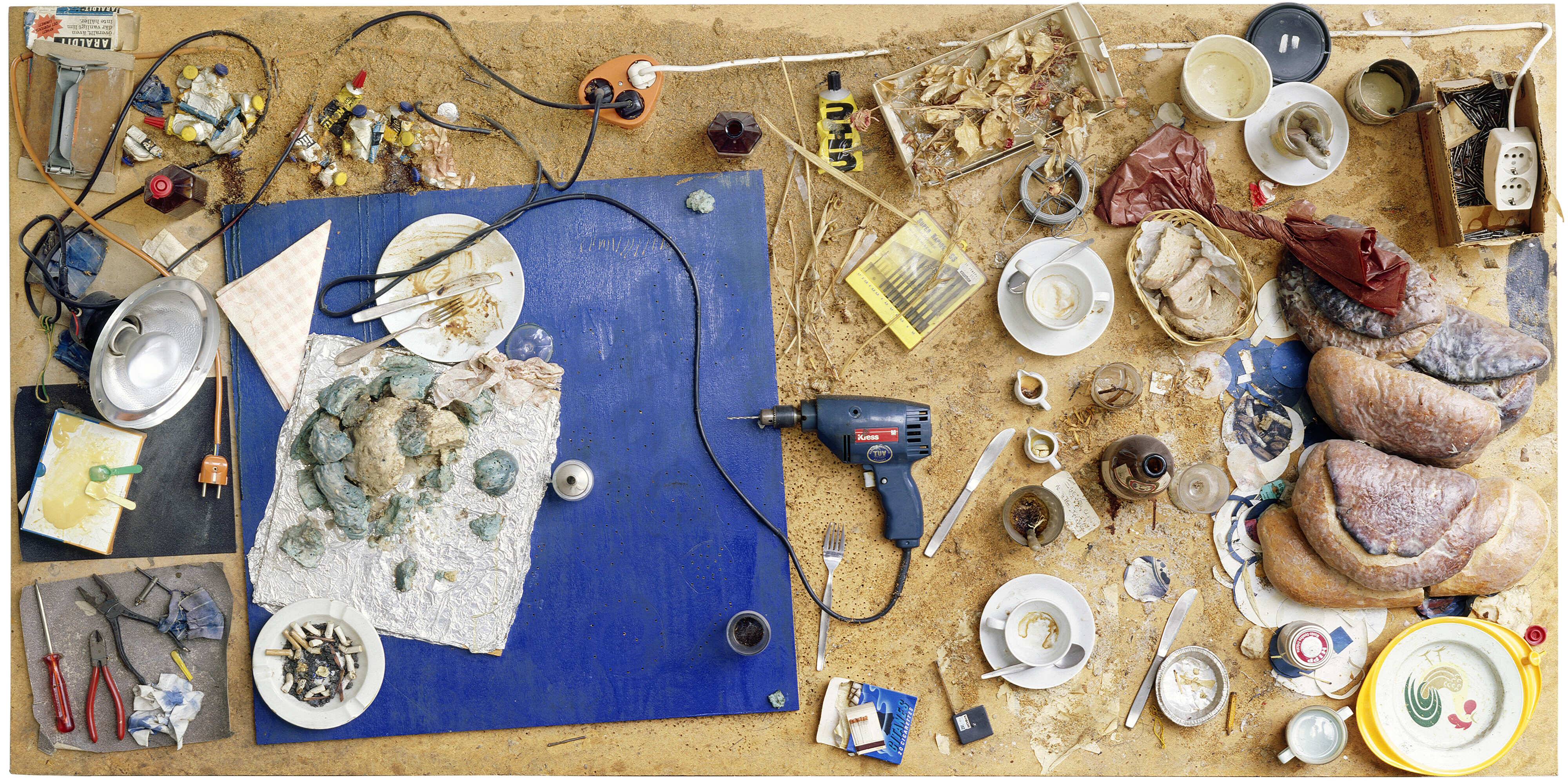
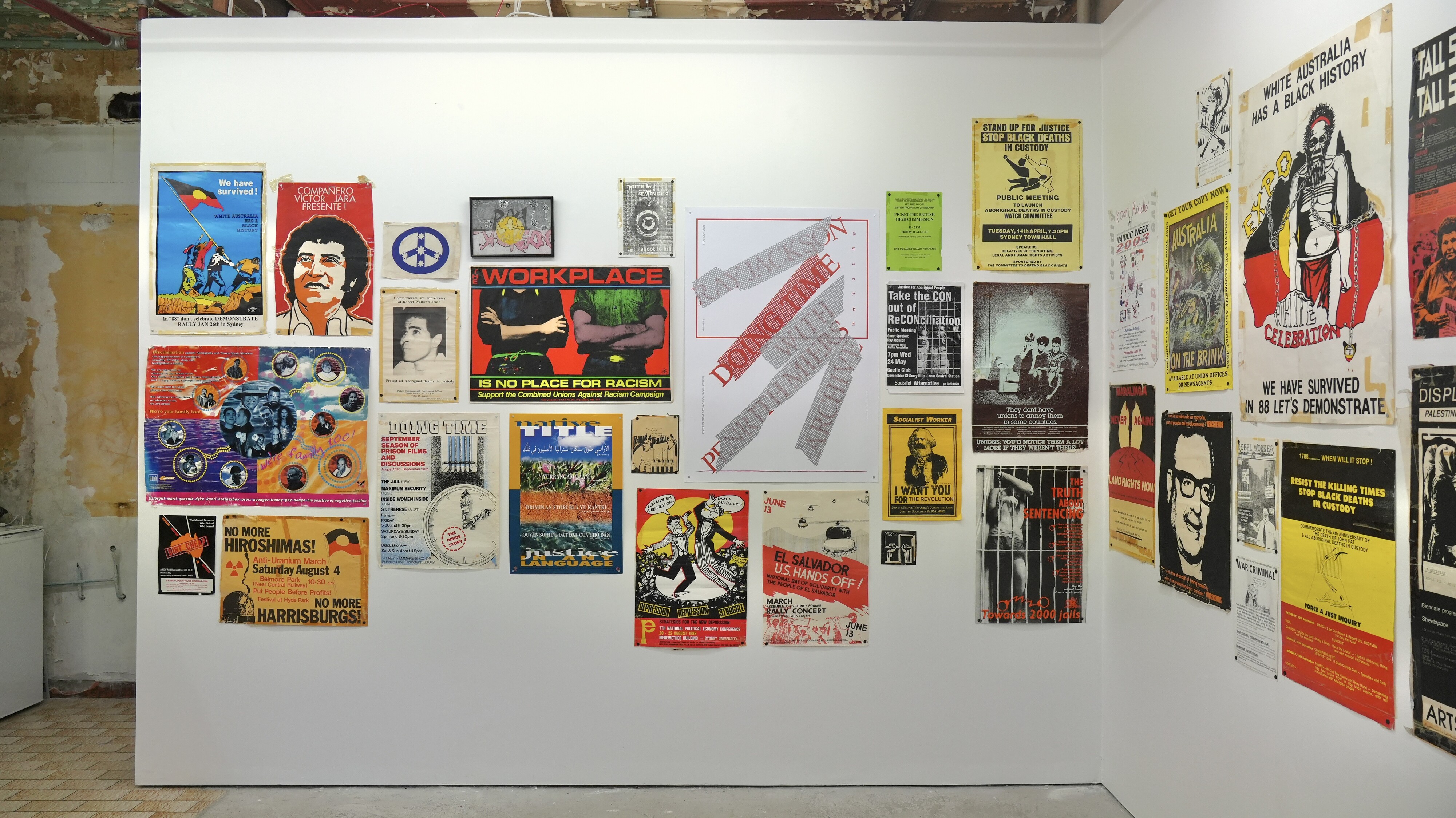
It’s an older work from Masato Takasaka that interests me. Untitled 4B.T (2007–08), a work of pencil and watercolour, is something of a schematic for Takasaka’s famous hard-edged abstractions, which he famously replicates over and over. This work at Hayden’s is like a tender side-note to these cool paintings. In the small gallery next to the office, Stuart has done a hang of three works by Dane Lovett, Mira Oosterweghel, and Jessie Smith that is so schmick. Oosterweghel surprises the most. Boneless horn (2025), a sculpture made from horsehair, adds dimension to the artist’s mostly performance-based practice. There is a real sense of—and I cringe typing this overused word—“community” in this show, where Stuart has given artists at all career stages in the complex the opportunity to be shown with tight curation. And the fact that artists were not expected to make new art tells me that Stuart is an artist’s curator, aware of the pressures placed on them to produce.

Installation view of Studios Exhibition at Hayden’s Melbourne. Left to right: Dane Lovett, Mira Oosterweghel, Jessie Smith. Courtesy of Hayden’s, Melbourne.
What’s the takeaway? At FUTURES, Perth-based curator Annika Kristensen was also visiting the gallery. She said that end-of-year group shows offer an ideal opportunity to view a gallery’s artist cohort at once. A gallerist’s stable, while certainly composed of who the gallerist believes to be commercially viable, also points to their personal tastes. Lest we forget that Sigglekow signed Matthew Harris to FUTURES long before he was a known quantity—before he showed in the Yokohama Triennale, was collected by the NGV, or was signed by The Commercial in Sydney. Indeed, much of the behind-the-scenes work for these achievements is done by the gallerist. Black2, Family Values, and Hayden’s Studio Exhibition are distinct statements of the gallerists’ styles. What’s more, it is an opportunity to see the artists’ sense of self—be that through their choice of partner at FUTURES, or through the choice of work they display at Hayden’s. And, because it’s the end of the year and I have very few fucks left to give, allow me to finish by revisiting my initial metaphor. The end of year group exhibition is like the iceberg. Not because it should be avoided at all costs. But because there is, you guessed it, more than meets the eye. You’re welcome.
Amelia Winata is a founding editor of Memo Review and a curator based in Narrm Melbourne. She holds a PhD in Art History from the University of Melbourne.