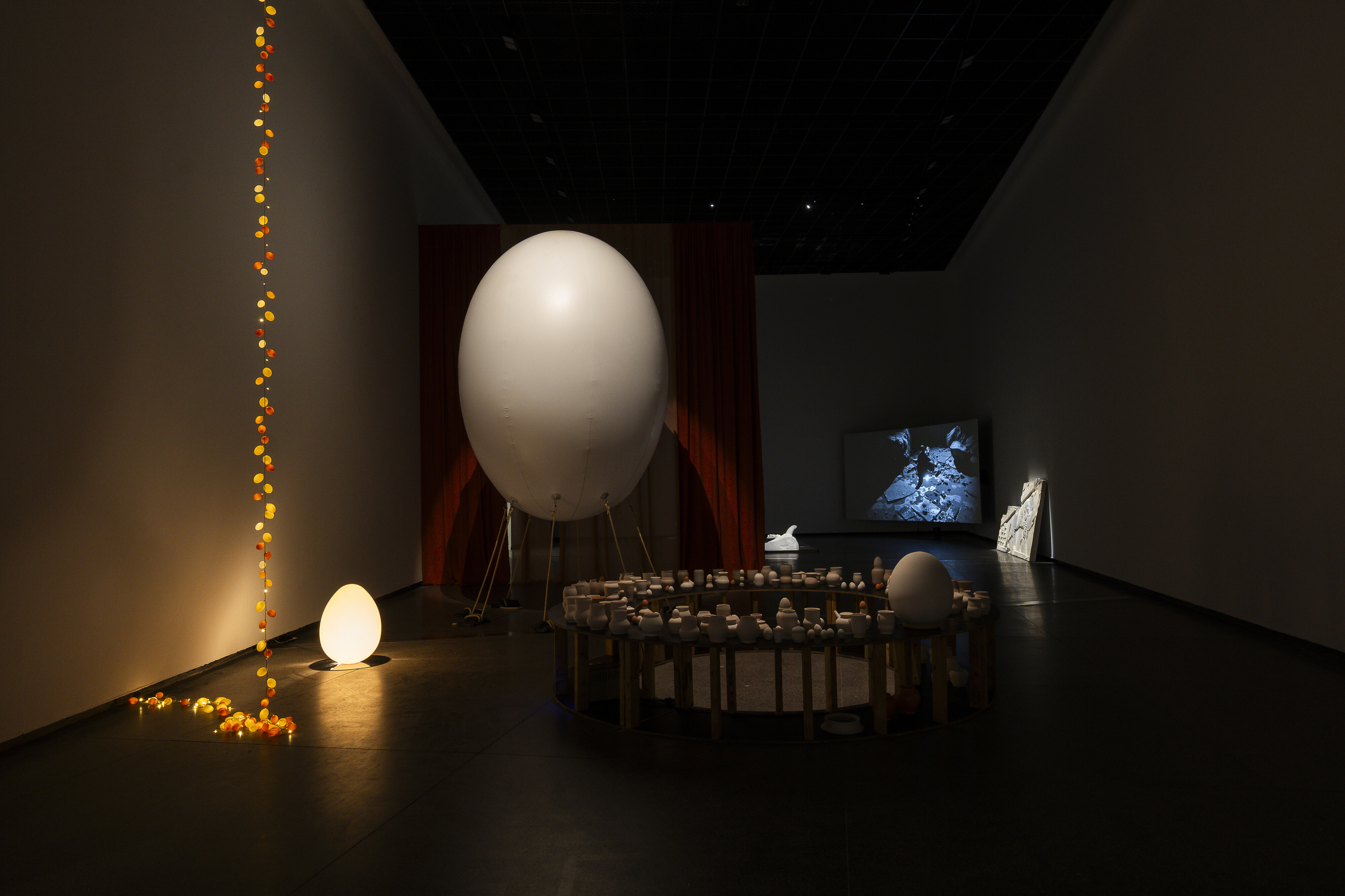
Installation view of Louise Paramor, The Reunion, 2020, plastic, painted wood and glass; and John Meade, Silvia, 2014, auto enamel paint on cast aluminium, horsehair, linen thread, bronze, nylon and rubber. Photo: Andrew Curtis, courtesy of Geelong Gallery.
Alchemy–Material Transformations
by Ella Howells
I seem to mystify the gallerinas at first. When I mention that I’m here to see Alchemy, perhaps they’re thinking I’ve come to the wrong place (or the wrong era, asking them to perform the ancient, near-mythical feat of transforming raw materials into gold) until one chimes in, “Oh! Head through the red doorway.” Mysterious…
Given the history of alchemy, from Aristotle to mediaeval Islamic chemists to Isaac Newton, to its reappraisal as secretive pseudoscientific magic after Victorian spiritualists revived it, it’s fitting that an exhibition titled Alchemy–Material Transformations is installed in the windowless basement gallery of a grand Victorian building. This trove of objets d’art conjures an air of covert—possibly occult—experimentation through the combined organic and synthetic materials of the vessels, jewellery, figures, and tools, which include bronze, wax, horsehair, glass, plastics, and alloys. After traipsing around the concurrent blockbuster Impressionist exhibition, with all its sweeping verdant landscapes, there’s reprieve in descending the wooden stairs into this obscure Wunderkammer of household oddities.

Installation view of Julia Blyfield, Funnel, 2017, silver; Stopper Pendant, 2017, oxidised silver and wax, and Kristen Coelho, Bottle and Tea Caddy, 2017, porcelain with banded iron oxide. Photo: Andrew Curtis, courtesy of Geelong Gallery.
Tucked between the two symmetrical staircases is a Victorian glass-fronted cabinet with barley-twist woodturning, playing host to an ensemble of frilly porcelain ladies with tiny musical instruments—the only drawing-room-style display within the exhibition. Its presence is as though a piece of the Windsor’s décor wound up in a Sofitel suite, taking into account the greige armchairs and coffee table set up in the centre of the carpeted room. Otherwise, all the objects are entirely sealed within low-lit, longline vitrines built into the room’s perimeter.
Within the vitrines, the objects are essentially arranged clockwise in sequence of their physical fragility. Shirts and skins. Each links to the next, whether through the quirks of its material, a similarity in form, or a shared function. There’s a crossword-like sequence of clues that bridge from Clive Stephen’s stone pelican form, carved nestling into itself, to Modernist bronzes by the likes of Clement Meadmore and Inge King; Louise Paramor’s plastic diorama tableaux to Jessica Murtagh’s satirical ceramics; etched Bohemian glassware; and, finally, Giles Bettison’s Murrini glass vases. Most of these artists are either Australian born or emigrated to Australia during the twentieth century, and the pared-back visual language is refreshing when contrasted with the Continental flair showcased above.

Clive Stephen, Pelican, 1940, stone with wooden base. Photo: Andrew Curtis, courtesy of Geelong Gallery.
Geelong has a storied relationship to the decorative arts, being the home of the Australian Decorative and Fine Arts Society. They’ve presented annual public lecture programs and amassed their own collection since 1992, including Tony Hanning’s plum-hued carved cased glass bowl Set (2002), which they gifted to the gallery on their tenth anniversary. Artist societies, with varying degrees of secrecy and exclusivity, played an integral role in the production of many works in Alchemy. Lenton Parr, Inge King, and Vincas Jomantas met as members of The Victorian Sculptors Society, then splintered off with Clifford Last and Teisutis Zikaras to form the main-character-monikered Centre Five in 1967. Inge King lived for a time at the Abbey Arts Centre, a Victorian estate that became a postwar enclave for Australian art figures such as Robert Klippel and Bernard Smith, who were seeking proximity to the London art world.

Inge King, Icon, 1964, bronzed steel. Photo: Andrew Curtis courtesy of Geelong Gallery.
After living in the fecund metropolises of Berlin, London, and New York City, King settled permanently in Warrandyte, and remarked that her newest New World surroundings seemed comparatively “rather flat, like a can of flat beer.” Viewing this environment from her Robin Boyd–designed home, it steadily grew on her, and her painted bronze work Gateway to Never Never (2006) depicts this antipodean flatness as an angular concertina partition with a cutout door signposted by atomic blue Atomic Age matrices welded overhead.
Perhaps chasing a horizon beyond clean lines, Clement Meadmore’s spindly bronze Standing Figure (1954) has a similar stature to his earlier furniture design, but dwarfs and abstracts it during this transitional slice of his career after he began sculpting, but before his move to New York, where he scaled up in a big way. Each work in the exhibition measures roughly fifty cm or less, either indicative of their shrinkage into maquettes, figurines or dioramas, or pointing to the practical household functions of polishing, pouring or storing.

Lenton Parr, Foyer sculpture maquette, 1969, painted steel. Photo: Andrew Curtis, courtesy of Geelong Gallery.
There are many examples of the former in both Louise Paramor and Lenton Parr’s works. Roughly half of Parr’s painted steel works in this exhibition were fabricated as maquettes for larger sculpture commissions and public art projects, which fit the alchemical theme with their metal composition and celestial titles, and it’s fascinating to observe them at this reduced scale after having seen a full-size, posthumous fabrication of Vega recently at Point Leo Estate’s sculpture park. Louise Paramor, recognisable for her colourful, modular highway-side arrangements, viewable on the way from Melbourne to said sculpture park, seals a minuscule moment of embrace amongst candy-like structures in an airtight box. It’s titled The Reunion, and the fact that it was created in 2020 accounts for its air of sanitary isolation.

Louise Paramor, The Reunion, 2020, plastic, painted wood and glass. Photo: Andrew Curtis, courtesy of Geelong Gallery.
Since 2020, I’ve noticed a pronounced post-lockdown cultural turn towards detailed analyses of interior décor, which has led to the recent coinage of the adjective “(tasteslop),” an endless barrage of tantalisingly replicable design arrangements digested by gen AI, excreted, then served under a cloche called Pinterest. Being confronted with our own aesthetic realities so vividly during that time fuelled a hunger to consume how others were utilising their spaces, and to visually gauge how well they were coping within the (dys)functional dioramas of their homes.
Art world sales were reported by Art Basel to have (peaked in 2022), and a new crop of writers began externalising their interior décor monologues, voraciously interrogating the proliferation of monstera plants and Scandinavian-designed chairs (à la Vincenzo Latronico’s Perfection, 2025), the transformative potentialities of psychoanalysis and DIY home renovation (Lauren Elkin’s Scaffolding, 2024), and the philosophy of the home (the title of Emanuele Coccia’s 2025 book). This facet of the zeitgeist culminates in content like the game show Interior Motives, where guests try to guess the gender, sexuality, age, and location of a room’s inhabitant based on aesthetic cues and cleanliness alone. Alchemy: Material Transformations feels timely because it traces the decorative tendencies of the Victorians all the way through to now, and the circumstances of the 2020s are hauntologically reminiscent of that era’s impulse to control one’s immediate surroundings through cleanliness, exoticised objects, and technology when the infection-rife unpredictabilities of the outside world threaten to close in.

John Meade, Silvia, 2014, auto enamel paint on cast aluminium, horsehair, linen thread, bronze, nylon and rubber. Photo: Andrew Curtis, courtesy of Geelong Gallery
Next to Paramor’s hermetic work, John Meade’s Sylvia (2014) evokes the Victorians’ fascination with horsehair keepsake jewellery, featuring a lush tail’s-worth dangling from a string threaded through a Minimalist green hook and fastened with a brass ring. Metallurgically speaking, brass was often the closest you could visually get to making gold, which gave it high value at points throughout history. The sculpture itself could be read as a portrait of a high-value couple: a muscle car boyfriend spooning his leggy Tom Ford–era Gucci clean-girl girlfriend.

Installation view of Nicholas Mangan, Monument for Small Change, 2007, bronze, edition 37/50 and Benjamin Armstrong, Pink and Black, 2009, blown glass and wax. Photo: Andrew Curtis, courtesy of Geelong Gallery.
The theme of cleanliness is wryly continued in Meade’s second offering. Screw Babs (2010) is a wave of steel and gypsum cement fringed with broom-like oceanic blue polyethylene fibres that gravitationally fall onto the sculpture’s steel base. Its apex points to the next piece along, both in form and colour: Nadine Christensen’s Knot 33 (2024), a 3D-printed broom with a knotted-up handle entirely in complementary orange. It’s positioned as though drawn back to sweep away Ricky Swallow’s Forgotten Foundation (2002), which takes the resin-rendered form of a crushed aluminium can and a skinny apple core. Adding to the debris, Nicholas Mangan’s Monument for Small Change (2007) reimagines what look like obsolete Australian pennies into an organic vertical glob of coppery bronze lava. Although this set of pieces could be considered among the least functional in terms of the household hierarchy, there persists that balance of cleanliness and dereliction which domesticity mediates.

Bohemian glass beaker with maritime scene, 17th Century, glass with wheel engraving. Photo: Andrew Curtis, courtesy of Geelong Gallery.
Vessels dominate the more fragile end of the exhibition’s material spectrum as we move from the left to the right, just as you’re doing right now, reader. Benjamin Armstrong’s glass vase, Pink and Black (2009), has wax scumbled across its surface in a captivating trompe l’oeil of sea glass. It’s crowned by a lacquered black ball forming a lid that suggests the preservation of the lumpy, flesh-like wax ball contained within. Another ingredient in the alchemical potion. More vessels and their accoutrements follow: Julia Blyfield’s delicately ridged funnel wrought from silver rests upturned, and her silver and wax stopper lies next to Kristin Coelho’s iron-oxide-lipped porcelain bottle as though paused midway through concocting a remedy following exposure to the preceding waste. Originally used in Ancient Egypt, iron oxide was frequently used in Victorian medicines, as well as in their alchemical practices.
Jessica Murtagh playfully interpolates the Victorians’ fascination with Ancient Egyptian artefacts by using sand-carved glass to depict hieroglyphic relief scenes of supermarket self-checkouts. The Victorians loved sandblasting glass, especially their architrave windows, for additional privacy, which adds irony to the choice to depict the most routine example of surveillance-integrated facial recognition tech. Although subtle, Murtagh’s vase is a bit Ai Weiwei-adjacent for my sensibilities, but if one artwork epitomised the exhibition’s general sense of humour and art-historical scope, it would be this one.

Installation view of Nick Mount, Scent Bottle, 2006, blown glass with zanfirico decoration. Photo: Andrew Curtis, courtesy of Geelong Gallery
The selections of glass that conclude the exhibition rove from bohemian to Bohemian. Nick Mount’s bong-like blown-glass Scent Bottles (2006) oscillate in hallucinatory Zanfirico patterns, with illicit, shisha-style crazy straws looping out of their tops towards an imagined nose or mouth. A duo of Giles Bettison vases exhibit extraordinarily fine glass-handling detail. He specialises in the Murrini technique, wherein hundreds of small, individually created tiles are fused together using heat then cold-worked to a satin finish. I notice his tiny initials. Then there’s a gathering of seventeenth-century Bohemian Czech glassware delicately etched with scenery representing various places, including Nuremberg and Potsdam, from the collection of Sylvia Cherny. Her family, after emigrating from Germany, established the opal jewellery business Altmann + Cherny in Melbourne, which still continues to trade in Sydney. Jewellery by Robert Baines in the form of complicated, bright red and gold structures features in two vitrines that flank both staircases, representing his forays into the research of archaeometallurgy, but their palette is limited, and I had somewhat hoped to see a broader representation of jewellers, given their frequent material transformations.

Robert Baines, Redline Chain, 2016, powder coated silver and coloured plastic. Photo: Andrew Curtis, courtesy of Geelong Gallery
The Victorians, with their eclectic, globalised tastes and expanded manufacturing capabilities, evident throughout Alchemy, indelibly framed how Australians came to know, produce, and appreciate the decorative arts to this day, but they never managed to use alchemy to create gold. The first successful attempt took place in 1941, putting mercury neutrons into a particle accelerator, which produced a few atoms of impractical, radioactive gold. Subsequent attempts over the past couple of decades using the Large Hadron Collider to turn gradually increasing amounts of bismuth into two hundred and sixty billion nuclei of gold amounted to nineteen picograms, equivalent to one yeast cell, at the expense of one trillion times its market value. In the exhibition, a few hatpins by Baines seem to be the only gold in sight, but a closer look reveals that the finish is actually electroplated silver. The gold still eludes us, like the almost fruitless alchemical process. Almost.
Ella Howells is a writer, artist and arts worker in Naarm/Melbourne. Recently, she coordinated the public programs at Melbourne Art Fair 2026.