Hoda Afshar, Vernon Ah Kee, Behrouz Boochani, still from Code Black / Riot 2025, four-channel digital video, colour, sound, 33 mins. Courtesy of the artists and Milani Gallery.
a/part: Hoda Afshar
by Chelsea Hopper
How does an artist represent those who have experienced institutional violence? It is a question I ask myself after encountering the work of Hoda Afshar, an artist who has collaborated with, and made work about, refugees and asylum seekers detained on Manus Island, whistleblowers who have faced jail time, and Aboriginal and Torres Strait Islander children who have endured the brutal conditions of youth detention. Trained in Iran as a documentary photographer, Afshar draws on the conventions of the genre. Her work often incorporates first-hand testimonies alongside factual information with carefully composed, highly stylised portraits, extreme close-ups, and poetic sequences of bodies in landscapes.
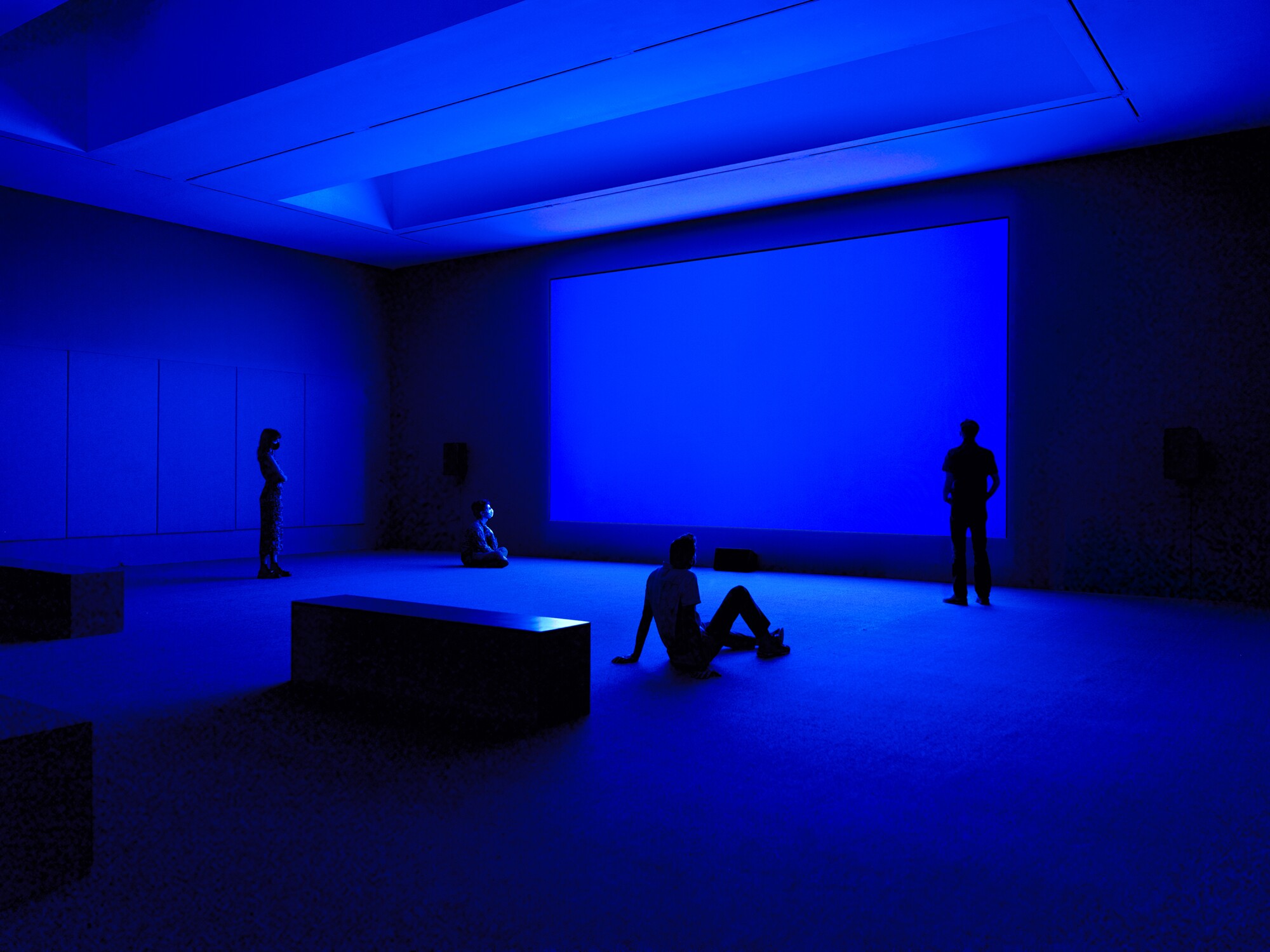
For Afshar’s exhibition a/part at Buxton, Code Black / Riot (2025) takes up the most real estate, occupying the gallery’s entire ground floor. Developed in North Queensland, the project is framed as a collaboration between Afshar, artist Vernon Ah Kee, and writer, filmmaker, and human-rights advocate Behrouz Boochani—each contributing individually authored works for the show. It is a form of collaboration I don’t see frequently, in which three artists do not work under the banner of a collective but retain their own voices, drawing on their distinct experiences of, and engagements with, institutional violence and incarceration. Given the subject of youth incarceration, specifically in Australia, and questions of who exactly gets to represent whose experiences, it seems like a smart approach.

Installation view of a/part: Hoda Afshar, Buxton Contemporary, the University of Melbourne, 2026. Featuring Hoda Afshar, Vernon Ah Kee, Behrouz Boochani, Code Black / Riot 2025. Photo: Christian Capurro.
In the first room, I am met with Afshar’s sixteen portraits of Aboriginal and Torres Strait Islander children—their faces variously obscured, painted, or hidden by everyday objects, flowers, clothing—a hat, a glove—or the limbs of others. The subjects of the portraits are playful, though some of them appear recalcitrant in front of the makeshift backdrop—a sheet fastened to a fence in a temporary studio. Each portrait feels strangely placeless. I learn from the wall label that these photographed young participants were invited to conceal their identities by Afshar in whatever way they saw fit. Little in the images suggests the circumstances that brought them before Afshar’s camera.

Installation view of a/part: Hoda Afshar, Buxton Contemporary, the University of Melbourne, 2026. Featuring Hoda Afshar, Vernon Ah Kee, Behrouz Boochani, Code Black / Riot 2025. Photo: Christian Capurro.
In one portrait, three teens throw middle fingers, their arms intersecting in an arrangement that is as much the result of photographic chance as deliberate concealment. The central figure wears a T-shirt bearing an enormous portrait of the American professional basketball player Steph Curry, who is the only person whose face is entirely visible. There is something both freeing and controlled about this image, with its suggestion of narrative that I find less apparent in the other portraits. There is movement, a sense of something happening outside the photograph.

Hoda Afshar, Untitled #01 from Code Black / Riot (Portraits) series 2025, inkjet print. Courtesy of Hoda Afshar and Milani Gallery
These portraits do the work of individualising these young people, while in the accompanying multi-channel video installation, Code Black / Riot (2025), we hear some recount their experiences living in youth detention. First presented across two venues at this year’s Biennale of Sydney, the various components are brought together in much closer proximity at Buxton. In the adjoining main gallery, the thirty-three-minute video has been reconfigured as an immersive installation, playing on loop across eight suspended screens.
It is here that I first catch anonymised detention-centre staff speaking about two things in particular: the accommodation units, named after birds (I’ll return to this soon), and the colour-coded system used to classify emergencies in order to regulate the kids in detention, to which the work’s title alludes.
Intercut with the staff testimonies, the same incarcerated children describe the codes in their own words, with a tone and delivery that has a casual bluntness: code pink, one of them says, is used when someone “kills themselves.” The camera frequently crops their faces so only their mouths are visible. “Can you see my whole face or just my mouth?” one boy asks as he prepares to be interviewed. It’s like an outtake, a practical question, but one that speaks to the broader matter running throughout the exhibition of who gets to determine how they are seen. The camera zooms in and out on details; I notice a fresh scar on a child’s knuckle and a hair elastic fitted snugly around the wrist of another.

The accounts of detention staff in the film sound full of rather ordinary, workaday details. They speak matter-of-factly about being short-staffed and the physical weight of the prison doors, which leave their arms sore from repeated use. Understaffing has consequences for those detained. When staff numbers are low, we learn of the imposition of a tactic known as “night mode,” where the lights are kept off regardless of the time of day. Sensory deprivation is known to be a form of torture. One girl recalls the boys spending as long as a week in “night mode,” sleeping in an attempt to get through it. She later becomes clearly distressed when recalling watching a boy being roughly handled by staff and abruptly asks to take a break from the interview. Her mouth quickly escapes from the camera’s tight framing.

Hoda Afshar, Vernon Ah Kee, Behrouz Boochani, still from Code Black / Riot 2025, four-channel digital video, colour, sound, 33 mins. Courtesy of the artists and Milani Gallery
The accounts of the children are interspersed with idyllic shots of young people jumping about in slow motion, walking busy streets at night alone, or swimming in a creek. In one shot, a young boy lies on his back stretched out on a rock, catching the sun. The scenes suggest a freedom otherwise denied to them, or perhaps newly found; these moments also provide something of a reprieve from the intense, if not confronting, testimonies. I am torn. I find myself seduced by the poetics of these scenes where teenagers sit high upon treetops. But do these moments ask too much of the landscape—or perhaps rather too little—which here functions so straightforwardly, so conclusively, as a stand-in for freedom?

Installation view of a/part: Hoda Afshar, Buxton Contemporary, the University of Melbourne, 2026. Featuring Hoda Afshar, Vernon Ah Kee, Behrouz Boochani, Code Black / Riot 2025. Photo: Christian Capurro.
Colour is another framing device. It indexes the emergency codes heard that are almost all explained in the video and visually rendered by Ah Kee in his nine colour-coded panels hung near the stairs leading up to the gallery’s first level. The colour-coding extends to the frames of Afshar’s portraits, though I’m not convinced it offers the same moment of discovery. With Ah Kee’s panels, it takes a second to make the connection. It is only as one moves past them that the lettering glistens under the gallery light, revealing the blunt language of the emergency codes, as you’d think, and where the code in black corresponds to “riot.” We never see a riot or a medical emergency; we are only told about them. And that is the point.
Upstairs, about six people are already watching Arash Kamali Sarvestani and Behrouz Boochani’s 2017 documentary Chauka, Please Tell Us the Time, playing in Buxton’s Education Room. I sit off to the side and end up watching the entire film, which surely warrants more than the four-day run it was afforded as part of the show. Filmed secretly by Boochani on a mobile phone during his years of incarceration on Australia’s offshore Manus Island immigration detention facility, the film takes its title from the chauka, a native bird whose call at a particular time of day is used by locals as a kind of avian clock. Chauka is well known and highly regarded in Manus as a symbol of beauty and cultural identity (it even appears on the island’s flag). It is also the name given to a solitary confinement unit inside the detention centre, where Boochani himself was sent twice. The film returns repeatedly to this cruel irony, and its parallels to Code Black / Riot are eerily apparent where the housing units are also named after birds. Only later, do I find that as I read on the tram home Boochani’s accompanying text, “The Horizon Is the Host of Colours,” he makes this connection explicit: “These prison facilities employ the same logic, and learn from each other.”

Arash Kamali Sarvestani, Behrouz Boochani, still from Chauka, Please Tell us the Time 2017.
In Chauka, the routines of life in detention show the conditions of the compound. There are verbal accounts of suicide, self-harm, torture, lack of resources, and inadequate medical care, with scenes of prisoners being hospitalised as a result of starvation. There are particularly painful scenes of detainees trying to communicate with family by phone. Kaveh speaks to his mother, and later to his wife. He tries to talk to his father, who is never put on the line. We never find out what condition his father is in or whether something worse has happened. At one point, Boochani films his own feet in a pair of cheap flip-flops; he has them propped up in a barred fence. In another scene, he experiments with the camera’s zoom, bringing the ocean into view—a scene he can see but cannot physically reach. There is a lyricism to these incidental shots, which register both Boochani’s own aesthetic sensibilities and his own presence within the conditions he is documenting.

Installation view of a/part: Hoda Afshar, Buxton Contemporary, the University of Melbourne, 2026. Featuring Hoda Afshar, Agonistes series 2020. Photo: Christian Capurro.
Boochani himself can also be spotted more than once at the other end of the gallery in Afshar’s iconic 2018 video and portrait series Remain, in which he appears alongside other men detained on Manus Island. The portraits bear the names of those depicted, including Ari, Behrouz, Emad, Edris, Ibrahim, Mohamed, Ramsiyar, Shamindan, Ramsiyar, and Thanus. With the exception of Boochani, the video introduces another group of men, also identified by name, as they recount their experiences of detention.
In Afshar’s series Agonistes (2020), however, the names disappear. Nine whistleblowers are identified only by their profession, ranging from an officer and lawyer in the Australian Special Forces to an occupational health and safety manager, a former migration support worker, and a community lawyer who campaigned to raise the age of criminal responsibility.

Installation view of a/part: Hoda Afshar, Buxton Contemporary, the University of Melbourne, 2026. Featuring Hoda Afshar, Agonistes series 2020. Photo: Christian Capurro.
Afshar first created three-dimensional scans of her subjects, from which she produced white, 3D-printed models that she then photographed. Resembling ancient Roman busts, they also look like figurines waiting to be painted, their blank eyes and glossy surfaces giving them an oddly unfinished appearance. In the accompanying twenty-minute video, the eyes of the subjects depicted in the busts return, along with their hands and mouths—all cropped to such an extent that every wrinkle or fold of skin can be counted. Hoda tells me she took inspiration for these extreme close-ups from the documentary The Ghost of Abu Ghraib (2007). In Agonistes, each testimony is interwoven, and it takes time to piece together who is saying what, and what has happened to whom, along with myriad consequences for these nine people speaking out. The video feels something like an extended teaser trailer for the interviews themselves, offering just these fragments of testimony that leave me anticipating the moment the camera will zoom out, to hear more from each person.

Hoda Afshar, Timothy Johannessen, still from Shafaq 2026. One-channel digital video, colour, sound looped 12 mins.
In a smaller room near the stairs is Afshar’s most recent video, Shafaq (شفق){dir=”rtl”} (2026), a twelve-minute visual essay assembled from iPhone photos taken at an air show during a trip to the Northern Territory in July this year. It is perhaps her most personal work to date, this time with not a person in sight. Afshar narrates the work in Farsi, recounting the experience of watching war unfold in southern Iran from afar, unable to contact her family living there. She finds affinities between the landscape in Iran and the red sand and white cliffs of the Northern Territory. In a succession of stills, fighter jets appear and reappear across the screen. Birds make an appearance too. Even here, Afshar can’t seem to escape them.

Hoda Afshar, Untitled #03 from Code Black / Riot (Portraits) series 2025, inkjet prints. Courtesy of Hoda Afshar and Milani Gallery.
The inclusion of Boochani’s documentary Chauka makes it difficult not to measure, or at least read, Afshar’s work through the conventions and standards of documentary filmmaking. And the same might be said in respect of Ah Kee’s involvement in the project in that his four-channel video work tall man (2010) seems to hover over the show like an intertextual ancestor. Compiled from edited CCTV, mobile-phone, and news footage, tall man documents an uprising known as the Palm Island riot following Mulrunji Doomadgee’s death in police custody. For me, Boochani and Ah Kee’s films serve to emphasise Afshar’s own aesthetic and conceptual decisions about how another person’s experience will be seen and heard within an art context. Collaboration is clearly important to her, though so too is the mastered poise she exercises in the presentation of these experiences. Beauty is indeed central to her approach in this respect, in which she filters her subjects through an Arcadian light, whose visibility is otherwise so often represented by suffering, reduction to “victimhood,” and control by outlets beyond their means (the media, the state, the Australian government). Yet the beautiful also suggests a surface and, not unlike the Arcadian scenes of freedom, provokes suspicion of what lies beyond that surface, or of what it veils or covers over. Afshar’s pursuit of beauty therefore cannot help but compete with itself and, ultimately, with the reality it presents.
Chelsea Hopper is a curator and writer whose research centres on modern and contemporary photography. She is Art Director of Memo Magazine.