Bodies in Motion
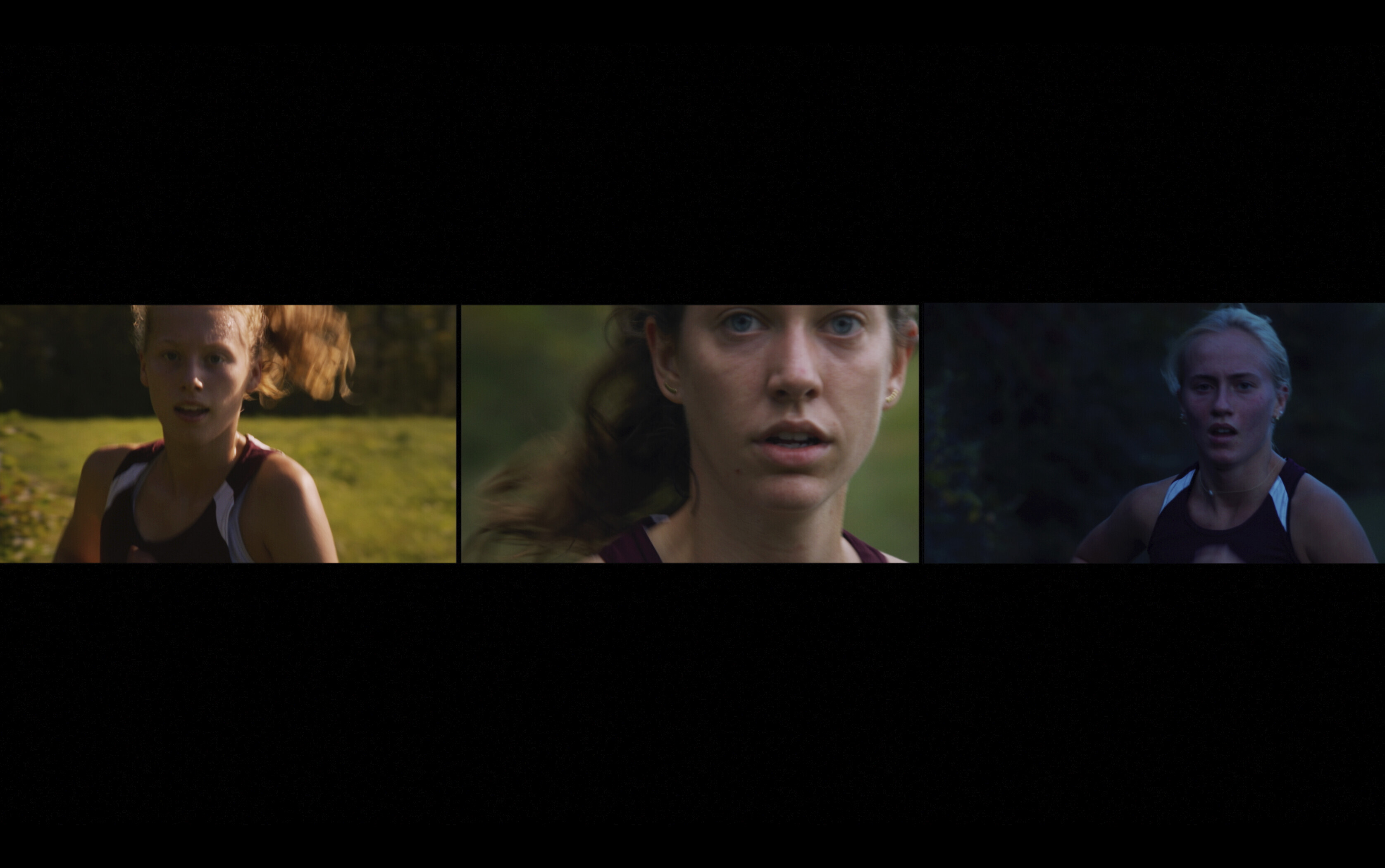
Following three women as they compete in a cross-country race, Sam Contis’s Five Kilometers (2025) suggests the body itself as an instrument and register of time’s passage.
From the Latin con (“with, together”) and spirare (“to breathe”), a conspiracy is, at its roots, to be moved by the same currents, to exchange gases, to mingle your exhalations with others. To breathe, a diaphragmatic contraction opens the ribcage, producing a vacuum in the chest. The winds move into the body, as they do through the atmosphere, to fill a low-pressure void. Air rushes up through the nostrils or into the mouth, down the windpipe and into the bronchi, before arriving at the lungs. Oxygen passes through the respiratory membrane and into the blood. A pulse, and the bloodstream quickens, tracing its finite orbit. Cells respire, manipulating the chemical composition of inhaled air. As the diaphragm relaxes, air whistles outward from the lungs. It’s been said that an exhalation is not an activity but rather a release, or a letting-go. I can’t say it always feels that way.
Exclusive to the Magazine
Bodies in Motion by Nicole Kaack is featured in full in Issue 5 of Memo magazine.
Get your hands on the print edition through our online shop or save up to 20% and get free domestic shipping with a subscription.
Nicole Kaack is a writer, editor, and curator whose research interests include language, memory, and performance. Her writing on contemporary art and literature has appeared in magazines, reviews, and catalogues. She is co-founder of the collaborative artists’ book project prompt:.