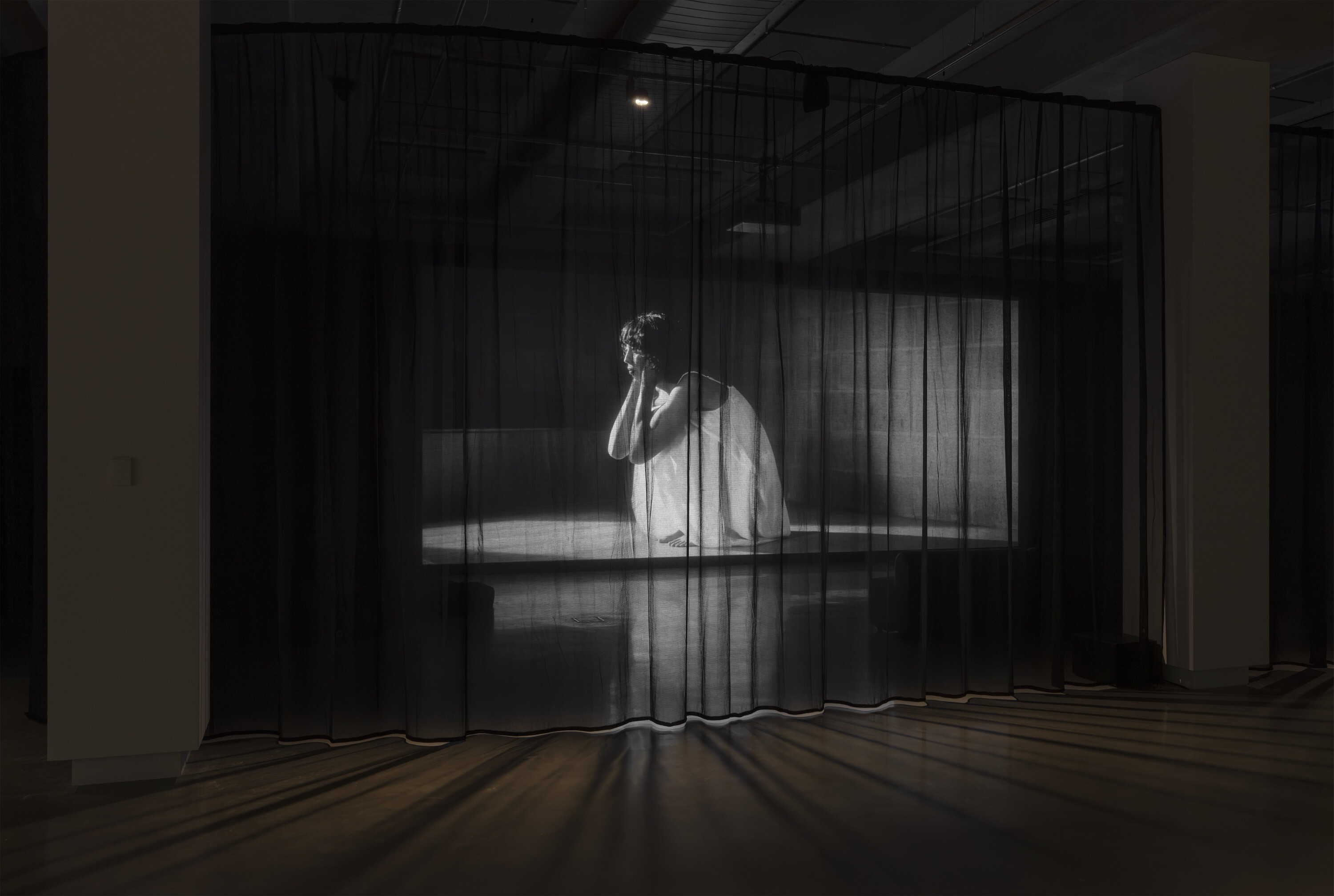
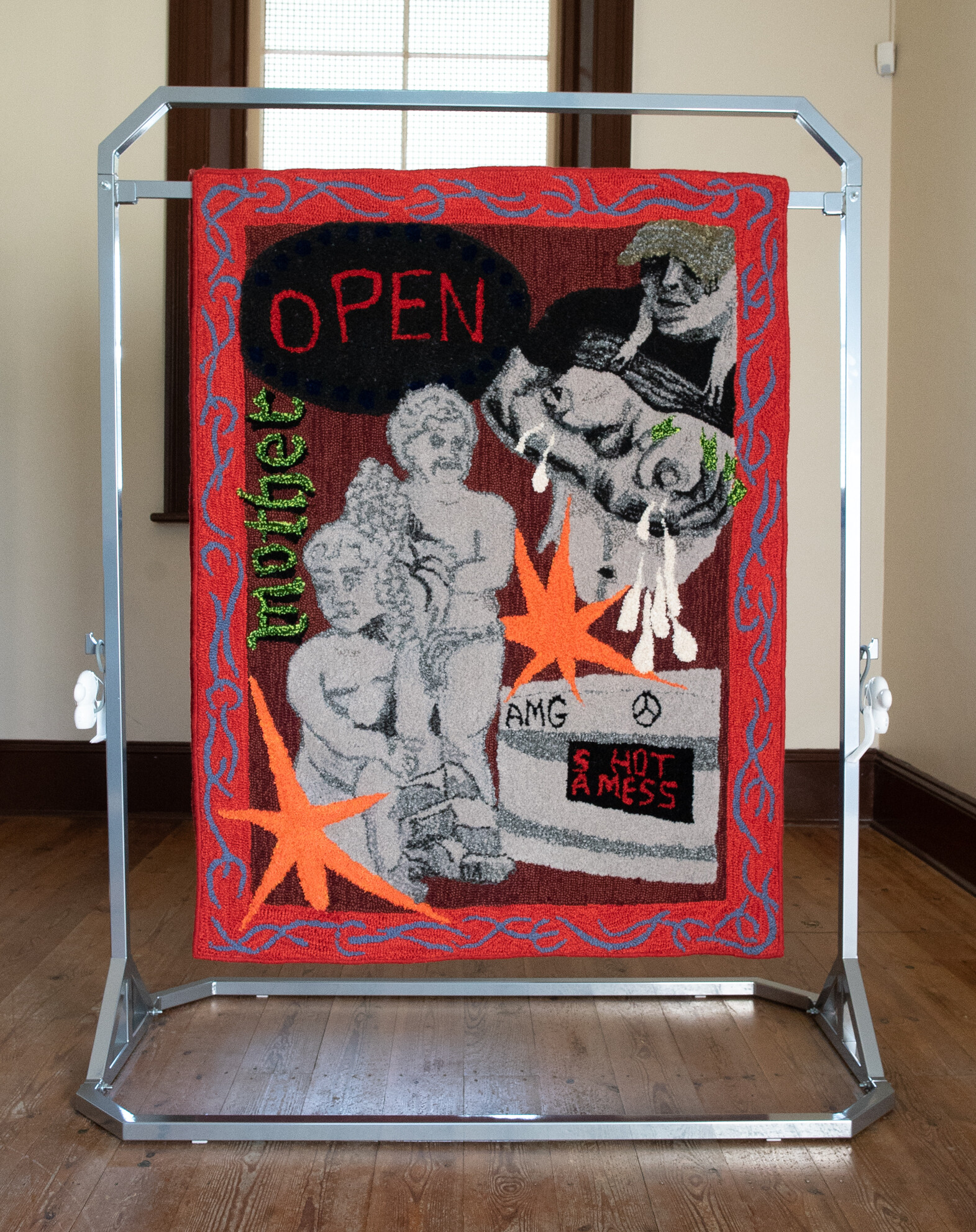
megan evans, PARLOUR – Maree, 2019, digital print on rag, 200 x 150 cm. Photo courtesy of the artist.
The Uncomfortable Truth: Maree Clarke and megan evans
by Susie Anderson
In a week, Victoria will hold its state election. Jess Wilson’s Liberal party has vowed to walk back Victoria’s commitment to Treaty, and the race has become a litmus test for the next federal election, and more generally a temperature check on where the Australian public might sit on the political spectrum, as right-wing ideologies gain traction globally. After the unsuccessful 2023 referendum that called for an Aboriginal and Torres Strait Islander Voice to parliament, I feel numb to this reality. There are misunderstandings about what Treaty means to Aboriginal people in Victoria, and non-Aboriginal people across our state have also misconstrued the truths outlined in the Yoorrook Justice Commission. Governments always have such a slippery relationship to truth, and having grown up in a safe Nationals seat I’m not naive about what’s to come. It is under the weight of all of this context that I visit Maree Clarke and megan evans’ collaborative exhibition, aptly named The Uncomfortable Truth.
Installed at Booroondara Council’s Town Hall Gallery in Hawthorn and curated by Rachel Keir-Smith, the exhibition presents Clarke’s contemporary Aboriginal practice and cultural revival alongside a familial colonial reckoning from evans. It is the culmination of a decades-long friendship between the artists, featuring new and old works from each.

Installation view, The Uncomfortable Truth: Maree Clarke and megan evans, Town Hall Gallery, 2026. Photo: Christian Capurro.
In an interview with Lynette Russell that accompanies the exhibition, Clarke states: “I’m trying to invite (people) to sit with the truth, even when it’s painful and challenging.” I have family connections to Wemba-Wemba Country through my Wergaia great-grandmother Jessie Pepper, who was married to Wemba Wemba man Jackson Stewart. The cultural revival that Clarke—a Mutti Mutti/WambaWamba/Yorta Yorta and Boonwurrung artist—has undertaken throughout her career, particularly in her 2021 NGV exhibition Ancestral Memories, has always resonated given this shared culture. Likewise, evans’ contribution is familiar from her 2020 exhibition at Horsham Regional Art Gallery—my hometown’s gallery, and a location that could really stand to see some of these truths.
evans’ artist statements speak of a willingness to face the shame and guilt of the past, while Clarke’s are framed in terms of cultural revival, self-determination, and community. The contrast leaves me wondering how much of the weight of colonial history this space can hold. The gallery itself is within the still-functioning Hawthorn Town Hall: a grey, grandiose building that presides over the surrounding affluent suburb of mansions and four-wheel-drives, and Swinburne University students breaking for lunch on Glenferrie Road. What truths do we owe such communities? How many more times do Aboriginal people have to show settlers that we belong to this place before they will treat us humanely? And if we invite allies to carry some of this load alongside us—as the public programming for the exhibition will attempt—how can they interrogate their complicity in the colonial project without taking up space?
Clarke’s approach to mourning rituals fascinates me. Having entered through the back door, I head straight towards a glass cabinet housing about twenty grey spheres, which I know are a new series of kopi caps. The automatic sliding door keeps opening across the room as I crane my neck towards the vitrines, and yet no one enters. I decide it’s a ghost, or a guide, entering the space. Aboriginal community members paint a gypsum mixture on their forehead as a part of the mourning process, adding to it until the layers grow into a cap-like head covering—a practice that has been documented widely across south-eastern Australia. Clarke’s Kopi Mourning Caps (2026) were created in honour of the artist’s deceased kin and community members, and each cap has a photo and story beside it. I feel the layers of loss. Felt by Clarke, her community, my own family and community, and beyond: the losses of our cultural practices, and loss of time left to learn them. I wonder how my own life would have been changed by such a clearly defined and embodied process of grieving. The door opens again and I look up from the vitrine. Who is in here with us, I think. Again, nobody enters. I soon realise that the door is overly sensitive to the people walking past in the corridor outside, and in a twist of irony, I realise my ghost is just a symptom of a dysfunctional mechanism of the institution.

Maree Clarke, Kopi Healing, 2026. The Uncomfortable Truth: Maree Clarke and megan evans, Town Hall Gallery, 2026.
evans recalls the time Clarke encouraged her to wear kopi cap after the death of her husband. Externalising grief into an object was a healing process for her, absorbing the tension and emotion her body had stored in response to loss. I find myself wishing that the exhibition had more defined, tender moments of crossover between the artists like this. My wish is partially fulfilled by evans’ video Sins of the father (2019), a work originally commissioned for the Lindsay Family Parlour, a permanent recreation of a Victorian sitting room at the Ballarat Art Gallery. The work features Clarke walking the streets of Ballarat toward the gallery, wearing a kopi and a possum fur cloak. She enters the gallery, making her way to sit beside evans on a couch in the parlour, an ornate and colonially-decorated room, which evans has peppered with more colonial tchotchkes from her own collection. The video creates a space for the two artists’ uncomfortable truths to directly confront each other, rather than one existing in the contemporary moment and the other looking to the past.
In other works, evans’ artistic interventions into settler consciousness largely address her own family line as well as systemic forms of oppression she witnessed her late husband experience. Although they are not in direct dialogue with Clarke’s practice, grief and a certain heaviness threads through her pieces, and the connections I see between other contemporary artworks surprise me. Proof (2016) is a fainting couch covered in white rabbit fur, elevated on stilts made of rifles, with a massacre map of Victoria embroidered in red on its back. It reminds me of Julie Gough’s installation The Gathering (2015), or her earlier series Manifestation (2010). Moreover, the black colonial dress worn in some of evans’ portraits recalls r e a’s seminal 2009 work poles apart, and photographs with faces covered by Australian botanicals have a clear relationship to Christian Thompson’s 2008 Black Gum series. The use of lower case on evans’ name also reminds one of the lower-case employed by bell hooks, although I notice that her signature on the prints uses capitals.
This language of visual metaphor and repurposed colonial artefacts, which evans shares with contemporary Aboriginal artists like Gough, r e a and Thompson, raises the question: is this the only way that art can grapple with the harms inflicted by the settler colony? As evans explains in the wall label for Isabella’s Helmet, “upending them and creating new shapes, destabilising them from their original purpose, is a metaphor for the unstable foundations on which our country is built.” This strikes me as an inversion of Audre Lorde’s famous maxim, “the master’s tools will never dismantle the master’s house”, with evans as the “master” employing the tools of the oppressed to construct an expression of decolonial emancipation.

Installation view, The Uncomfortable Truth: Maree Clarke and megan evans, Town Hall Gallery, 2026. Photo: Christian Capurro.
ChequeMATE #1, #2 and #4 is a sequence of reproduced colonial cheques adorned with beaded feathers. These, and the adjacent prints transposing buildings of the Hawthorn area onto domestic objects, are the most layered of evans’s work in the exhibition. Beadwork and embroidery— typically women’s work—is a key interest for the artist, and here the metaphors are exploratory, rather than literal. Two separate trios of christening garments are embroidered with blood-red thread, one with a reinvented Dorothea MacKellar poem, and another with an ode to evans’ late partner, Gunditjmara artist Les Griggs. The garments of Embroidered Tattoo (2026) name all the many boys homes that Griggs was sent to as a child of the Stolen Generations.

Installation view, The Uncomfortable Truth: Maree Clarke and megan evans, Town Hall Gallery, 2026. Photo: Christian Capurro.
In this same room, glimmers of Clarke’s glass objects flitter across the black-painted walls from her exquisite sculptures Ngargee (river reed canoes) (2023) and Murrini glass canoe (2024), the latter a three-metre canoe suspended from the ceiling. For Clarke, reflection and light are a material she employs throughout her practice, for example, her lenticular light box works, Made from Memory on the banks of the Murrumbidgee River II and III, which occupy the other room. In particular she uses glass as an agent for this exploration. She writes that “glass is both fragile and enduring… (like) the way cultural knowledge is carried through generations, sometimes changing and adapting, but never losing its connection to Country.” Similarly, light changes as it refracts and bends, and is fragile in its immateriality, yet this is the source from which all growth occurs.
The materiality of light is explored further in photography within the exhibition. In works such as Isabella’s Helmet (2019), evans evokes the tall, proud and hardy settler women in her family who made it work in the new, rough conditions of Australia. A loneliness emanates from the sparse set dressing and black background. This effect is made perhaps more obvious by the contrast with Clarke’s family and community, which is ever-present in her nearby portraits. The photographic series We Are Still Here (2026) puts the evans recreations into dialogue with Clarke’s family and community members. Dressed in Victorian and Georgian mourning clothing, they sit in tableaus reminiscent of Australian photography of that period, yet there are kopi caps, botanicals, and echidna quill jewellery alongside colonial set dressings, with some of the models wearing mourning paint. In these works, the two sides of the story address each other.
I say “address,” but there is a deliberate air of avoidance in the prints featuring evans’ family photographs, who are hidden underneath native Australian flora. They’re “peering through the leaves” cautiously observing Aboriginal people from afar, perhaps overwhelmed by the fearsome bush, the same one Frederick McCubbin painted. One of these images used blackened gum leaves from the Black Saturday bushfires in 2009 near evans’ mother’s house, which I find a touching connection to people and place of today. evans owns that when she started looking into her own family’s history she felt like she needed to hide somehow from the truth, and these works portray settler colonists who were unwilling to fully look at their complicity.
In preparation for the show, Clarke says she and evans “talked about our parallel lives and the different worlds we had grown up in. But as the work developed, I realised it was much bigger than that. Our work comes from different perspectives but together it speaks to ‘The Uncomfortable Truth’—the truths of our shared history, the inequalities that shaped our lives and the lasting impacts of colonisation.” Yet while one artist has spent her life knowing that the colony has historically excluded her, and therefore has no reason to protect its symbols and its myths, the other is using its visual language to provide an entry point for her fellow settlers to question their complicity in this exclusion. There are two quite different types of discomfort at stake here, and they are far from equal.
For some, the discomforts of this exhibition will be moving, revealing, and perhaps transformative. For others, who know the truths of the colony only too well, this may not be quite enough.
Susie Anderson is the author of the body country (2023) and currently Managing Editor at Blue Art Journal, an online publication of First Nations arts writing.