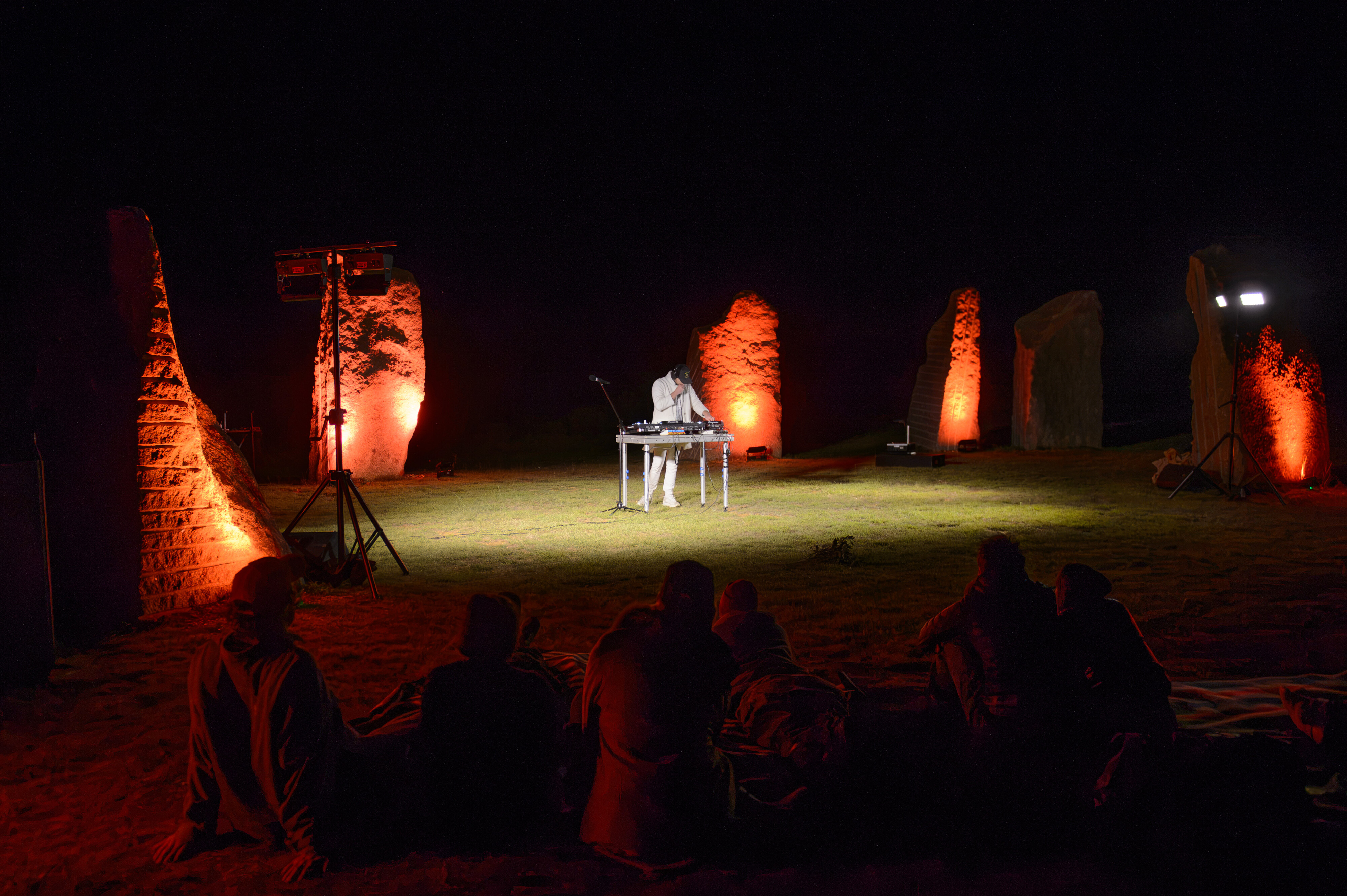
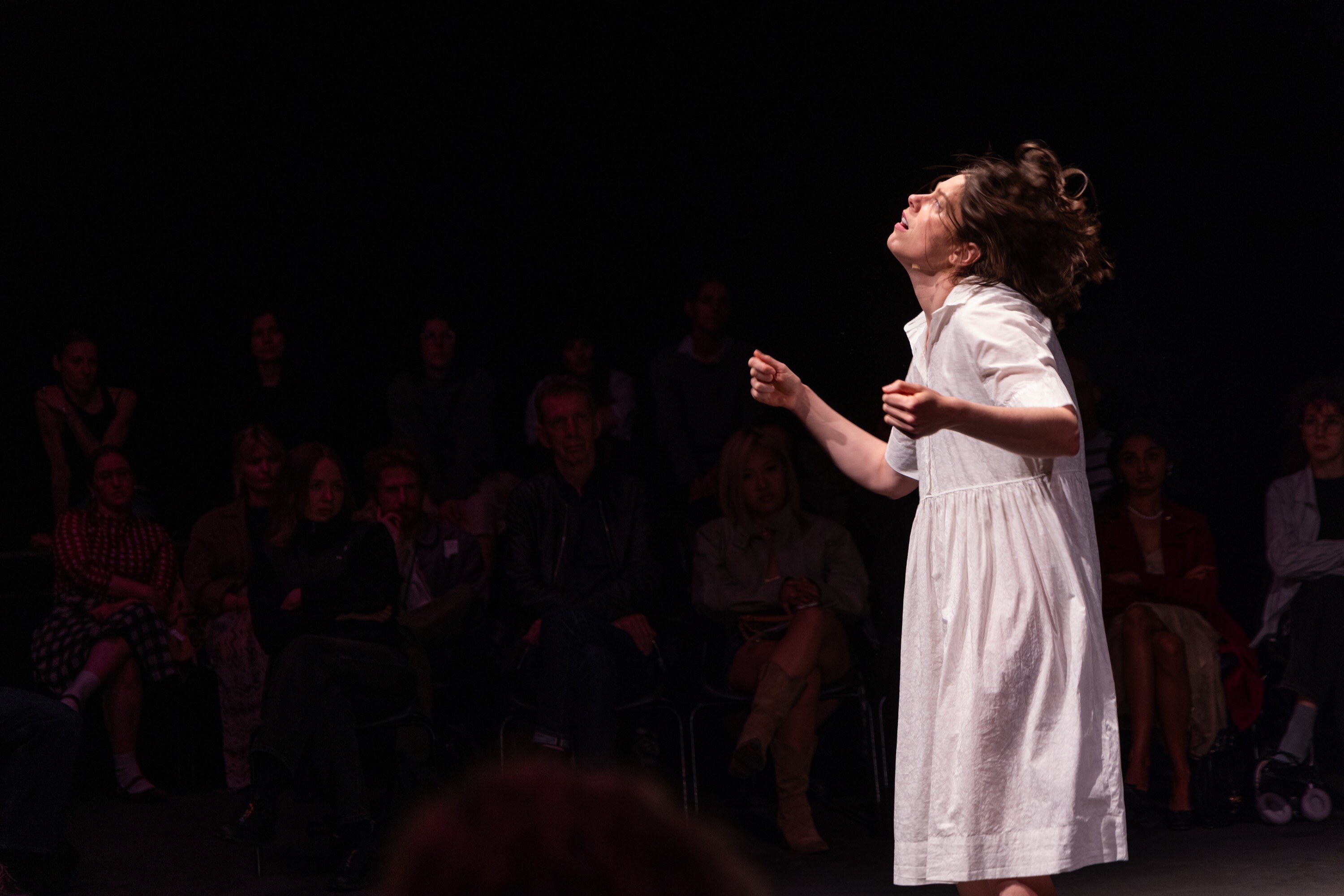
A Constructed World, Devil Electricity 02, 2026, performance, with Pheno, Tallulah Smith, Michele Robecchi, David Suyasa, Kathy Bail, Simon Barney, Mikala Dwyer, Tony Oxley and Eva Payne. Courtesy of the artist and Roslyn Oxley9 Gallery, Sydney
A Constructed World: Pheno 03: Outside Broadcast: My voice keeps changing on me; Electricity & the Devil; Endless Lonely Planet x ACW; Devil Electricity 03
by Judy Annear
A performance by A Constructed World (ACW) can operate like a charabanc trip: a kind of magical mystery tour of possibilities and provocations from the intellectual to the scatological. Rather than simple farce, their performances and projects are utterly serious in their absurdities. They are a set of reflections on the human condition that are neither satiric nor nostalgic—they are generated often at random and are repetitive, non-hierarchal performances that give new form to big metaphysical questions.
Since 2004, ACW have been grouping their work into a series of “Partitions”, each one bringing together performances and related objects that have accumulated across weeks and sometimes years, and across a wide array of locations and collaborators. ACW’s most recent Partition (Partition #26) commenced with performances in Paris late last year and continued, in considerably more developed form, in Anchorage in April. ACW is now in Australia, presenting components of the Partition across the country: in performances at Sydney’s Roslyn Oxley9 Gallery, where there is integral material on display (entitled Pheno 03: Outside Broadcast: My Voice Keeps Changing On Me), and in a set of performances at Melbourne’s Haydens Gallery, Melbourne University, and other locations around the city. Fragments of each iteration are carried across to the next, whether objects, words, music, actions, or personnel. This rolling aggregation results in inevitable rearrangements according to availabilities. Changes and mistakes creep in according to time, memory and possible usefulness. They are utilised to revivify, rearrange and continue working out. There are multiple routes to any form of meaning. The conclusion to this Partition will occur this Saturday, 18 July, in Sydney in a performance at Roslyn Oxley9 Gallery.

A Constructed World, Sending Transmission: From Cabine Téléphonique, Bordeaux, 2026, performance, with Jules Bernagaud, Michele Robecchi and David Suyasa. Courtesy of the artist and Roslyn Oxley9 Gallery, Sydney.
ACW is a collaborative project founded by Geoff Lowe and Jacqueline Riva in 1993. Lowe had been involved in informal collaborations since the early 1980s, working with colleagues, friends, and family through his paintings and related works, steadily evolving and refining his thinking around the role of an art practice and socio-political matters. Juliana Engberg noted in the catalogue for his 1992 exhibition, Geoff Lowe: Collaborations 1980-1992 (Australian Centre for Contemporary Art) that Lowe “has been forever concerned with models and worlds.” This was encapsulated in his 1982 paintings of good and bad government in the style of the fourteenth-century Sienese painter Ambrogio Lorenzetti, and furthered through his work in the 1980s and early 1990s with Melbourne collectives such as Sunnyside Up, Rosebud, and DAMP. In this same period, Jacqueline Riva studied and practised film, video, and photography, and was involved in the Melbourne music and club scene. Riva and Lowe’s skills were complementary and useful to each other as they honed their ideas around the productiveness of “not-knowing” in collaboration with others. For example, Lowe started working with video and Jacqueline started painting though neither had trained in these mediums. Their first joint project in 1993 was Artfan, a publication that ran for ten issues and focused on non-professional writing about contemporary art.
How to speak and how to understand have been ongoing questions for ACW. Their commitment to collaborating with people of diverse skills, whether professional or amateur, and regardless of language or art form, has offered one path to answer these questions—a way of juxtaposing and relativising different forms of knowledge. As Sebastien Pluot writes in the 2012 Potter Museum of Art catalogue Based on a True Story: Geoff Lowe 1971-92 and A Constructed World 1993-2012:
De-hierarchisation was ACW’s idiosyncrasy before becoming a deliberate political device… nothing appears privileged. …The painting is not better or worse than what it represents. It is part of a whole environment.
One of ACW’s key figures for this de-hierarchisation of knowledge is Pheno, a ventriloquist doll who cannot speak at all. Pheno featured heavily in ACW’s opening performance at Roslyn Oxley9 Gallery on 27 June, and made repeat appearances in Melbourne. Dependent on whoever manipulates him (none of whom are professional ventriloquists), Pheno appears perpetually out of register with his surroundings. Yet we bend toward him in the fascination humans have toward their own likeness. He doesn’t fit, but this not-quite-fitting is what we all know to be a truth about ourselves in any given context. When Pheno is not in the arms of one of his manipulators, he is perched on a chair or couch, arranged as though observing the action. Pheno points to the ordinariness of inexactness, that which is sensed though not always understood. The not-understanding opens an ethical space for working out. There is no dead-end in the world of ACW. As one of their current songs goes, “…at least if it’s buried you can dig it up again.”

A Constructed World, Devil Electricity 03, 2026, performance, with Pheno, Eliose Mignon, Michele Robecchi, Masato Takasaka, Jon Campbell, Ruby Lowe, Justin Clemens and more… Courtesy of the artist and Roslyn Oxley9 Gallery, Sydney, Haydens Gallery, Melbourne.
If the ventriloquist dummy is one prop that allows ACW to stage the uncertainties of speaking and knowing, another is the simple telephone, which is often used within ACW performances to reach outside collaborators. The exceptional advent in the nineteenth century of this apparatus enabling the electronic transmission of speech was accompanied by an increasing interest in telepathy—the possibility of direct communication with another’s mind. Speaking to a familiar yet disembodied voice via a barely understood electronic medium was guaranteed to excite the collective imagination. ACW’s enquiry into evolving technologies and their socio-political impacts considers the dramatic move away from the immediacy and strange intimacy of one-on-one forms of bodiless communication (like the telephone), and their replacement by an image and text-based contraction of the world’s plurality into the space of a small screen. Today, much of this transmitted material takes the form of spam or slop. Yet it is not ACW’s modus to be critical of such tendencies—they are interested in how dissent or conflict can be equitably acknowledged to live an ethical life.
Following on from the opening performance at Roslyn Oxley9 Gallery, two large scale ACW performances were held in Melbourne at very different venues. The first, Electricity & The Devil—A Play took place on 2 July in a Melbourne University performance space with raked seating and simple theatrical framing. The presentation was largely fixed and frontal, forming tableaux. The slightly haphazard aspect of ACW’s work was therefore overt. The nature of good and evil, of being human, and the form of a revolution was discussed and interspersed with music and songs. A tree sat in the audience, another recurring ACW character that attends their events where possible. The devil danced, the effect of electricity on the natural and made world was noted, a heavy metal guitar solo was the penultimate act, followed by a wheelbarrow of (shaved coconut) heads tipped into the audience.

A Constructed World, Electricity & The Devil, 2026, performance, (Musical director: Michele Robecchi; Script with Eloise Mignon) with the participation of Pheno, Esther Edquist, Emily Shaw, Jon Campbell, The Telepathy Project, Ruby Lowe, Simon Barney, Lisa Radford, Jules Bernagaud, Masato Takasaka, Sue Cramer, Rosie Isaac as the Translator & more… Courtesy of the artist and Roslyn Oxley9 Gallery, Sydney.

A Constructed World, Devil Electricity 03, 2026, performance, with Pheno, Eliose Mignon, Michele Robecchi, Masato Takasaka, Jon Campbell, Ruby Lowe, Justin Clemens, Una Clemens, Hayden Stuart and more… Courtesy of the artist and Roslyn Oxley9 Gallery, Sydney, Haydens Gallery, Melbourne.
For Devil Electricity 03 at Haydens nine days later, the open and level environment allowed for movement between areas. The segues were nuanced. The signature blue of ACW, replicating the Earth as it is seen by astronauts against endless dark matter, appeared in and on various objects—shoes, a tarp, bits of foam, a guitar cover. A series of vignettes unfolded from the final moments of the previous performance—the heavy metal guitar solo wound backwards from the floor. The tree, the ongoing symbol of inclusivity, was to one side.
In ACW’s performances, companionship and the imagination are powerful forces for individuals and groups to work with. ACW has acknowledged and continues to include elements that are associated with the humanness of abjection and the scatological, for example, eating shit. The nervousness of our laughter reveals our knowledge of both, whether the actuality or the horror of that. In Devil Electricity 03 two events were especially significant—Justin Clemens read a text and his daughter appeared to expostulate with him about this. The audience laughed, receiving the event as a send-up of parent-child relations. Later, a Lionel Fogarty poem from 1980 was read, Kargun, which had been sent by Philip Morrissey. This poem excoriates the state and the abusive power relations between state and other. Though the audience saw one event as amusing and the other as chastening, they are aligned in their demonstrations of inequity and abjection.


A Constructed World, Devil Electricity 03, 2026, performance, with Pheno, Eliose Mignon, Michele Robecchi, Masato Takasaka, Jon Campbell, Ruby Lowe, Justin Clemens, Una Clemens, Hayden Stuart and more… Courtesy of the artist and Roslyn Oxley9 Gallery, Sydney, Haydens Gallery, Melbourne.
The performance at Melbourne University on 2 July included a small painting made by Simon Barney using the action of static electricity, as well as a much larger painting made by the same means. The large work had previously been seen in Sydney and the small work reappeared at Haydens. The accompanying text in all three instances read:
Beneath us is a giant churning electromagnet. Electrical signals are currents exchanged by our neurons. Electricity is a material event. The world is moving through us.
ACW’s interest in the environment and the transference of energy as galvaniser is another pervasive aspect of their work. Here the emphasis on the immediate and personal nature of the enormous forces that hold us to the Earth, and the Earth to the Universe through the Solar System, is revealed modestly through the electrostatic application of paint onto canvas without the use of the hand, though of course the artist is supporting the action. The emphasis is on materialism and the integration of everything that exists, including our minds and bodies.

A Constructed World, Electricity & The Devil, 2026, performance, (Musical director: Michele Robecchi; Script with Eloise Mignon) with the participation of Pheno, Esther Edquist, Emily Shaw, Jon Campbell, The Telepathy Project, Ruby Lowe, Simon Barney, Lisa Radford, Jules Bernagaud, Masato Takasaka, Sue Cramer, Rosie Isaac as the Translator & more… Courtesy of the artist and Roslyn Oxley9 Gallery, Sydney.
ACW’s ability to hold together the profound and the absurd was also evident in a more low-key way in Slipin’, one of a series of minor incursions across inner Melbourne curated by artist Christopher LG Hill (as Endless Lonely Planet). In this performance Lowe realised his apparently long-held desire to insert a slice of mortadella into a hole in a telegraph pole on Gertrude St. This hole had been, in 2007, an occasional artist space administered by Hill. The dead tree has held up wiring in service of power to the local community for many decades. The conveniently located hole received the folded piece of flesh. Both were then in dynamic interaction with each other, despite their manufactured remove from their origins and the assembled audience. There is an innocence to such actions as well as a power, because the desire to act in this instance is benign and the transmutation of objects into each other reveals how other unthought-of third forms can emerge into the world.
Ultimately, it is this act of emergence rather than any single resolution that marks ACW’s work. Their various performances and objects, and the Partitions that they add up to, refuse finality, amounting to a series of absurdly, richly textured questions about our being in the world. It is a practice of metaphysics by other means. “Who gets to bask in the glow of the afterlife?” they ask, “Are we permitted to be together?”
Judy Annear is a writer and Honorary Fellow at Melbourne University School of Culture & Communication. She lives in Naarm/Melbourne on Wurundjeri Country.